Phone call conversations represent one of the most common yet challenging aspects of spoken English. Many learners struggle with understanding tone, pronunciation, timing, and vocabulary because visual cues are missing during phone communication. This guide will walk you through how to confidently start, maintain, and end effective phone conversations in English.
Why Practice Phone Call Conversations?
Practicing phone call conversations enhances verbal fluency and listening comprehension without relying on body language. Here’s why it matters:
- Improves listening: You must focus fully on words and tone.
- Builds fluency: Speaking over the phone forces spontaneous sentence formation.
- Prepares for real situations: Useful for both professional and personal communication.
- Boosts confidence: Mastering call etiquette improves overall English-speaking confidence.
Key English Phrases for Phone Calls
Here are some commonly used sentences and expressions for different parts of a call:
| Situation | Useful Phrases |
|---|---|
| Starting a Call | Hello, this is [Name]. May I speak with [Name], please? Good morning, I’m calling from [Company Name]. |
| Handling Connection Issues | I’m afraid the line is not clear. Can you hear me properly? Let me call you back in a moment. |
| Ending a Call | It was nice talking to you. Thanks for your time. Have a great day! Goodbye. |
Structure of a Phone Conversation
Every effective phone conversation generally follows a logical structure:

This makes it easier to stay organized and polite during any type of call.
Example 1: Formal Business Call
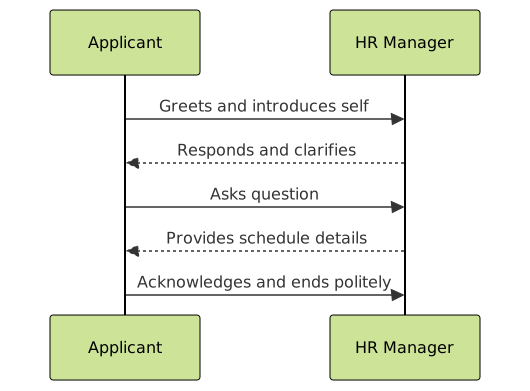
Scenario: A job applicant calls the HR department to ask about interview scheduling.
HR Manager: Good morning, this is the HR department of SkyTech Solutions. How can I help you?

Applicant: Hello, this is Priya Sharma. I recently applied for the Digital Marketing position and wanted to confirm if my interview schedule is finalized.

HR Manager: Yes, Ms. Sharma. Your interview is scheduled for Monday at 10:30 AM.

Applicant: Thank you very much for the confirmation. I’ll be there on time.

HR Manager: You’re welcome. Have a great day!

Applicant: You too. Goodbye!
Example 2: Casual Conversation with a Friend
Scenario: A casual call to plan a weekend outing.
Riya: Hey, Arjun! How are you doing?

Arjun: Hi Riya! I’m great, just finishing work. What’s up?

Riya: Thinking of going to the new café this Saturday. Want to join?

Arjun: Sounds awesome! What time?

Riya: Let’s meet at 5 PM near Metro Station Gate 2.

Arjun: Perfect. See you then!

Riya: See you, bye!

Interactive Practice Idea
To make your learning more effective, you can simulate real phone conversations with a practice partner or even use a voice recorder. Here’s a step-by-step activity:
- Pick a topic (e.g., ordering food, setting a meeting, catching up with a friend).
- Write down your key phrases and expected responses.
- Record your conversation using your phone.
- Listen back and note pronunciation or fluency issues.
- Repeat until you sound natural and confident.

Tips for Natural Phone Conversations
- Speak clearly: Avoid rushing; clarity is more important than speed.
- Smile while talking: It actually helps your voice sound friendlier.
- Listen actively: Let the other person finish before replying.
- Take notes: For business or important calls, jot down key points.
- End politely: Always thank the person before hanging up.
Example 3: Customer Service Call
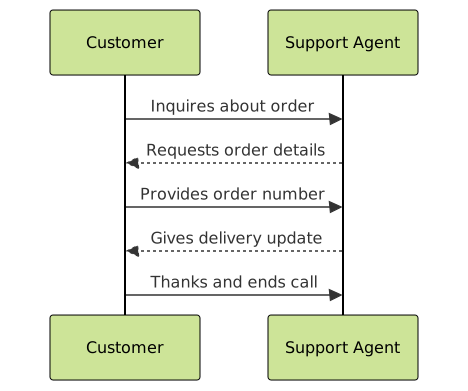
Scenario: Calling to check delivery status of an online order.
Customer: Hello, this is Aakash. I ordered a laptop last week and I’d like to check the delivery status.

Support Agent: Sure, could you please share your order number?

Customer: Yes, it’s #ORD7453.

Support Agent: Thank you. I see your order is out for delivery and should arrive by evening.

Customer: That’s great. Thanks for the update.

Support Agent: You’re welcome. Have a nice day!
Common Mistakes to Avoid
- Not introducing yourself at the start of the call.
- Interrupting the speaker or overlapping speech.
- Using informal slang during professional calls.
- Forgetting to confirm details or follow-up actions.
Conclusion
Practicing phone call conversations in English can transform your communication confidence both professionally and personally. Whether you’re making business calls, catching up with friends, or handling customer queries, structured practice combined with polite language ensures clarity and confidence. Start small, build consistency, and soon speaking naturally over the phone will feel effortless.