In modern computer science, persistent data structures play a crucial role in the design of safe, immutable, and efficient systems. Unlike traditional, mutable data structures, persistent versions ensure that every update operation preserves the previous version of the structure, allowing non-destructive modifications. This makes them a natural fit for concurrent programming, functional languages, undo operations, and distributed systems.
This article provides a detailed breakdown of persistent data structures: what they are, why they matter, their operations, visual models, and working examples in code. Whether you are a beginner in algorithms or a professional looking to refresh your knowledge, this guide provides a complete reference.
What are Persistent Data Structures?
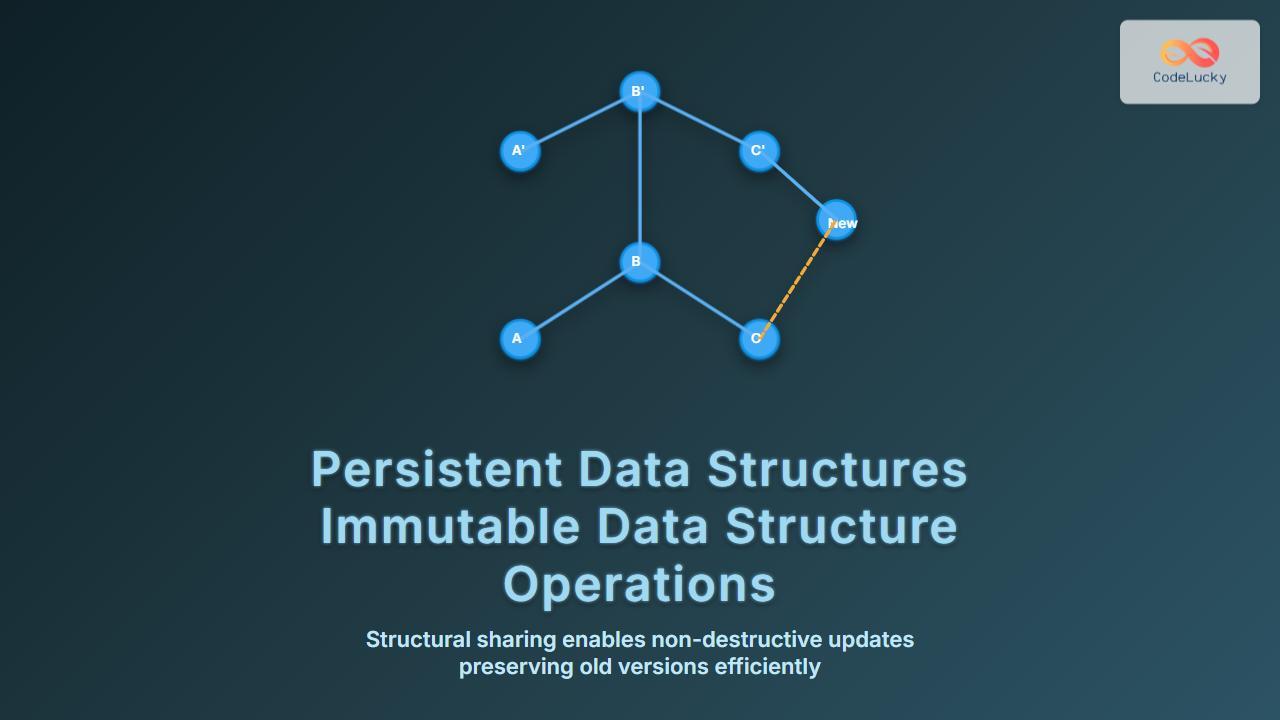
A persistent data structure is one that always preserves the previous version of itself when modified. Instead of overwriting or destructively updating, the data structure creates a new version that shares most of its structure with the old version. This makes them immutable, as no operation can permanently destroy old states.
Persistence can be classified into three types:
- Partial Persistence: All versions can be accessed, but only the newest can be updated.
- Full Persistence: All versions can be both accessed and updated.
- Confluent Persistence: Versions can be combined or merged, enabling branching histories to converge.

Why Use Persistent Data Structures?
There are compelling reasons to adopt persistent data structures in algorithmic and real-world scenarios:
- Immutability: Prevents accidental modification of state, making reasoning and debugging easier.
- Concurrency Safety: Multiple threads can share structures without locks, since existing versions cannot be altered.
- Undo/Redo Functionality: Easily traverse to previous states in applications like editors and games.
- Memory Efficiency: Structural sharing avoids duplication, storing only the new changes rather than the entire new structure.
Examples of Persistent Data Structures
Persistent Linked List
The simplest example of a persistent structure is the immutable linked list. When a new element is added (prepend), it creates a new head node referencing the original list. Old versions remain fully valid.

Here, inserting X creates a new head node. The structure of nodes A → B → C remains unmodified.
# Example: Persistent Linked List in Python (Immutable)

class Node:
    def __init__(self, value, next_node=None):
        self.value = value
        self.next = next_node

def prepend(head, value):
    return Node(value, head)

# Original list: 1 -> 2 -> 3
list1 = Node(1, Node(2, Node(3)))
# Create new version by prepending 0
list2 = prepend(list1, 0)

# Outputs preservation
print("List1:", list1.value, list1.next.value, list1.next.next.value)  # 1 -> 2 -> 3
print("List2:", list2.value, list2.next.value, list2.next.next.value)  # 0 -> 1 -> 2 -> 3
Persistent Binary Tree
Trees are another widely used persistent structure, often employed in functional languages for sets, maps, and priority queues. In a persistent binary tree, an insertion or deletion creates a new path from root to leaf, with unchanged subtrees shared across versions.

Operations on Persistent Data Structures
Common operations across persistent data structures include:
- Insert: Adds a new element by creating a modified path or head.
- Delete: Returns a new version without the element, preserving the old version.
- Update: Similar to insert, but replaces values while maintaining old nodes in memory.
- Access: Since old structures are immutable, access works regardless of version.
Performance Considerations
Since persistent structures share unchanged parts, memory usage grows sublinearly relative to the number of versions. However, operations often take logarithmic or amortized O(1) time depending on data structures used (linked lists, trees, tries).
Examples:
- Persistent linked list prepend: O(1)
- Persistent tree insert: O(log n)
- Persistent array (copy-on-write): O(n) in simple cases, O(log n) with advanced techniques like RRB-Trees.
Real-World Applications
Persistent data structures are used in several domains:
- Version Control Systems: Git internally uses persistent trees.
- Functional Programming Languages: Clojure, Haskell, and Scala rely heavily on immutability.
- Databases: Multi-version concurrency control (MVCC) uses persistence concepts.
- Editors and CAD Tools: Undo and branching operation histories.
Interactive Example: Persistent Stack
Below is a simple interactive demonstration of a persistent stack using Python. Updating the stack does not destroy previous versions, letting us go back in history easily.
class PersistentStack:
    def __init__(self, items=None):
        self.items = items if items else []

    def push(self, value):
        return PersistentStack([value] + self.items)

    def pop(self):
        if not self.items:
            return self, None
        return PersistentStack(self.items[1:]), self.items[0]

    def __repr__(self):
        return f"Stack({self.items})"

# Demonstration
s1 = PersistentStack()
s2 = s1.push(10)
s3 = s2.push(20)
s4, popped = s3.pop()

print("s1:", s1)
print("s2:", s2)
print("s3:", s3)
print("s4:", s4, "popped:", popped)
Conclusion
Persistent data structures provide strong guarantees of immutability, structural sharing, and safe concurrency. Through efficient implementations in lists, trees, and stacks, they enable versioning and stability in both theoretical and practical systems. From Git to functional languages and modern applications, persistence shapes the foundation of reliable computing.
Understanding how to apply persistent data structures allows developers to design safer, more maintainable codebases while taking advantage of structural sharing to avoid unnecessary memory overhead.