The Percolation Problem is a classic example of connectivity in grids, often used to model phenomena such as fluid flowing through porous materials, electrical connectivity, or network reliability. It involves determining whether a system percolates — meaning there exists a connected path through the system.
One of the most efficient ways to solve this problem computationally is the Union-Find (Disjoint Set Union) data structure, which allows fast connectivity queries and union operations. This article dives deep into the real-world application of the Union-Find algorithm to the Percolation Problem, providing detailed explanations, examples, and visual diagrams to clarify the principles.
What is the Percolation Problem?
Imagine a grid representing a porous material where each cell can be either open (allowing fluid to pass) or blocked. The goal is to determine if fluid poured on the top row can find a continuous path through open cells to the bottom row.
Percolation can be modeled as an n x n grid where each cell is either open or blocked. The problem asks if there is at least one vertical path from the top to the bottom via adjacent open cells (up, down, left, right).

Why Use Union-Find for Percolation?
Checking connectivity in a grid naively could involve recursive depth-first searches or breadth-first searches after each cell update, which is inefficient. The Union-Find data structure optimizes this by maintaining connected components dynamically.
Union-Find supports two main operations efficiently:
- Find: Determine which component/set an element belongs to.
- Union: Merge two sets/components.
When opening a cell, Union-Find helps quickly unite it with adjacent open cells, so connectivity is maintained in almost constant time, making percolation detection scalable even for large grids.
Union-Find Data Structure Explained
The Union-Find or Disjoint Set data structure can be implemented using two arrays: parent[] and rank[]. Each element points to a parent, and sets are represented by their root nodes.

- Find operation: Follows parent pointers until it reaches the root.
- Union operation: Connects two roots, favoring the root with higher rank to keep tree shallow.
- Path Compression: During find, update nodes directly to point to root for amortized efficiency.
Implementing Percolation Using Union-Find
The grid is modeled as a linear array for Union-Find operations. We create two virtual nodes: one connected to all open cells in the top row and another to all open cells in the bottom row. The system percolates if these virtual nodes are connected.
- Initialize Union-Find with
n*n + 2nodes (including two virtual nodes). - When a cell opens, union it with adjacent open neighbors.
- Check if virtual top node and virtual bottom node are connected using find.
Example Code Snippet (Python-like pseudocode)
class UnionFind:
    def __init__(self, size):
        self.parent = list(range(size))
        self.rank = [0] * size

    def find(self, x):
        if self.parent[x] != x:
            self.parent[x] = self.find(self.parent[x])  # Path compression
        return self.parent[x]

    def union(self, x, y):
        rootX = self.find(x)
        rootY = self.find(y)
        if rootX != rootY:
            if self.rank[rootX] > self.rank[rootY]:
                self.parent[rootY] = rootX
            elif self.rank[rootX] < self.rank[rootY]:
                self.parent[rootX] = rootY
            else:
                self.parent[rootY] = rootX
                self.rank[rootX] += 1

class Percolation:
    def __init__(self, n):
        self.n = n
        self.uf = UnionFind(n*n + 2)  # +2 virtual nodes
        self.top_virtual = n*n
        self.bottom_virtual = n*n + 1
        self.open_sites = [False] * (n*n)

    def index(self, row, col):
        return row * self.n + col

    def open(self, row, col):
        idx = self.index(row, col)
        self.open_sites[idx] = True
        # Connect to adjacent open sites
        for r, c in [(row-1, col), (row+1, col), (row, col-1), (row, col+1)]:
            if 0 <= r < self.n and 0 <= c < self.n and self.open_sites[self.index(r,c)]:
                self.uf.union(idx, self.index(r,c))
        # Connect to virtual top/bottom
        if row == 0:
            self.uf.union(idx, self.top_virtual)
        if row == self.n - 1:
            self.uf.union(idx, self.bottom_virtual)

    def percolates(self):
        return self.uf.find(self.top_virtual) == self.uf.find(self.bottom_virtual)
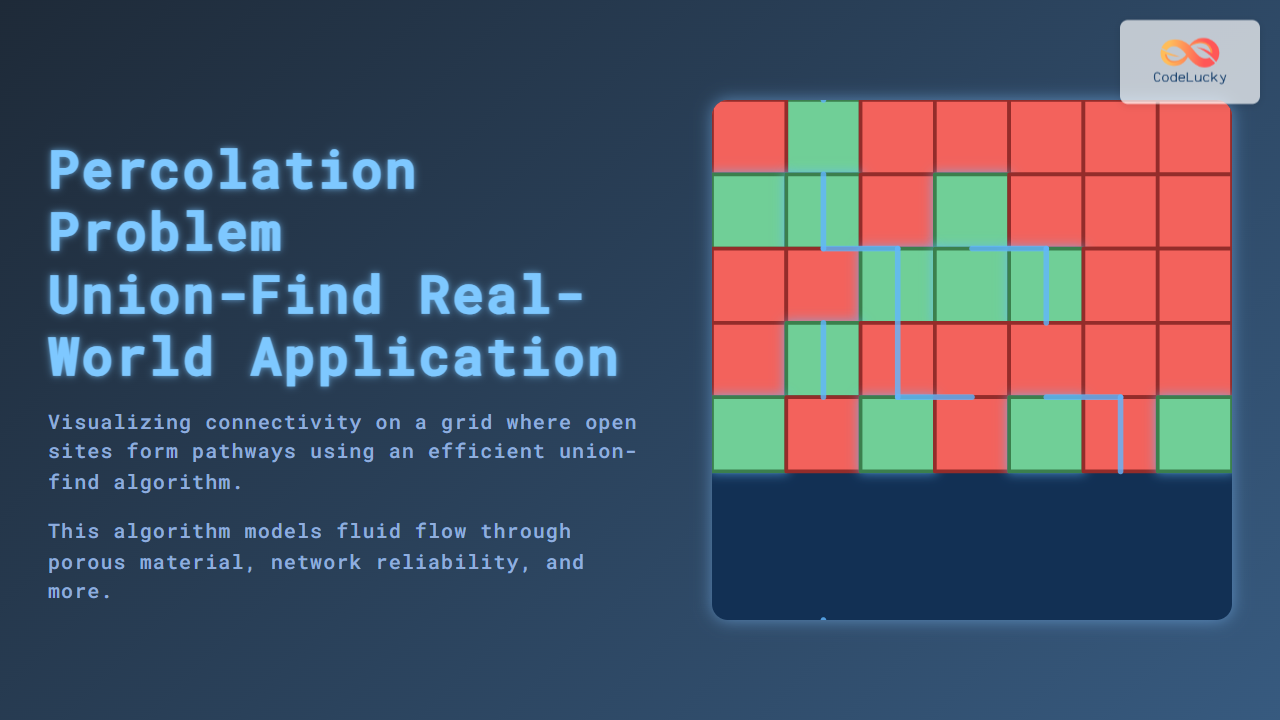
Visualizing Connectivity and Percolation Status
Consider a 5×5 grid example with some cells open (O) and others blocked (X):
X O X X X
O O X O X
X X O O O
X O X X X
O X O X O
After opening cells, the program links connected open sites and checks if top virtual node is connected to bottom virtual node.

The system percolates if there is a vertical connection from any open cell in the top row to any open cell in the bottom row.
Real-World Applications
- Material Science: Modeling fluid flow in porous rocks or filters.
- Network Reliability: Checking connection consistency in communication networks.
- Electricity Grids: Determining whether electrical connectivity is maintained.
- Epidemiology: Simulating spread across connected populations.
Interactive Concept
An interactive demo can let users open/close cells on a grid to visualize how connectivity changes and when percolation occurs. This real-time interaction greatly aids understanding.
Summary
The Percolation Problem is a fundamental example of connectivity in computer science and physical simulations. Using the Union-Find data structure optimizes the solution, enabling rapid connectivity checks and efficient dynamic updating as sites open.
This powerful combination has wide-ranging real-world applications and is a valuable algorithmic tool in various fields.