Past Perfect Tense is one of the most important yet tricky tenses in English grammar. It is used to show that one action happened before another action in the past. If you want to structure your story, describe past experiences, or clarify a sequence of events, mastering the past perfect tense is essential.
What Is the Past Perfect Tense?
The Past Perfect Tense describes an action that had already happened before another past action occurred. It uses the auxiliary verb had followed by the past participle form of the main verb.
Formula:
Subject + had + past participle + (object / complement)Example:
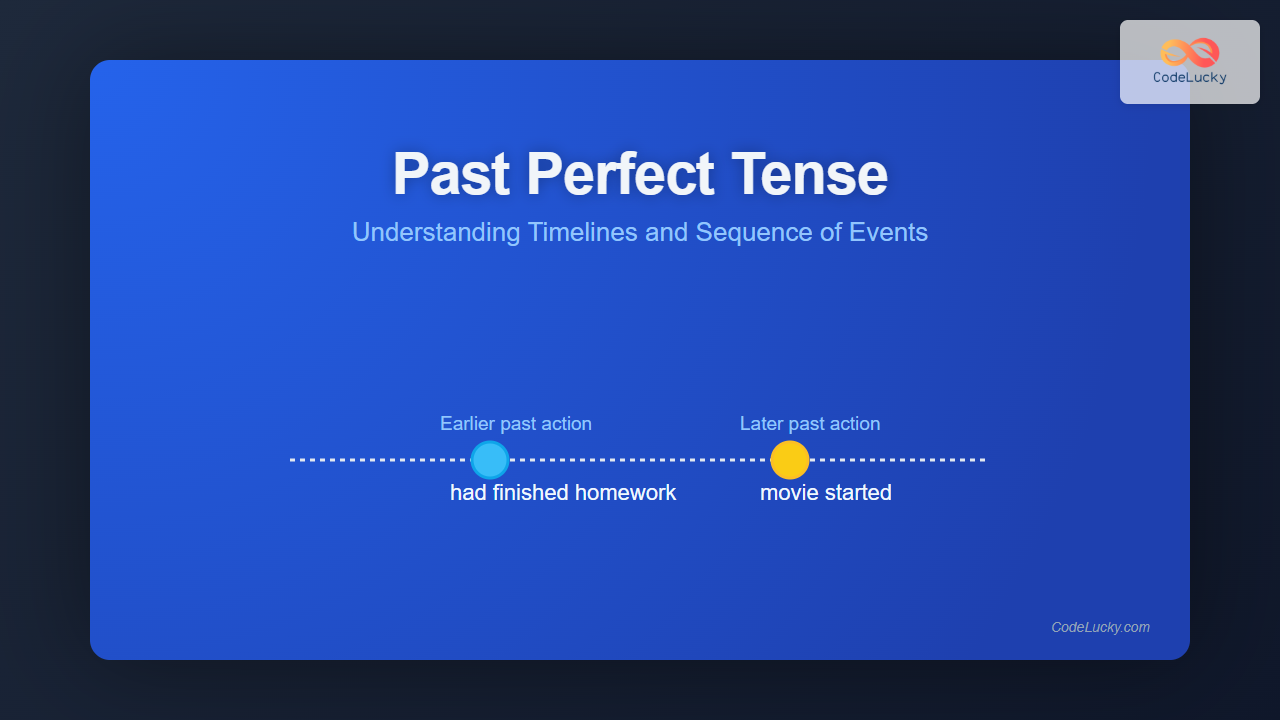
She had finished her homework before the movie started.
Here, “had finished” happened first, and “started” happened later. The Past Perfect helps establish this timeline clearly.
Understanding Past Perfect with Timelines
To visualize how Past Perfect works, imagine a timeline that separates two past actions. The action closer to the present is described in Simple Past, while the earlier action uses the Past Perfect.

This sequence shows that the “had finished” event occurred first, though both happened in the past.
When to Use Past Perfect Tense
Past Perfect is not for every past action — it’s used to emphasize the order of events. Here are the main scenarios:
- To show one action earlier than another past action:
He had left before we arrived. - To indicate cause or reason in the past:
The match was canceled because it had rained heavily. - With reported speech:
She said she had visited London before. - With time expressions:
Use words like after, before, when, by the time, already, just, never to relate two past actions.
Formation of Negative and Question Forms
Like other tenses, Past Perfect can be used in affirmative, negative, and interrogative forms:
| Type | Structure | Example |
|---|---|---|
| Affirmative | Subject + had + past participle | They had eaten dinner before going out. |
| Negative | Subject + had not (hadn’t) + past participle | They hadn’t eaten before going out. |
| Interrogative | Had + subject + past participle? | Had they eaten before going out? |
Interactive Exercise (Test Yourself)
Try filling in the blanks below:
- She ______ (finish) her meal before her guests arrived.
- By the time the train reached, we ______ (leave) the station.
- They ______ (not/see) such a beautiful sunset before.
- Had you ever ______ (hear) about it before yesterday?
Check your answers:
Click to reveal answers
- had finished
- had left
- had not seen
- heard
Past Perfect in Comparison with Other Tenses
Understanding how the Past Perfect fits among other tenses makes it easier to apply correctly.

The Past Perfect comes before the Simple Past — both belong to the past timeline, but the Past Perfect signals the earlier moment.
Examples That Clarify Usage
- By the time she got to the station, the train had departed.
- I had never seen snow until I visited Manali.
- They had lived in Delhi before moving to Mumbai.
- He had completed the report before the manager asked for it.
Notice how each Past Perfect verb signals completion before another event.
Timeline of Multiple Past Events
When several past events happen in sequence, only the earliest action takes the Past Perfect form for clarity.

“Had packed” is the earliest event; others follow naturally in Simple Past.
Common Mistakes to Avoid
- ✅ Use Past Perfect only to show an earlier past action, not for single past events.
- ✅ Don’t omit the auxiliary “had.” Example: He had gone, not He gone.
- ✅ Avoid overusing it — use only when the sequence needs clarity.
Quick Practice Timeline
Identify which event should be in Past Perfect:

Answer: The earlier action “John left home” should be in Past Perfect → “John had left home before his friend called him.”
Summary
The Past Perfect Tense is a precision tool for storytelling and explanation. It helps you pinpoint which event came first in the past. Use it with time words like “before,” “after,” and “by the time” to make your sentences richly descriptive yet grammatically sharp.
Keep practicing with everyday examples, and soon you’ll naturally use the Past Perfect to bring order and depth to your writing!