The Past Continuous Tense is one of the most useful tenses for storytelling, helping you describe ongoing actions in the past or background scenes that make your narrative vivid and alive. Whether you are narrating a personal experience or writing a novel, this tense sets the stage by showing what was happening at a particular moment in the past.
What Is the Past Continuous Tense?
The Past Continuous Tense expresses actions that were ongoing at a specific time in the past. It is formed using the auxiliary verbs was or were plus the verb + ing form.
Structure: Subject + was/were + verb-ing + (object)
Examples:
- I was reading a novel when my phone rang.
- They were walking to school while it was raining.
- She was studying all evening yesterday.
How It Enhances Storytelling
In storytelling, the Past Continuous Tense adds flow and continuity. It helps you set the background for other actions (usually in the Simple Past), show interrupted actions, or describe multiple events happening simultaneously.
1. Background Description
Writers often use this tense to describe the situation or atmosphere before a main event.
Example: The sun was setting, birds were singing, and children were playing in the park.
2. Interrupted Actions
Use it to show that one action was happening when another action interrupted it.
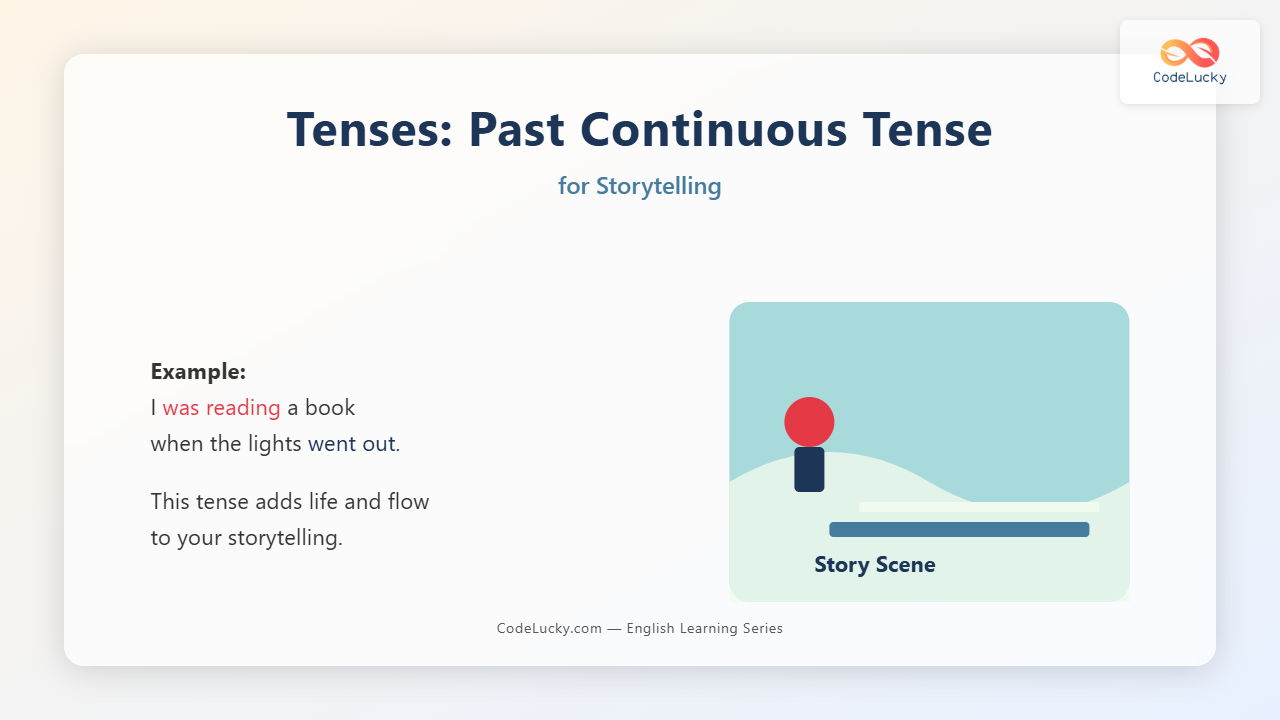
Example: I was watching TV when the lights went out.
3. Parallel Actions
Two or more actions can be shown as happening at the same time in the past.
Example: While I was cooking, my brother was cleaning his room.

Forming the Past Continuous Tense
Use the following formula to form the tense correctly:
Affirmative: Subject + was/were + verb-ing
Negative: Subject + was/were + not + verb-ing
Question: Was/Were + subject + verb-ing?
Examples:
- He was running fast. → (affirmative)
- He was not running fast. → (negative)
- Was he running fast? → (question)

Time Expressions Used with Past Continuous
Past Continuous Tense often works with certain time expressions or subordinate clauses to denote when the action occurred.
- While
- When
- As
- At that moment
- All day / All evening
- During that time
Examples:
- While I was walking, it started to rain.
- As they were talking, the teacher entered the room.
- At that moment, we were still trying to find the key.

Past Continuous vs Past Simple
The Past Continuous describes the ongoing background action, while the Past Simple indicates the main or completed action.
Example: I was cooking (ongoing) when the doorbell rang (completed).
Interactive Practice (Try It Yourself)
Fill in the blanks using the correct form of the verb in Past Continuous:
- They ________ (play) football when it started to rain.
- What ________ you ________ (do) at 9 PM last night?
- I ________ (not sleep) when you called me.
- She ________ (watch) TV while her mother ________ (cook).
Answers:
- were playing
- were you doing
- was not sleeping
- was watching, was cooking

Common Mistakes to Avoid
- Using “was/were” without adding “-ing” to the main verb. ❌
- Mixing Past Continuous with Present or Future Tense in the same clause. ❌
- Forgetting that “was” is for singular and “were” is for plural subjects. 🔁
Correct Example: They were talking quietly when the teacher came in.
Quick Summary Table
| Function | Formula | Example |
|---|---|---|
| Affirmative | Subject + was/were + verb-ing | He was reading. |
| Negative | Subject + was/were + not + verb-ing | They were not playing. |
| Question | Was/Were + subject + verb-ing? | Were you sleeping? |
Final Thoughts
Using the Past Continuous Tense effectively can transform your storytelling. It gives life to your past scenes, shows overlapping events, and adds cinematic detail to your writing. As you practice more, you’ll notice your English stories becoming more immersive and engaging.
Practice regularly, visualize the action as ongoing, and combine it with other past tenses for natural storytelling flow.