Passive Voice is one of the most common structures in English grammar, especially useful when the doer of an action is unknown or unimportant. If you are learning English, understanding how and when to use the Passive Voice will make your writing and speaking more natural. This article walks you through the concept step by step — with easy examples, structures, and visual diagrams.
What Is Passive Voice?
In a sentence, when the subject receives the action instead of performing it, the sentence is in the Passive Voice.
Example:
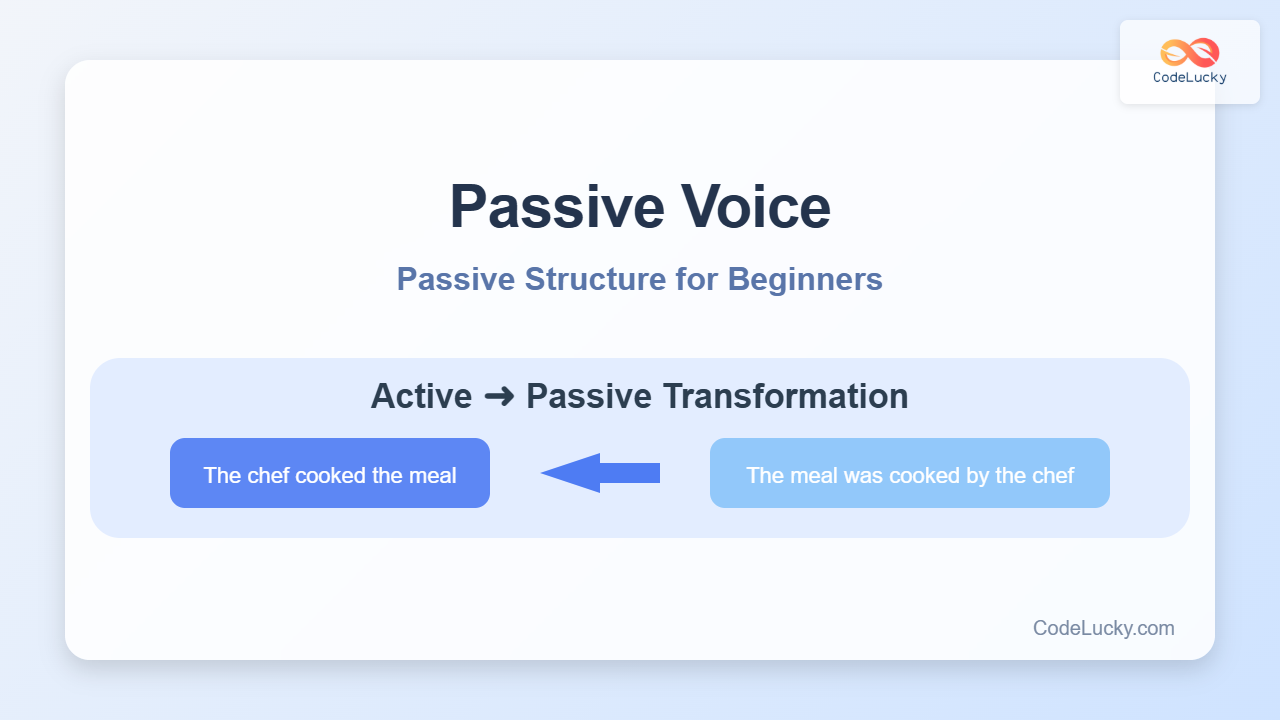
- Active Voice: The chef cooked the meal.
- Passive Voice: The meal was cooked by the chef.
In the active sentence, “the chef” performs the action. In the passive one, “the meal” becomes the focus and receives the action.
Why Use Passive Voice?
The Passive Voice helps when:
- The doer (agent) is unknown — “The window was broken.”
- The doer is unimportant — “The road was repaired last week.”
- You want to sound more formal or objective — “The survey was conducted in 2024.”
Passive Voice Structure
The formula of a passive sentence is simple:
Subject + To Be (am/is/are/was/were/been/being) + Past Participle (V3) + (by + Agent)
Here’s a visual explaining how an Active Voice sentence converts to Passive Voice:

Examples of Active to Passive Transformation
| Active Voice | Passive Voice |
|---|---|
| The teacher explains the lesson. | The lesson is explained by the teacher. |
| They built the bridge in 2010. | The bridge was built in 2010. |
| Someone has stolen my wallet. | My wallet has been stolen. |
| People speak English worldwide. | English is spoken worldwide. |
Passive Voice in Different Tenses
Passive Voice adapts to almost all tenses. Here’s a helpful chart to remember the correct forms:
| Tense | Passive Structure | Example |
|---|---|---|
| Present Simple | am/is/are + past participle | The car is cleaned daily. |
| Past Simple | was/were + past participle | The report was prepared yesterday. |
| Present Perfect | has/have been + past participle | The show has been canceled. |
| Future Simple | will be + past participle | The project will be completed soon. |
| Continuous Tenses | is/was being + past participle | The room was being cleaned. |
How to Identify Passive Voice Quickly
Here’s a quick rule: if “to be” + past participle (third form of verb) appears in your sentence, it’s likely passive.

Making Practice Interactive
Try reordering the following active sentences into passive ones:
- Someone cleaned the office yesterday.
- The committee will announce the results tomorrow.
- They are building a new stadium.
Think about the object first — that becomes your passive subject.
Possible Answers:
- The office was cleaned yesterday.
- The results will be announced tomorrow.
- A new stadium is being built.
Common Mistakes to Avoid
- Using wrong verb form: “was wrote” ❌ → “was written” ✅
- Forgetting “to be” verb in passive: “The letter sent” ❌ → “The letter was sent” ✅
- Making unnecessary passive sentences where active is clearer.
Active vs Passive: When to Choose Which
Use Active Voice when you want clarity, directness, and energy in your writing. Use Passive Voice when the focus is on the result or action rather than the doer.

Visual Summary

Final Tips for Learners
- Always identify the object before converting to passive.
- Memorize verb forms (especially the third form).
- Practice transforming daily sentences around you into passive ones.
- Use passive voice naturally in writing — don’t overuse it.
Example for practice: Think of your daily routine — “I wash the dishes.” → “The dishes are washed (by me).” This is how you can train your brain to recognize passive patterns.
Mastering Passive Voice takes practice, but once you understand the core idea — focusing on the receiver of the action — it becomes much easier to use naturally and confidently.
Continue your English learning journey with CodeLucky.com — where grammar becomes simple and logical.