Sorting is one of the most fundamental operations in computer science, with wide-reaching implications in data structures, information retrieval, and system performance. With the rise of multicore processors and distributed systems, sequential sorting algorithms like Merge Sort and Quick Sort have been evolved into parallel sorting algorithms to fully utilize computational resources.
This article explores Parallel Merge Sort and Parallel Quick Sort, breaking them down with step-by-step examples, diagrams, and visual explanations to understand how parallelization improves sorting efficiency.
Understanding the Need for Parallel Sorting
Traditional sorting algorithms like Bubble Sort, Insertion Sort, Merge Sort, and Quick Sort operate in a sequential fashion. While efficient algorithms like Quick Sort and Merge Sort achieve O(n log n) complexity, they do not leverage the modern multicore hardware effectively. Parallel sorting algorithms aim to divide the workload across multiple processors, reducing execution time significantly, especially for large datasets.
Advantages of Parallel Sorting
- Faster execution by utilizing multiple CPU cores.
- Better performance on massive datasets.
- Scalability across distributed memory systems.
- Crucial in big data, database systems, and scientific computing.
Parallel Merge Sort Algorithm
Merge Sort is a divide-and-conquer algorithm that recursively splits an array into two halves, sorts them, and merges back the results. In parallelization, these recursive divisions are processed concurrently across available computing units.
Steps in Parallel Merge Sort
- Divide the array into two halves recursively until individual elements remain.
- Allocate separate processors (threads or cores) to sort each half concurrently.
- Merge the sorted halves back together in a parallel fashion.

Visualization Example
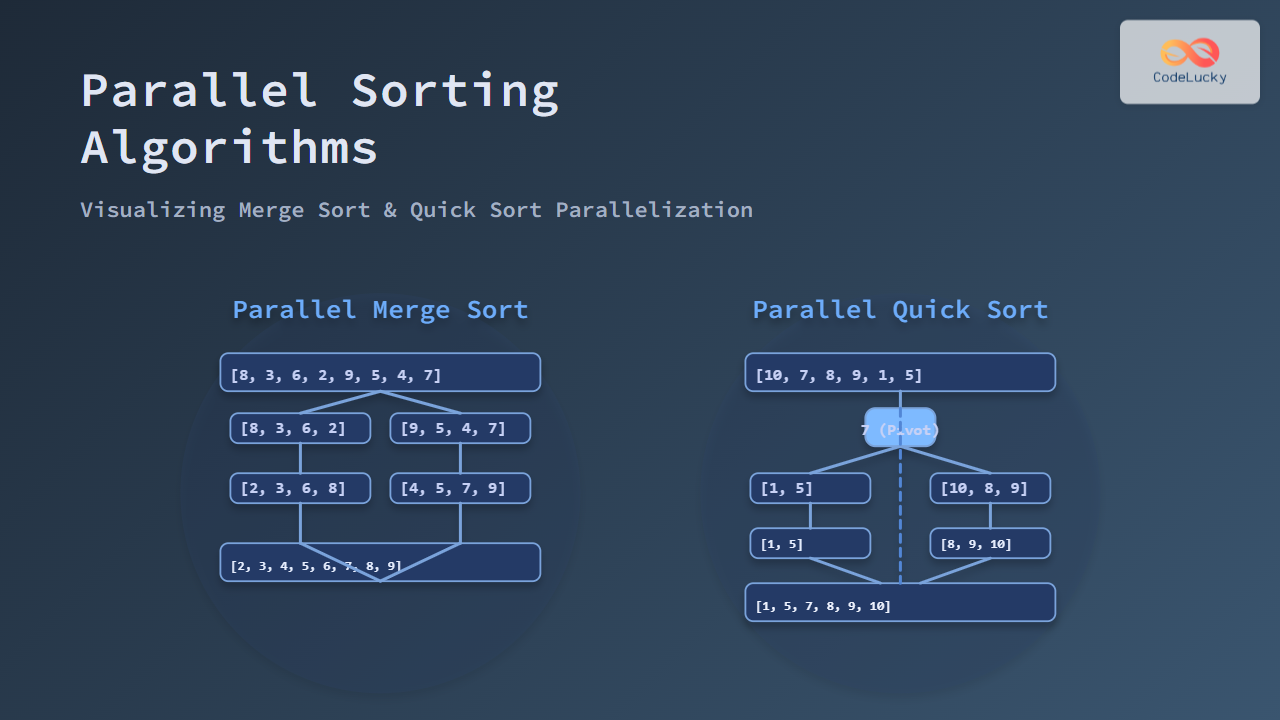
Initial Array: [8, 3, 6, 2, 9, 5, 4, 7]

Step 1 (Divide in parallel):
  Left --> [8, 3, 6, 2]
  Right --> [9, 5, 4, 7]

Step 2 (Sort halves in parallel):
  Left Sorted --> [2, 3, 6, 8]
  Right Sorted --> [4, 5, 7, 9]

Step 3 (Merge):
  Final Sorted --> [2, 3, 4, 5, 6, 7, 8, 9]
Parallel Quick Sort Algorithm
Quick Sort relies on selecting a pivot and partitioning the array into two parts — elements smaller than the pivot and elements larger than the pivot. The recursive sorting of partitions can naturally be executed in parallel.
Steps in Parallel Quick Sort
- Select a pivot element.
- Partition the array into left (smaller) and right (greater) subarrays.
- Process left and right partitions concurrently in separate threads.

Visualization Example
Initial Array: [10, 7, 8, 9, 1, 5]

Step 1: Pivot = 7
   Left --> [1, 5]
   Right --> [10, 8, 9]

Step 2: Sort partitions in parallel
   Left Sorted --> [1, 5]
   Right Sorted --> [8, 9, 10]

Step 3: Concatenate
   Final Sorted --> [1, 5, 7, 8, 9, 10]
Comparison Between Parallel Merge Sort and Parallel Quick Sort
| Aspect | Parallel Merge Sort | Parallel Quick Sort |
|---|---|---|
| Approach | Divide and merge concurrently | Pivot-based partitioning |
| Load Balancing | Well balanced (equal halves) | Depends on pivot quality |
| Time Complexity | O(n log n) in all cases |
O(n log n) average, O(n²) worst case |
| Suitability | Great for evenly distributable workloads | Efficient for random datasets with good pivots |
Interactive Demonstration of Parallel Sorting
Consider a web-based interactive visualization where each recursion step is drawn as separate parallel tasks. For illustration:
Input: [12, 4, 8, 15, 6, 3]

Parallel Merge Sort Execution:
 Processor 1 --> [12, 4, 8]
 Processor 2 --> [15, 6, 3]

 Processor 1 sorts: [4, 8, 12]
 Processor 2 sorts: [3, 6, 15]

 Processor 3 merges results: [3, 4, 6, 8, 12, 15]
Real-World Applications of Parallel Sorting
- Big Data Analytics: Sorting terabytes of log files or transactional data quickly.
- Database Systems: Query optimization, indexing, and join operations.
- Scientific Computing: Sorting simulation results, genomic data, physics computations.
- Parallel File Systems: Organizing distributed storage efficiently.
Conclusion
Parallel Merge Sort and Quick Sort illustrate how classic sorting algorithms evolve in high-performance computing. By intelligently dividing sorting tasks across multiple processors, execution speed can be drastically improved. However, the choice of algorithm depends on the nature of data and the underlying parallel architecture.
For evenly balanced workloads, Parallel Merge Sort ensures consistent performance, while Parallel Quick Sort can outperform with good pivot selection strategies. Both remain vital tools in modern data-intensive applications.