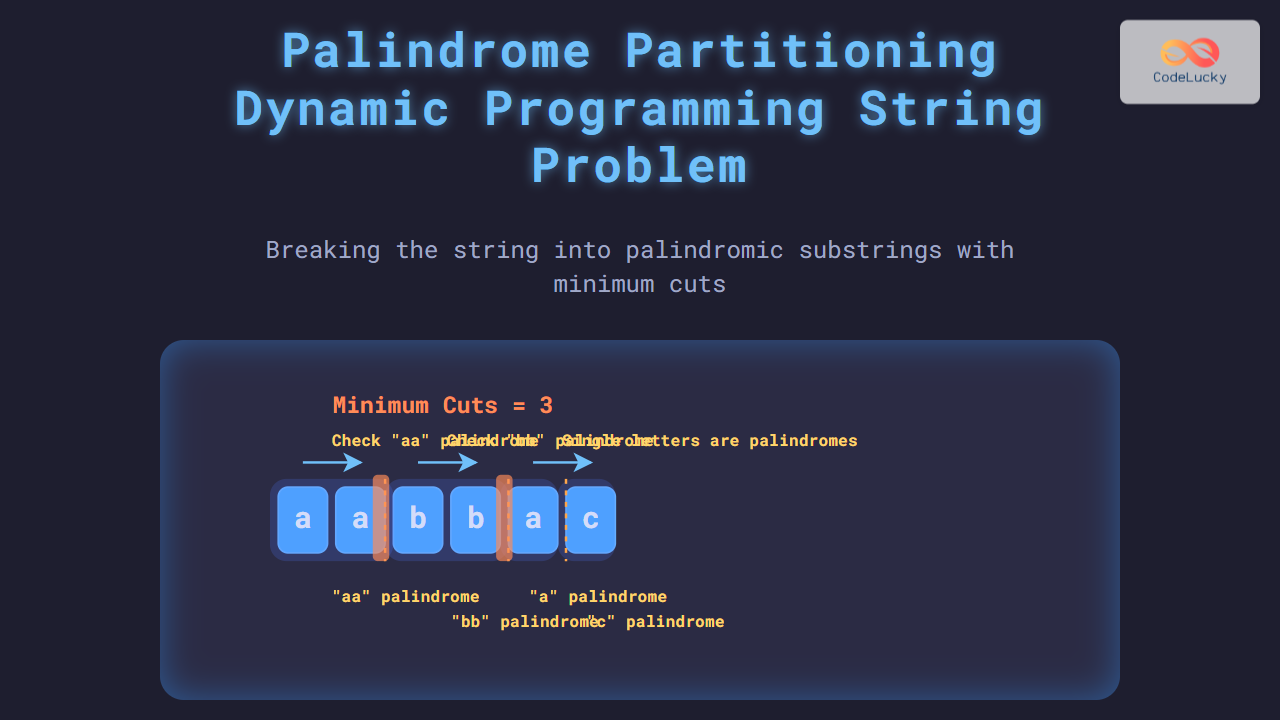
Palindrome Partitioning is a classic dynamic programming string problem that combines the principles of palindrome checking with optimized partitioning. The main idea is to divide a given string into the minimum number of partitions, such that every partitioned substring is a palindrome.
This problem has direct applications in natural language processing, text segmentation, DNA sequencing, and even in certain compiler design optimizations. In this article, we will dive deep into the Palindrome Partitioning problem, understand its variations, and solve it step by step with dynamic programming, complete with visual explanations and Python code implementations.
What is Palindrome Partitioning?
A palindrome is a string that reads the same forwards and backwards. Examples include madam, racecar, and level.
Palindrome Partitioning means breaking the given string into substrings such that each substring is a palindrome.
Example:
Input: "aab"
Output: ["aa", "b"]
Explanation: "aa" is a palindrome and "b" is a palindrome.
Here, the string “aab” can be partitioned into ["aa","b"], resulting in 1 cut. Another valid partition could be ["a","a","b"], which takes 2 cuts. The minimum is always preferred in optimization problems.
Problem Variants
- Palindrome Partitioning (Enumeration): Generate all possible palindrome partitions of a string.
- Palindrome Partitioning (Min Cuts): Find the minimum number of cuts needed to partition the string into palindromic substrings.
Naive Approach
The brute force way involves trying out all possible partitions and checking if each partition is palindrome. This approach, however, has O(2^n * n) time complexity (since every possible cut is considered), which is very inefficient for larger strings.
Dynamic Programming Approach
The optimal solution uses Dynamic Programming (DP). We use two main DP techniques here:
- Palindrome Checking DP: Precompute whether substring
s[i...j]is a palindrome. - Partitioning DP: Compute minimum cuts using previously computed palindromic checks.
Step 1: Palindrome Table
We create a table isPalindrome[i][j] which stores True if substring from index i to j is a palindrome.
Step 2: DP for Minimum Cuts
We define dp[i] as the minimum cuts needed for substring s[0..i]. The recurrence is:
dp[i] = 0, if s[0..i] is palindrome
dp[i] = min(dp[j] + 1) for all j < i if s[j+1..i] is palindrome
Python Implementation
Check Minimum Cuts
def min_palindrome_cuts(s: str) -> int:
    n = len(s)
    # Step 1: Build palindrome table
    is_palindrome = [[False] * n for _ in range(n)]
    for i in range(n):
        is_palindrome[i][i] = True

    for length in range(2, n + 1):
        for i in range(n - length + 1):
            j = i + length - 1
            if s[i] == s[j]:
                if length == 2:
                    is_palindrome[i][j] = True
                else:
                    is_palindrome[i][j] = is_palindrome[i+1][j-1]

    # Step 2: DP for minimum cuts
    dp = [0] * n
    for i in range(n):
        if is_palindrome[0][i]:
            dp[i] = 0
        else:
            dp[i] = min(dp[j] + 1 for j in range(i) if is_palindrome[j+1][i])
    return dp[-1]

print(min_palindrome_cuts("aab"))  # Output: 1
Generate All Partitions
def all_palindrome_partitions(s: str):
    result = []
    def backtrack(start, path):
        if start == len(s):
            result.append(path[:])
            return
        for end in range(start, len(s)):
            substring = s[start:end+1]
            if substring == substring[::-1]:  # palindrome check
                path.append(substring)
                backtrack(end+1, path)
                path.pop()
    backtrack(0, [])
    return result

print(all_palindrome_partitions("aab"))
# Output: [["a","a","b"], ["aa","b"]]
Example Walkthrough
Consider input string "banana":
- Possible partitions:
- [“b”,”a”,”n”,”a”,”n”,”a”]
- [“b”,”anana”]
- [“ban”,”ana”]
- Minimum cuts: 1 (partition into
["b","anana"])
Time and Space Complexity
- Building Palindrome Table: O(n²)
- DP Minimum Cut Calculation: O(n²)
- Total Complexity: O(n²)
- Space Complexity: O(n²) for the palindrome table and O(n) for DP cuts.
Applications of Palindrome Partitioning
- Data Compression: Breaking data into symmetric chunks for storage optimization.
- NLP: Sentence segmentation based on palindromic patterns.
- Bioinformatics: Palindromic DNA sequence detection for genetic research.
- Compiler Optimization: Detecting symmetrical syntax patterns.
Conclusion
Palindrome Partitioning is not just a string manipulation problem, but also a solid example on how dynamic programming can be applied effectively. By precomputing palindrome substrings and using them in DP, we reduced an exponential brute force to a polynomial solution. This problem is an excellent demonstration of overlapping subproblems and optimal substructure, the two key principles of dynamic programming.
With clear understanding and implementation, you can extend this approach to solve more complex string problems in interviews or real-world applications.