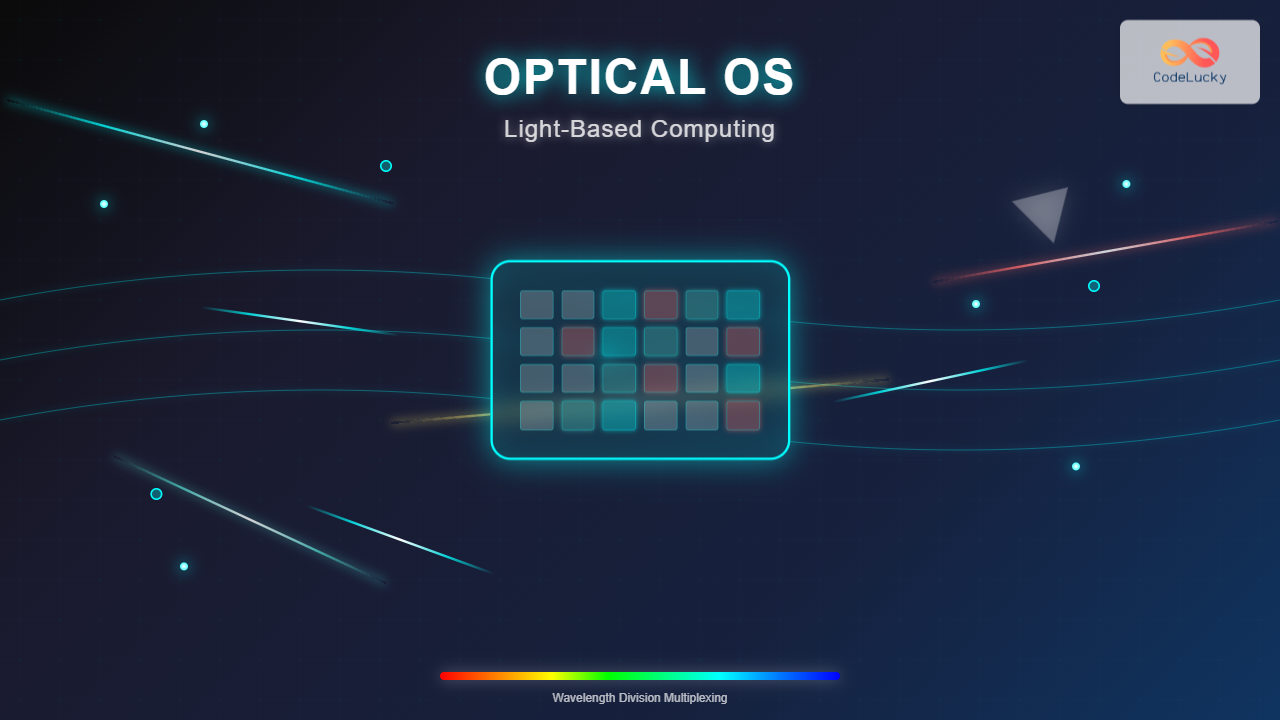
Optical operating systems represent a revolutionary paradigm shift in computing, utilizing light photons instead of electrical signals for processing and data transmission. This emerging technology promises unprecedented computational speeds, reduced power consumption, and enhanced parallel processing capabilities that could fundamentally transform how we interact with computers.
Understanding Optical Computing Fundamentals
Traditional computing relies on electronic circuits that manipulate electrical signals to process information. In contrast, optical computing harnesses the properties of light—such as wavelength, amplitude, phase, and polarization—to perform computational operations. This fundamental difference enables optical systems to process multiple data streams simultaneously through different wavelengths of light.

Key Components of Optical Systems
- Photonic Processors: Replace traditional silicon chips with optical circuits that manipulate light beams
- Optical Interconnects: Use fiber optics and waveguides for ultra-fast data transmission
- Light Sources: Lasers and LEDs generate coherent light signals for computation
- Optical Memory: Holographic storage systems that store data as light patterns
- Photodetectors: Convert optical signals back to electrical signals when needed
Architecture of Optical Operating Systems
Optical operating systems require a completely different architectural approach compared to conventional electronic systems. The OS must manage light-based resources, coordinate photonic processors, and handle the unique challenges of optical computing.

Optical Kernel Functions
The optical kernel serves as the core component that manages all light-based operations:
- Wavelength Management: Allocates different wavelengths to various processes and applications
- Coherence Control: Maintains phase relationships between different light sources
- Optical Path Routing: Directs light beams through appropriate processing units
- Interference Mitigation: Prevents unwanted light interactions that could corrupt data
Process Management in Optical Systems
Process scheduling in optical operating systems leverages the inherent parallelism of light to execute multiple processes simultaneously. Unlike electronic systems that rely on time-division multiplexing, optical systems use wavelength-division multiplexing (WDM) for true parallel processing.
Wavelength-Based Process Allocation
class OpticalProcessScheduler:
    def __init__(self):
        self.wavelength_pool = {
            '1550nm': None,  # Telecom band
            '1310nm': None,  # Low dispersion
            '850nm': None,   # Short range
            '780nm': None    # Visible red
        }

    def allocate_process(self, process_id, wavelength):
        if self.wavelength_pool[wavelength] is None:
            self.wavelength_pool[wavelength] = process_id
            return f"Process {process_id} allocated to {wavelength}"
        else:
            return self.find_alternative_wavelength(process_id)

    def parallel_execution(self):
        active_processes = []
        for wavelength, process in self.wavelength_pool.items():
            if process is not None:
                active_processes.append(f"{process}@{wavelength}")
        return active_processes

Memory Management with Light
Optical memory systems utilize holographic storage and photonic RAM to achieve ultra-fast data access. These systems can store vast amounts of information in three-dimensional space using the interference patterns of laser beams.
Holographic Storage Principles
- Volume Storage: Data stored throughout the entire volume of the storage medium, not just on surfaces
- Associative Recall: Entire data pages can be retrieved using partial information
- Wavelength Multiplexing: Multiple holograms stored in the same location using different wavelengths
- Angular Multiplexing: Different incident angles create separate storage layers
class OpticalMemoryManager:
    def __init__(self):
        self.holographic_storage = {}
        self.photonic_cache = {}
        self.wavelength_map = {}

    def store_hologram(self, data, wavelength, angle):
        key = f"{wavelength}_{angle}"
        self.holographic_storage[key] = {
            'data': data,
            'interference_pattern': self.generate_pattern(data),
            'timestamp': time.time()
        }
        return key

    def retrieve_data(self, partial_key, reference_beam):
        for key, hologram in self.holographic_storage.items():
            if self.pattern_match(partial_key, hologram['interference_pattern']):
                return self.reconstruct_data(hologram, reference_beam)
        return None

    def generate_pattern(self, data):
        # Simulate interference pattern generation
        return f"pattern_{hash(data) % 10000}"
File System Architecture for Optical Storage
Optical file systems must accommodate the unique characteristics of light-based storage, including holographic retrieval methods and wavelength-based organization.

Optical File System Operations
class OpticalFileSystem:
    def __init__(self):
        self.wavelength_directories = {
            '1550nm': OpticalDirectory('telecom_data'),
            '1310nm': OpticalDirectory('system_files'),
            '850nm': OpticalDirectory('user_data')
        }

    def create_file(self, filename, data, wavelength='1550nm'):
        directory = self.wavelength_directories[wavelength]
        hologram_id = directory.store_hologram(data)

        file_entry = {
            'filename': filename,
            'hologram_id': hologram_id,
            'wavelength': wavelength,
            'size': len(data),
            'created': time.time()
        }

        directory.add_file_entry(filename, file_entry)
        return hologram_id

    def read_file(self, filename, wavelength='1550nm'):
        directory = self.wavelength_directories[wavelength]
        file_entry = directory.get_file_entry(filename)

        if file_entry:
            return directory.retrieve_hologram(file_entry['hologram_id'])
        return None
Input/Output Operations in Optical Systems
Optical I/O systems must interface between traditional electronic peripherals and photonic processing units. This requires sophisticated conversion mechanisms and signal processing capabilities.
Electro-Optical Conversion
- Modulators: Convert electrical signals to modulated light beams
- Photodiodes: Transform optical signals back to electrical form for display and storage
- Wavelength Converters: Adjust light frequencies for optimal processing
- Optical Amplifiers: Boost signal strength without electrical conversion
class OpticalIOController:
    def __init__(self):
        self.input_modulators = {}
        self.output_detectors = {}
        self.wavelength_channels = 16

    def process_input(self, electrical_signal, target_wavelength):
        # Convert electrical to optical
        modulated_light = self.electro_optical_modulator(
            electrical_signal,
            target_wavelength
        )

        # Route to appropriate processor
        return self.route_optical_signal(modulated_light)

    def generate_output(self, optical_data, output_device):
        # Convert optical to electrical for display
        electrical_signal = self.opto_electrical_converter(optical_data)

        # Send to output device
        return self.transmit_to_device(electrical_signal, output_device)

    def electro_optical_modulator(self, signal, wavelength):
        return f"modulated_{wavelength}_{signal}"

    def opto_electrical_converter(self, optical_signal):
        return f"converted_{optical_signal}"
Advantages of Optical Operating Systems
Performance Benefits
- Speed of Light Processing: Photons travel at approximately 300,000 km/s, enabling near-instantaneous computation
- Massive Parallelism: Multiple wavelengths can process different tasks simultaneously
- Low Latency: Direct optical processing eliminates electrical conversion delays
- High Bandwidth: Optical channels can carry terabits of data per second
Energy Efficiency
- Reduced Heat Generation: Photonic processes generate minimal thermal energy
- Lower Power Consumption: Light-based operations require less energy than electronic switching
- Passive Components: Many optical elements require no electrical power
Reliability and Durability
- Electromagnetic Immunity: Light signals are unaffected by electrical interference
- No Electrical Wear: Optical components don’t degrade from electrical stress
- Temperature Stability: Many optical processes are less sensitive to temperature variations

Current Limitations and Challenges
Despite their promising advantages, optical operating systems face several significant challenges that limit their current practical implementation.
Technical Challenges
- Light Source Stability: Maintaining coherent laser output over extended periods
- Optical Alignment: Precise positioning required for proper light beam interactions
- Signal Degradation: Light intensity decreases over long optical paths
- Limited Logic Operations: Certain computational operations are difficult to implement optically
Manufacturing Complexity
- Precision Requirements: Optical components need nanometer-level accuracy
- Integration Challenges: Combining optical and electronic systems efficiently
- Cost Considerations: High-quality optical components are currently expensive
- Scalability Issues: Mass production of optical systems remains challenging
Real-World Applications and Future Prospects
Current optical computing applications are primarily found in specialized fields where their advantages outweigh the implementation challenges.
Existing Applications
- Telecommunications: Fiber optic networks for high-speed data transmission
- Scientific Computing: Specialized optical processors for mathematical operations
- Signal Processing: Real-time analysis of high-frequency signals
- Cryptography: Quantum optical systems for secure communications
Emerging Opportunities
- Artificial Intelligence: Neural network acceleration through optical matrix operations
- Data Centers: Optical interconnects for reduced power consumption
- Autonomous Vehicles: Real-time sensor data processing using light-based systems
- Medical Imaging: High-speed optical processing for diagnostic applications
Development Tools and Programming Models
Creating software for optical operating systems requires new programming paradigms that account for the unique properties of light-based computation.
Optical Programming Languages
# Conceptual optical programming syntax
class OpticalProgram:
    def __init__(self):
        self.wavelengths = WavelengthManager()
        self.beams = BeamController()

    @optical_function(wavelength='1550nm')
    def parallel_matrix_multiply(self, matrix_a, matrix_b):
        # Utilize optical interference for matrix operations
        beam_a = self.beams.encode_matrix(matrix_a)
        beam_b = self.beams.encode_matrix(matrix_b)

        result_pattern = self.beams.interfere(beam_a, beam_b)
        return self.beams.decode_result(result_pattern)

    @optical_pipeline
    def data_processing_chain(self, input_data):
        stage1 = self.filter_operation(input_data, wavelength='1310nm')
        stage2 = self.transform_operation(stage1, wavelength='850nm')
        stage3 = self.aggregate_operation(stage2, wavelength='780nm')
        return stage3
Simulation Environments
Developers can use optical system simulators to test and debug their applications before deployment on actual hardware.
class OpticalSimulator:
    def __init__(self):
        self.virtual_wavelengths = 32
        self.simulation_precision = 1e-12  # picosecond resolution

    def simulate_optical_operation(self, operation, input_beams):
        result = []
        for beam in input_beams:
            processed_beam = self.apply_operation(operation, beam)
            result.append(processed_beam)

        return self.combine_beams(result)

    def measure_performance(self, operation_sequence):
        start_time = 0
        total_energy = 0

        for operation in operation_sequence:
            execution_time = self.calculate_optical_delay(operation)
            energy_consumption = self.estimate_photon_energy(operation)

            start_time += execution_time
            total_energy += energy_consumption

        return {
            'total_time': start_time,
            'energy_used': total_energy,
            'operations_per_second': len(operation_sequence) / start_time
        }
Integration with Existing Systems
The transition to optical operating systems will likely be gradual, requiring hybrid architectures that combine optical and electronic components. This integration presents both opportunities and challenges for system designers.
Hybrid System Architecture
- Optical Accelerators: Dedicated photonic processors for specific computational tasks
- Electronic Controllers: Traditional processors managing overall system coordination
- Conversion Interfaces: Seamless translation between optical and electrical domains
- Unified Memory: Combined optical and electronic storage systems
Security Implications
Optical operating systems introduce new security considerations while potentially solving existing vulnerabilities in electronic systems.
Security Advantages
- Physical Security: Light beams are difficult to tap without detection
- Quantum Properties: Photon entanglement enables ultra-secure communications
- Interference Detection: Unauthorized access can be detected through signal disruption
New Vulnerabilities
- Optical Injection: Malicious light signals could disrupt system operation
- Beam Interception: Sophisticated attackers might capture light signals
- Wavelength Spoofing: Unauthorized processes using allocated wavelengths
Conclusion
Optical operating systems represent a transformative technology that could revolutionize computing performance, energy efficiency, and processing capabilities. While current limitations prevent widespread adoption, ongoing research and development continue to address these challenges.
The future of computing may well depend on our ability to harness light’s unique properties for information processing. As optical components become more reliable and cost-effective, we can expect to see increased integration of photonic systems in everything from smartphones to supercomputers.
For developers and system architects, understanding optical computing principles will become increasingly important as this technology matures. The transition from electronic to optical systems will require new programming models, development tools, and system design approaches that fully leverage the power of light-based computation.
As we stand on the brink of this optical computing revolution, the potential for unprecedented computational capabilities continues to drive innovation in this fascinating field. The day when our computers run on light rather than electricity may be closer than we think.