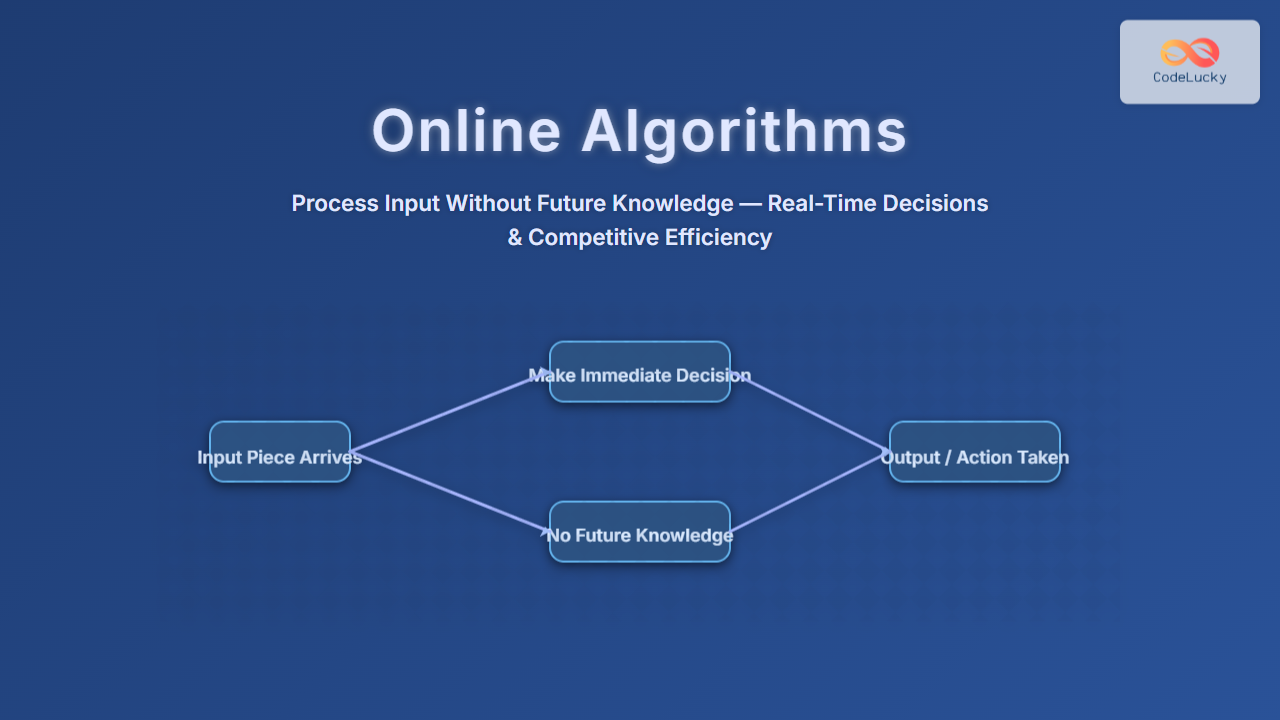
Online algorithms are a special class of algorithms that process input piece-by-piece in real-time, without any knowledge of future inputs. They make decisions as new data arrives, which sets them apart from offline algorithms that have complete access to input beforehand. This article explores online algorithms in depth, highlighting their design principles, importance, and practical examples to help developers and researchers understand how to work effectively without future knowledge.
What are Online Algorithms?
Unlike offline algorithms that operate with full knowledge of the entire input dataset from the start, online algorithms must make irrevocable decisions as each input arrives sequentially. The goal is to perform tasks with limited foresight, often where waiting to see all input is impractical or impossible.
This characteristic is common in many real-world applications like caching, scheduling, stock trading, and network routing, where decisions are required instantly and waiting means loss or inefficiency.
Key Characteristics of Online Algorithms
- Incremental processing: Input is revealed one piece at a time, and the algorithm must process it immediately.
- Irrevocable decisions: Once a decision is made, it often cannot be changed later.
- Limited or no future knowledge: The algorithm only knows past and current input, never future input.
- Performance measured by competitive analysis: The quality of an online algorithm is often compared to an optimal offline algorithm that has complete input knowledge.
Competitive Ratio: Evaluating Online Algorithms
Because online algorithms have less information, we measure their efficiency by the competitive ratio. This ratio compares the cost or performance of the online algorithm to the optimal offline algorithm.
Mathematically, if Cost_online is the cost incurred by the online algorithm and Cost_offline by the optimal offline one, the competitive ratio c is defined as:
c = max (Cost_online / Cost_offline)
An online algorithm with a competitive ratio close to 1 is highly effective, even without future knowledge.
Classic Examples of Online Algorithms
1. The Ski Rental Problem
This problem models a scenario where a person has to decide each day whether to rent skis or buy them without knowing how many days they will ski in total.
Problem statement: Renting skis costs a daily fee; buying skis has a one-time cost. The objective is to minimize the total cost without knowing future skiing days.

The greedy online solution is to rent skis until the rental cost equals the purchase cost, then buy skis. This strategy guarantees a competitive ratio of 2, meaning the cost will be at most twice the optimal offline cost.
2. The Paging/Caching Problem
A cache system stores a limited number of pages. When a new page is requested and the cache is full, the algorithm must decide which page to evict.
Without knowledge of future requests, online caching algorithms such as Least Recently Used (LRU) aim to minimize cache misses.

Online Algorithm Example: The Ski Rental Interactive Code
The following interactive JavaScript example simulates the ski rental decision problem. It shows how the algorithm decides to rent or buy based on the number of skiing days.
<div>
  <label>Total skiing days:</label>
  <input id="skiDays" type="number" min="1" value="5" />
  <button onclick="runSkiRental()">Run Ski Rental Algorithm</button>
  <pre id="result"></pre>
</div>

<script>
function runSkiRental() {
  const rentalCostPerDay = 10;
  const purchaseCost = 50;
  const days = parseInt(document.getElementById("skiDays").value, 10);
  let totalCost = 0;
  let decision = "";
  let rentDays = 0;

  for (let i = 1; i <= days; i++) {
    if (totalCost + rentalCostPerDay < purchaseCost) {
      totalCost += rentalCostPerDay;
      rentDays = i;
      decision = `Day ${i}: Rent skis. Total cost = $${totalCost}`;
    } else {
      totalCost = purchaseCost;
      decision = `Day ${i}: Buy skis. Total cost = $${totalCost}`;
      break;
    }
  }

  if (days > rentDays) {
    decision += `\nContinue skiing for remaining days without extra cost.`;
  }

  document.getElementById("result").textContent = decision + `\nFinal total cost after ${days} days is $${totalCost}.`;
}
</script>
Design Approaches for Online Algorithms
Developing online algorithms involves careful heuristics and approximations, often grounded in the following approaches:
- Greedy Methods: Make the best immediate choice.
- Randomization: Use probabilistic choices to mitigate worst-case scenarios.
- Primal-Dual Methods: Establish bounds relative to offline optimal solutions.
When to Use Online Algorithms?
Online algorithms are essential when:
- You cannot wait for complete input—for example, live data streams or real-time user interactions.
- The system state changes dynamically, and decisions must adapt quickly.
- Future input is unpredictable or costly to store or compute fully.
Summary
Online algorithms provide a powerful framework for decision-making without future knowledge, essential in real-time and dynamic environments. They trade off some optimality to gain immediacy and practicality. Understanding their principles, design patterns, and evaluation metrics like competitive ratio is key to applying them effectively.
The concrete examples of the ski rental and caching problems illustrate how online algorithms work practically, balancing cost and performance under uncertainty.