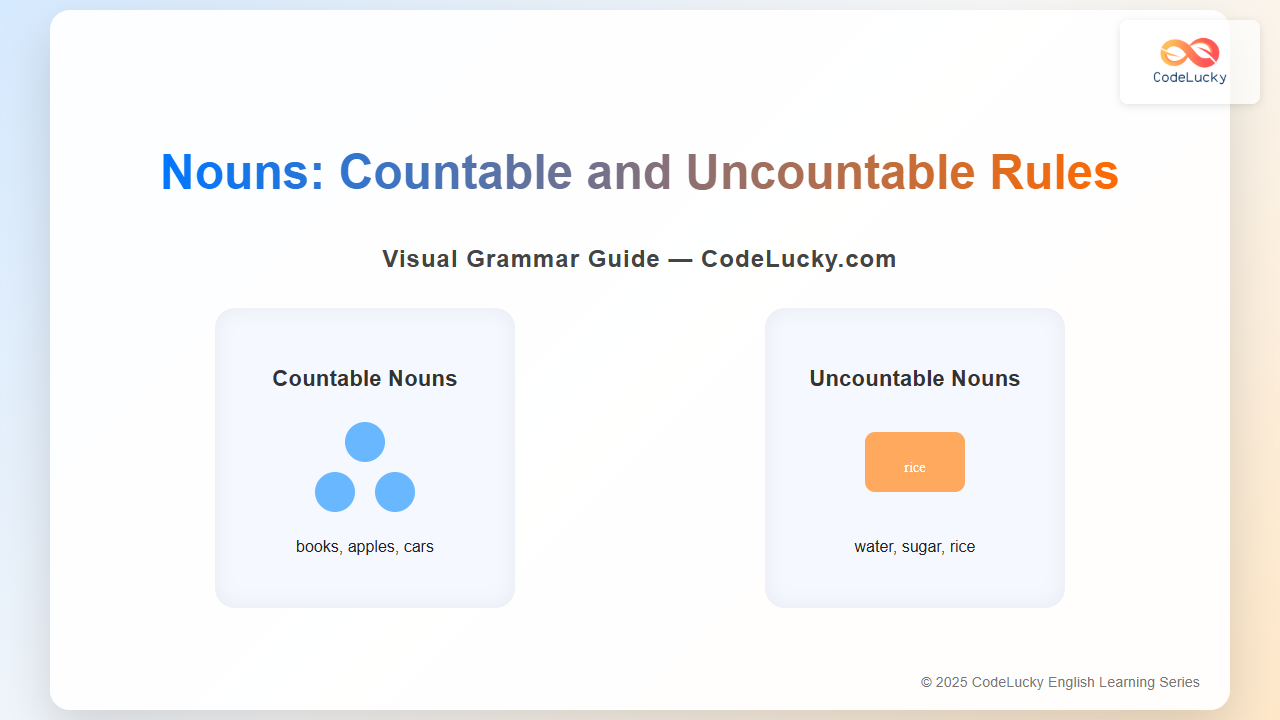
Countable and uncountable nouns are one of the fundamental grammar concepts in English. Understanding them helps you speak and write more precisely — especially when deciding whether to use a, an, many, much, few, or little. This article from CodeLucky.com explains countable and uncountable noun rules, usage, examples, and visual aids that make the concept easy to master.
What Are Countable Nouns?
Countable nouns are nouns that can be counted as individual items. They have both singular and plural forms.
- Singular form: Requires a or an before it. Example: a car, an apple.
- Plural form: Add -s or -es (usually). Example: cars, apples.
Examples of Countable Nouns
| Singular | Plural | Example Sentence |
|---|---|---|
| book | books | I have three books. |
| chair | chairs | There are four chairs in the room. |
| apple | apples | She bought some apples. |

What Are Uncountable Nouns?
Uncountable nouns (also called mass nouns) refer to substances, concepts, or things that we cannot count individually. They do not have a plural form and are usually treated as singular.
- We do not use a or an with them.
- They often take singular verbs.
Examples of Uncountable Nouns
| Uncountable Noun | Correct Usage | Incorrect Usage |
|---|---|---|
| water | some water | a water |
| money | much money | many moneys |
| information | a piece of information | an information |

Key Differences Between Countable and Uncountable Nouns
| Feature | Countable Nouns | Uncountable Nouns |
|---|---|---|
| Can be counted | Yes | No |
| Has plural form | Yes | No |
| Used with a/an | Yes | No |
| Quantifiers | many, few, several | much, little, a bit of |
| Examples | books, cars, pens | water, sugar, advice |

Quantifiers You Can Use
Quantifiers are words that tell us “how much” or “how many”. Knowing which quantifiers go with which noun type is crucial.
Common Quantifier Usage
- Countable nouns: many, a few, few, several, a number of
- Uncountable nouns: much, a little, little, a bit of, an amount of
Example Sentences:
- There are many chairs in the hall. ✅
- There is much noise outside. ✅
- There are many waters in the bottle. ❌

Interactive Rule Checker (Try It!)
Type any noun in the input field below to see if it is generally considered countable or uncountable. (Works locally; requires simple JavaScript hook.)
<input type="text" id="nounInput" placeholder="Enter a noun (e.g. rice, apple)" />
<button onclick="checkNounType()">Check Type</button>
<div id="result"></div>

<script>
function checkNounType() {
  const countables = ['book', 'apple', 'car', 'chair', 'pen', 'dog'];
  const uncountables = ['water', 'sugar', 'rice', 'information', 'advice', 'money'];
  const noun = document.getElementById('nounInput').value.toLowerCase().trim();
  let output = '';
  if (countables.includes(noun)) output = noun + ' is a Countable Noun.';
  else if (uncountables.includes(noun)) output = noun + ' is an Uncountable Noun.';
  else output = 'Not sure! This noun may depend on context.';
  document.getElementById('result').innerHTML = output;
}
</script>
Context-Dependent Nouns
Some nouns can be both countable and uncountable depending on their meaning or context:
| Noun | Countable Example | Uncountable Example |
|---|---|---|
| chicken | I bought three chickens. (animals) | We had chicken for dinner. (meat) |
| paper | I wrote three papers. (articles) | He bought some paper. (material) |
| hair | I found a hair in my soup. (a single strand) | She has beautiful hair. (collective mass) |
Quick Grammar Tips
- Never add -s to uncountable nouns (informations ❌, water ❌).
- Use a piece of, a bit of, or a slice of to quantify an uncountable noun.
- Pay attention to meaning; context can change a noun’s type.
Conclusion
Understanding the difference between countable and uncountable nouns is essential for accurate English grammar. It affects articles, quantifiers, and verb forms. Keep practicing with examples, and try identifying noun types in daily reading or speech. With these rules and visuals from CodeLucky.com, mastering nouns becomes simple and intuitive.