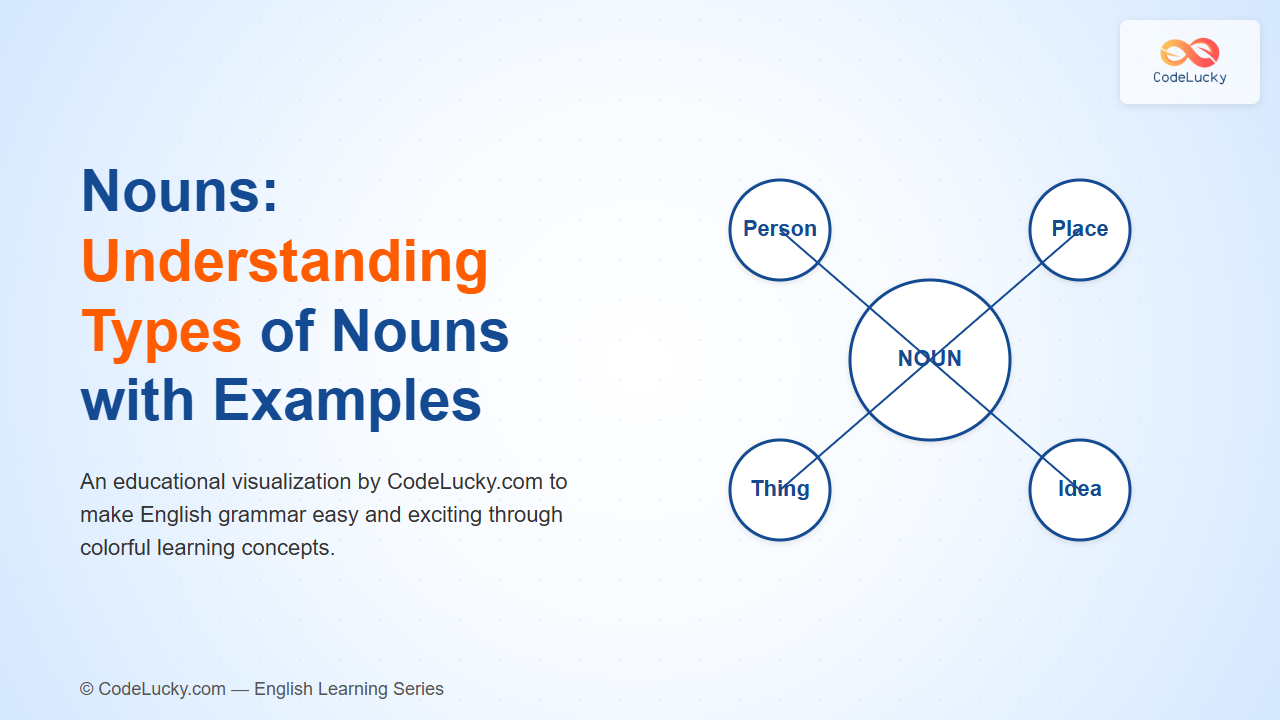
Nouns are the foundation of language and communication. Whether you write stories, create business reports, or speak daily English, nouns help identify the people, places, things, or ideas involved. In this comprehensive guide, you’ll understand the types of nouns with clear explanations, examples, and simple visuals. This guide forms part of CodeLucky.com’s English Learning Series, designed for learners who want to build strong, practical grammar skills.
What is a Noun?
A noun is a word used to name a person, place, thing, or idea. Every sentence in English revolves around nouns, because they act as the subject or the object—essentially the “who” or “what” of the sentence.
Examples:
- Person: Maria teaches English.
- Place: Paris is a beautiful city.
- Thing: The laptop works smoothly.
- Idea: Happiness is contagious.

Major Types of Nouns
English nouns are categorized based on meaning, form, and usage. Below are the major types explained with examples.
1. Proper Nouns
These nouns refer to specific names of people, places, organizations, or things. They always begin with a capital letter.
Examples: India, Google, Mount Everest, Ravi
In a sentence: Google is a leading technology company.
2. Common Nouns
Common nouns name general items that are not specific. They do not start with a capital letter unless they begin a sentence.
Examples: city, teacher, book, dog
In a sentence: The dog barked loudly.
3. Concrete Nouns
Concrete nouns refer to physical things that can be experienced with the five senses—something you can see, touch, hear, taste, or smell.
Examples: apple, music, perfume, stone
In a sentence: The music was too loud.
4. Abstract Nouns
Abstract nouns represent ideas, emotions, or states that cannot be touched or seen.
Examples: freedom, kindness, courage, patience
In a sentence: Patience leads to success.
5. Collective Nouns
Collective nouns refer to a group or collection of people, animals, or things considered as one unit.
Examples: team (group of players), flock (group of birds), bunch (group of grapes)
In a sentence: The team won the championship.

6. Countable and Uncountable Nouns
These types depend on whether the noun can be counted or not.
Countable Nouns
These have singular and plural forms. You can add a number before them.
- Examples: 1 car, 2 cars, 3 books
Uncountable Nouns
These refer to substances or concepts that cannot be counted individually.
- Examples: water, sand, information
In a sentence: The information is useful. (Not “informations”)

7. Compound Nouns
Compound nouns are created when two or more words combine to form one noun with a unified meaning.
Examples: toothpaste, football, mother-in-law, swimming pool
In a sentence: She keeps her toothbrush in the case.
8. Possessive Nouns
These show ownership or relation. Usually formed by adding an apostrophe + “s”.
Examples: John’s book, dog’s tail, women’s rights

Interactive Exercise
Try this simple test. Identify the noun type in each sentence:
- Ravi visited the zoo. — Proper, Common
- The crowd cheered loudly. — Collective
- Honesty is the best policy. — Abstract
- She loves chocolate. — Uncountable
Quick Tip: Ask “Can I count this?” or “Does it name something specific?”—these questions often help determine noun types quickly!
Quick Summary Table
| Type | Definition | Example |
|---|---|---|
| Proper Noun | Names a specific person or place | Peter, London |
| Common Noun | Names a general person or thing | girl, car |
| Concrete Noun | Something you can experience physically | apple, bell |
| Abstract Noun | Represents feelings or ideas | love, fear |
| Collective Noun | Group of similar items or people | team, family |
| Countable | Can be counted and has plural form | book, pen |
| Uncountable | Cannot be counted or pluralized | water, rice |
Conclusion
Understanding nouns and their types is the first major step toward mastering English grammar. Knowing whether a noun is abstract or concrete, countable or uncountable, helps in choosing the correct verb forms and articles in sentences. Keep practicing with daily examples from your environment—name what you see, touch, and think about, and identify the noun type. Over time, it becomes second nature.
This “Nouns: Understanding Types of Nouns with Examples” guide by CodeLucky.com makes learning grammar visual, simple, and practical—helping learners use English more confidently every day.