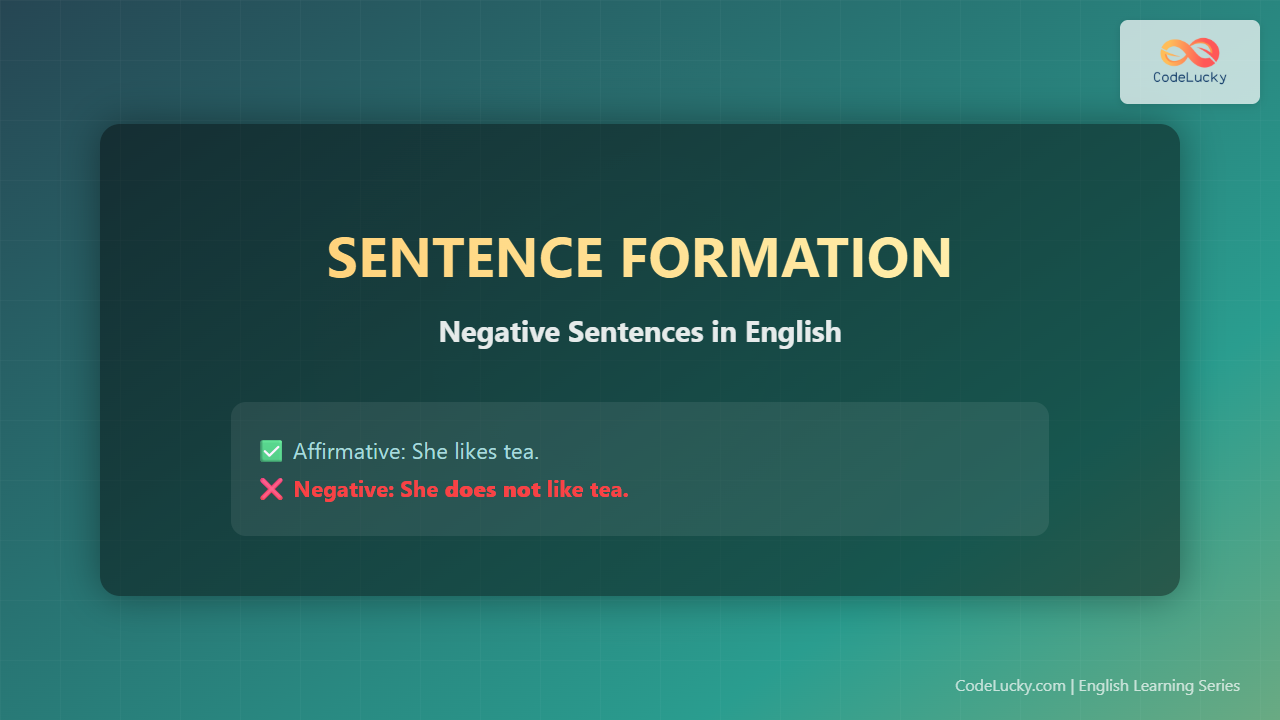
Negative Sentences in English are an essential part of daily communication because they help express denial, refusal, disagreement, or the absence of something. Understanding how to form them correctly improves both writing and speaking clarity.
This article on CodeLucky.com explains the concept of negative sentences in English, their structure, common errors, and how to use them effectively in different tenses. Whether you are a student, teacher, or English learner, this guide will enhance your grammar skills step-by-step.
What Is a Negative Sentence?
A negative sentence tells us that something is not true or that something does not happen. Most often, it includes the word not or other negative words like never, no one, or nothing.
Examples:
- She does not like coffee.
- They are not coming today.
- There is no milk left.
- He has never visited Delhi.
The Basic Structure of Negative Sentences
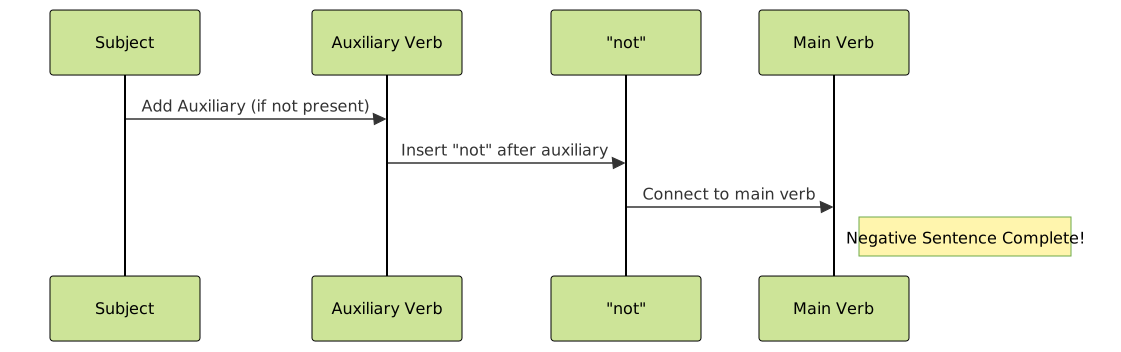
Most English sentences can be made negative by adding “not” after an auxiliary verb (like is, do, have, will). If no auxiliary verb exists, one must be added using do/does/did.
Let’s see how the structure changes:

Example Transformation:
| Type | Affirmative | Negative |
|---|---|---|
| Simple Present | I play football. | I do not play football. |
| Present Continuous | She is reading. | She is not reading. |
| Simple Past | They went home. | They did not go home. |
| Present Perfect | He has finished. | He has not finished. |
Negative Sentence Patterns by Tense
Understanding which auxiliary verb to use depends on the sentence tense. The following examples explain this clearly.
1. Simple Present Tense
Use do not (don’t) or does not (doesn’t).
Examples:
- I do not like spicy food. → I don’t like spicy food.
- He does not watch TV. → He doesn’t watch TV.
2. Present Continuous Tense
Add not after the verb am/is/are.
- She is not sleeping.
- We are not studying today.
3. Simple Past Tense
Use did not (didn’t) + base form of the verb.
- They did not arrive on time.
- I didn’t call him yesterday.
4. Present Perfect Tense
Place not after has/have.
- He has not completed his work.
- We have not seen that movie.
5. Future Tense
Insert not after will.
- I will not go out tonight.
- They won’t agree with the plan.
Interactive Check: Fill in the Negatives
Try to complete these sentences by inserting the correct negative form:
- He _____ (not/play) basketball after school.
- They _____ (not/come) to the meeting yesterday.
- She _____ (not/eat) meat.
- We _____ (not/finish) our homework yet.
Answer Key: 1. does not play, 2. did not come, 3. does not eat, 4. have not finished.
Negative Words Beyond “Not”
You can also create negative meaning using other words without “not”. These are called negative determiners, adverbs, or pronouns.
| Negative Word | Example Sentence |
|---|---|
| No | There is no sugar in the jar. |
| Never | I never forget my friends’ birthdays. |
| Nothing | Nothing can stop us now. |
| Nowhere | He went nowhere after school. |
| No one | No one called me today. |

Common Mistakes in Negative Sentences
- Double Negatives: Avoid using two negative words in the same clause (e.g., “I don’t have no money” → should be “I don’t have any money”).
- Wrong verb form: After do/does/did not, always use the base form of the verb, not the past or -s form.
- Incorrect position of “not”: Place “not” immediately after the auxiliary verb.

Practice Exercise
Convert these affirmative sentences into negative ones:
- She writes a letter every week.
- We are going to school.
- He has finished his project.
- I will attend the meeting.
Suggested Answers:
- She does not write a letter every week.
- We are not going to school.
- He has not finished his project.
- I will not attend the meeting.
Quick Reference Summary
- Use not after auxiliary verbs.
- Add do/does/did when no auxiliary is present.
- Avoid double negatives.
- “No”, “never”, “nothing” can replace “not” for emphasis.
Conclusion: Negative sentence formation is simple when the rules around auxiliaries and verb forms are clear. With regular practice, you will be able to express disagreement, denial, and absence accurately in English communication.
Continue exploring more lessons on CodeLucky.com for improving your English grammar, vocabulary, and sentence building skills.