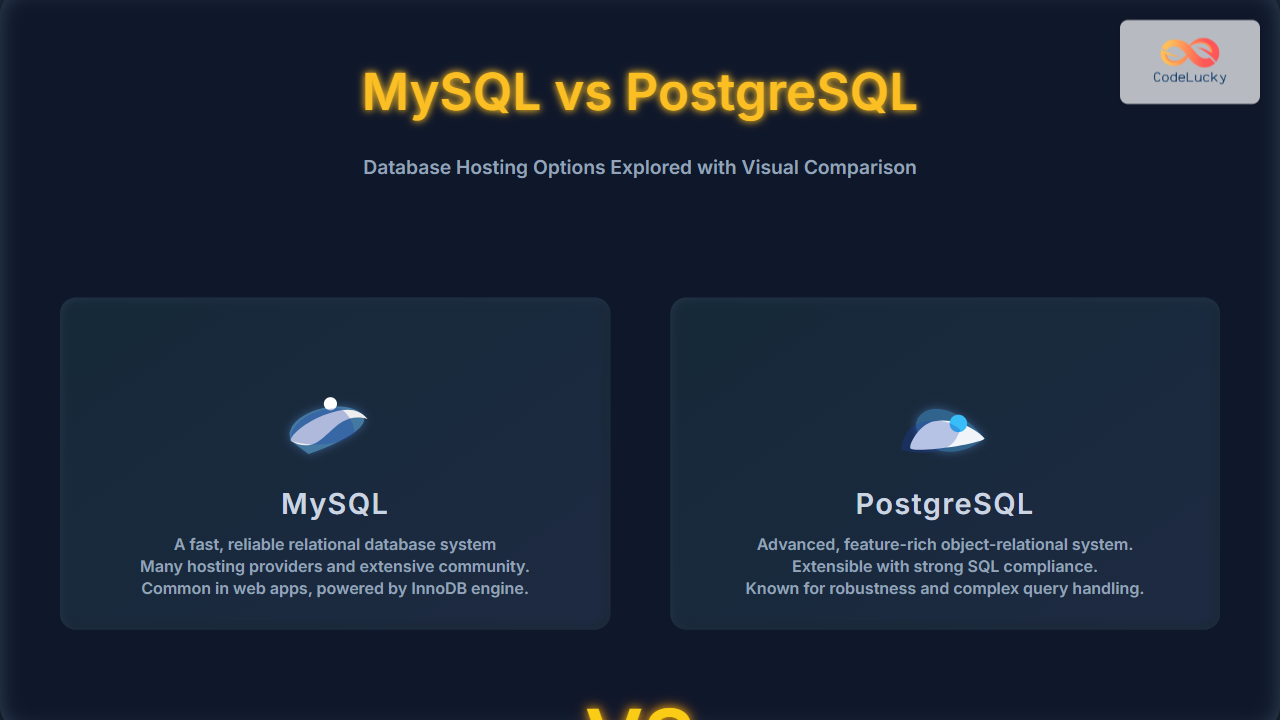
Choosing the right database hosting option is critical for application performance, scalability, and reliability. This detailed guide compares two of the most popular relational database management systems: MySQL and PostgreSQL. The article walks through their core features, hosting environments, advantages, practical examples with query outputs, and how to decide the best fit for your needs.
Understanding MySQL and PostgreSQL: A Primer
MySQL is an open-source relational database system renowned for its speed, simplicity, and widespread adoption, especially in web applications. It integrates well with PHP and the LAMP stack, and is supported by many hosting providers.
PostgreSQL (often called Postgres) is a powerful, open-source object-relational database system known for its standards compliance, advanced features, and extensibility. It is favored in environments requiring complex queries and data integrity.
Core Differences Between MySQL and PostgreSQL
| Feature | MySQL | PostgreSQL |
|---|---|---|
| ACID Compliance | Supported with InnoDB engine by default | Fully ACID compliant by design |
| SQL Compliance | Moderate, some syntax differences | Highly standards-compliant with advanced SQL features |
| Extensibility | Limited; supports plugins | Highly extensible with custom types, functions, and extensions |
| Indexing | B-tree, hash, full-text (with limitations) | B-tree, hash, GIN, GiST, BRIN for diverse use cases |
| Replication | Asynchronous replication, Group Replication (multi-master) | Asynchronous and synchronous replication, logical replication |
| JSON Support | Supported, but limited JSON functions | Advanced JSONB datatype with indexing |
Database Hosting Options Overview
Both MySQL and PostgreSQL provide flexibility in hosting choices, including on-premises servers, cloud providers, and managed database services. Let’s break down common hosting options:
- Self-Hosted Solutions: Ideal for full control, security, and customization. Requires manual setup, maintenance, and scaling.
- Managed Database Services: Offered by cloud providers, these services handle backups, scaling, updates, and high availability.
- Cloud-Native Databases: Purpose-built cloud databases with automated scaling and global reach, often proprietary but compatible with MySQL/PostgreSQL protocols.
Popular Hosting and Managed Services for MySQL and PostgreSQL
| Provider | MySQL Options | PostgreSQL Options | Notes |
|---|---|---|---|
| Amazon Web Services (AWS) | Amazon RDS for MySQL, Aurora MySQL | Amazon RDS for PostgreSQL, Aurora PostgreSQL | Aurora is a high-performance, fault-tolerant service compatible with both |
| Google Cloud Platform (GCP) | Cloud SQL for MySQL | Cloud SQL for PostgreSQL | Fully managed SQL database with automatic backups and replication |
| Microsoft Azure | Azure Database for MySQL | Azure Database for PostgreSQL | Managed instances with scaling and high availability options |
| DigitalOcean | Managed MySQL | Managed PostgreSQL | Simple setup and affordable pricing for small to medium workloads |
Example: Connecting and Querying MySQL vs PostgreSQL
Below are simple examples to showcase basic query differences and outputs from both databases.
MySQL Example
CREATE TABLE employees (
  id INT AUTO_INCREMENT PRIMARY KEY,
  name VARCHAR(100),
  hire_date DATE
);

INSERT INTO employees (name, hire_date) VALUES
('Alice', '2023-01-15'),
('Bob', '2022-12-01');

SELECT id, name, DATE_FORMAT(hire_date, '%W, %M %d, %Y') AS formatted_hire_date
FROM employees;
Expected Output:
| id | name | formatted_hire_date |
|---|---|---|
| 1 | Alice | Sunday, January 15, 2023 |
| 2 | Bob | Thursday, December 01, 2022 |
PostgreSQL Example
CREATE TABLE employees (
  id SERIAL PRIMARY KEY,
  name VARCHAR(100),
  hire_date DATE
);

INSERT INTO employees (name, hire_date) VALUES
('Alice', '2023-01-15'),
('Bob', '2022-12-01');

SELECT id, name, TO_CHAR(hire_date, 'FMDay, FMMonth DD, YYYY') AS formatted_hire_date
FROM employees;
Expected Output:
| id | name | formatted_hire_date |
|---|---|---|
| 1 | Alice | Sunday, January 15, 2023 |
| 2 | Bob | Thursday, December 01, 2022 |
Visualizing Replication Architectures

This diagram illustrates a typical asynchronous replication setup common in MySQL and PostgreSQL hosting where replicas serve read queries to scale traffic while the primary handles writes.
Choosing Between MySQL and PostgreSQL Hosting
- Choose MySQL if: The application depends on simple read-heavy workloads, you need broad hosting provider support, or you’re working with legacy projects favoring MySQL.
- Choose PostgreSQL if: The requirements demand advanced SQL features, complex transactions, extensibility, or you prioritize data integrity and compliance.
- Hosting support is extensive for both: Managed cloud services provide scalable, secure, and convenient options in both ecosystems.
Interactive Code Example Suggestion
Embedding interactive SQL query runners like db<>fiddle or similar playgrounds on CodeLucky.com can help users test and compare MySQL and PostgreSQL queries live for better understanding and experimentation.
Summary: MySQL vs PostgreSQL for Database Hosting
Both MySQL and PostgreSQL remain top choices for relational database hosting worldwide. Selecting a solution depends on specific use cases, complexity, and operational environments. Managed cloud hosting services from AWS, Google Cloud, Azure, and others provide reliable options for both, simplifying administration while offering scalability and performance. Understanding fundamental differences and hosting options ensures informed choices for application success.