Monte Carlo Methods are a class of computational algorithms that rely on random sampling to obtain numerical results. They are especially useful for approximating complex mathematical problems or simulating systems with many uncertain variables. This article delves deeply into these methods, explaining their principles, applications, and providing detailed examples with visualizations—including interactive content and insightful diagrams—to help practitioners and learners understand and apply Monte Carlo techniques effectively.
What Are Monte Carlo Methods?
Monte Carlo Methods use random inputs to explore problems usually involving probability, integration, optimization, or simulation. Named after the famous Monte Carlo casino for their use of randomness and chance, these methods help approximate solutions where direct analytical methods are impractical or impossible. Instead of deterministic computations, Monte Carlo employs statistical sampling to estimate results.
Core Principle: Random Sampling for Approximation
At the heart of Monte Carlo Methods is the idea of generating many random samples from a probability distribution to estimate a quantity of interest—such as an integral, expected value, or a solution to a differential equation.

Common Monte Carlo Applications
- Numerical integration: Estimating integrals in high-dimensional spaces.
- Financial modeling: Simulating stock prices or risk assessment.
- Physics simulations: Particle transport, quantum Monte Carlo.
- Optimization problems: Approximating solutions where exact methods fail.
Example 1: Estimating Pi Using Monte Carlo
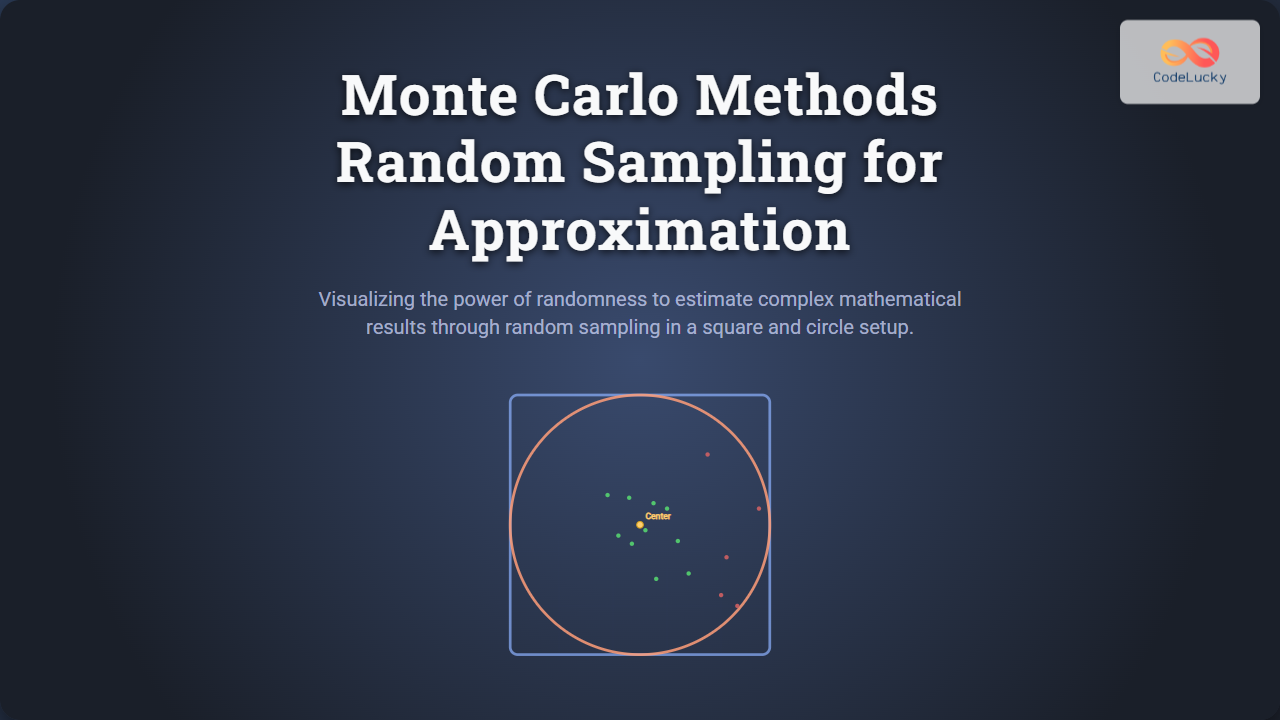
A classic illustration is approximating the value of π by randomly sampling points inside a square and counting how many fall inside the inscribed circle.
The ratio of points inside the circle to total points approximates the ratio of the areas, which is π/4 since the circle’s radius is 1.
// Monte Carlo estimation of Pi
function estimatePi(numSamples) {
    let insideCircle = 0;
    for(let i = 0; i < numSamples; i++) {
        let x = Math.random();
        let y = Math.random();
        if(x*x + y*y <= 1) {
            insideCircle++;
        }
    }
    return (insideCircle / numSamples) * 4;
}
console.log("Estimated Pi:", estimatePi(1000000));
Example 2: Monte Carlo Integration
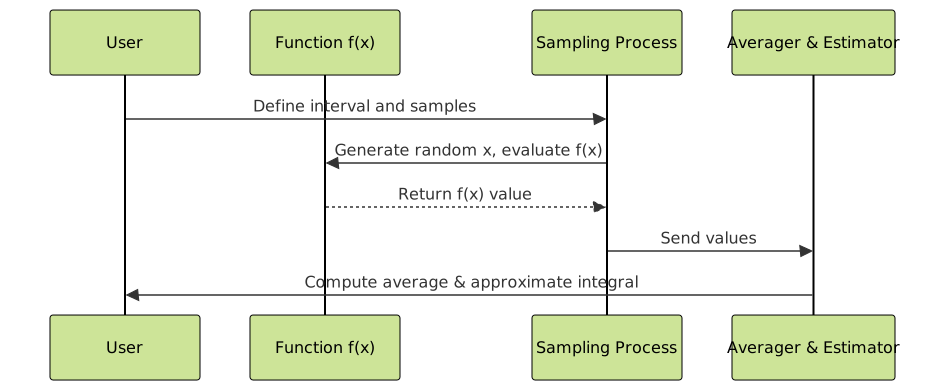
For functions that are difficult to integrate analytically, Monte Carlo can estimate integrals by sampling random points and averaging function values.
// Estimate integral of f(x) = x^2 over [0,1]
function monteCarloIntegral(f, a, b, numSamples) {
    let sum = 0;
    for(let i = 0; i < numSamples; i++) {
        let x = a + (b - a) * Math.random();
        sum += f(x);
    }
    return ((b - a) * sum) / numSamples;
}

function square(x) { return x*x; }

console.log("Integral approx:", monteCarloIntegral(square, 0, 1, 100000));
Steps in Monte Carlo Integration:
Why Use Monte Carlo Methods?
Monte Carlo methods scale well with dimension, unlike traditional grid-based numerical methods which suffer from the “curse of dimensionality.”
They also lend themselves easily to parallelization and can be applied to a wide range of complex problems where direct analytic or deterministic numerical methods fail.
Practical Considerations and Limitations
- Randomness quality: Poor random number generators may bias results.
- Convergence rate: Typically \(O(\frac{1}{\sqrt{N}})\), slow but predictable.
- Variance reduction techniques: Importance sampling, stratified sampling improve efficiency.
Interactive Demo: Estimate Pi with Adjustable Samples
Use this simple interactive example to see how increasing sample size improves π estimation accuracy.
1000
Estimated π:
Conclusion
Monte Carlo Methods provide a versatile and intuitive approach to solving complex problems via random sampling. From estimating π to high-dimensional integration and simulation, their power lies in simplicity and adaptability. Though they come with limitations like slower convergence, modern techniques and computational power have amplified their utility across various scientific and engineering domains.
Mastering Monte Carlo techniques opens doors to a rich toolkit for approximation and simulation, complementing deterministic algorithms with probabilistic insights.