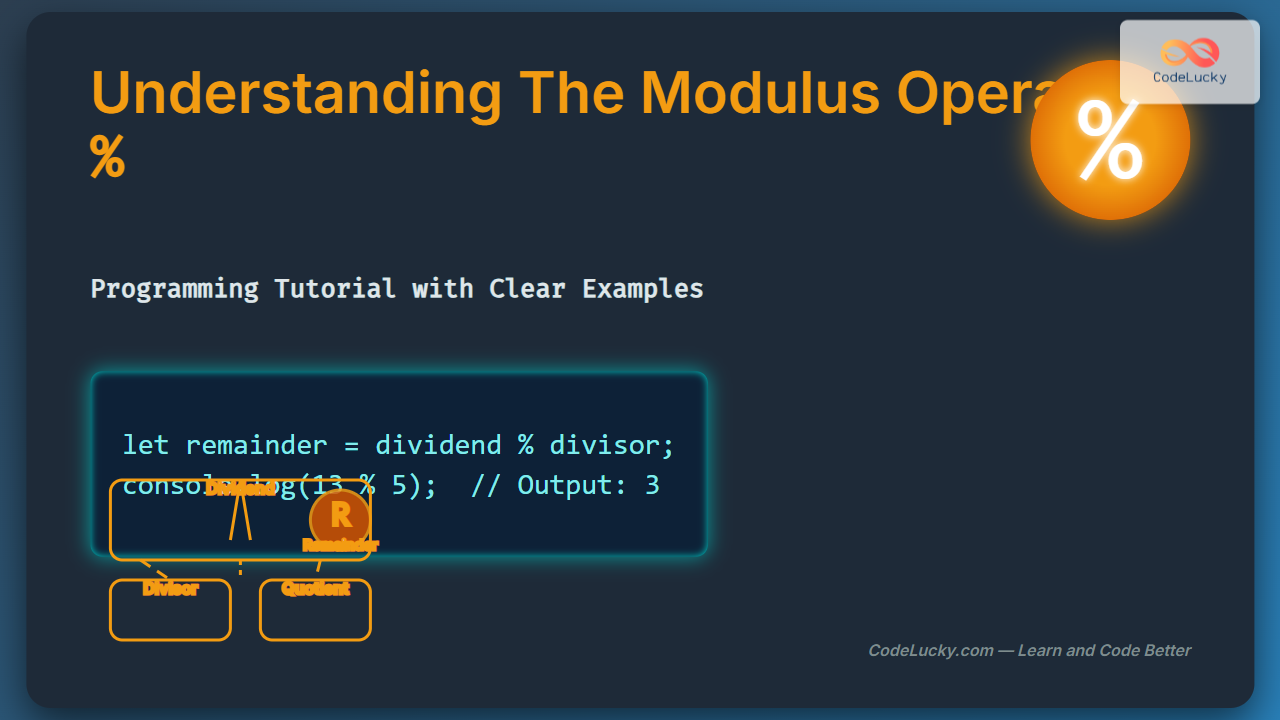
The modulus operator (%) is a fundamental concept in programming used to find the remainder of a division between two numbers. Understanding how it works and where to apply it will significantly enhance your problem-solving skills in coding. This guide walks through everything you need to know—from basic definitions to practical examples, supported by clear visualizations and interactive snippets.
What is the Modulus Operator?
In simple terms, the modulus operator returns the remainder after dividing one number by another. The syntax looks like this in most programming languages:
result = dividend % divisor;Here, result holds the remainder value when dividend is divided by divisor.
Mathematical Explanation
When you divide two integers:
\[ \text{dividend} = (\text{divisor} \times \text{quotient}) + \text{remainder} \]
The modulus operator gives you the remainder:
\[ \text{remainder} = \text{dividend} \% \text{divisor} \]

Key Properties of the Modulus Operator
- Remainder is always less than divisor: The output of
a % bwill always be less thanbifbis positive. - If dividend is less than divisor: The remainder equals the dividend itself.
- Works with integers primarily: Most languages enforce modulus on integers; behavior with floats may vary.
- Sign of the result may vary: Depending on language, the sign of the remainder can behave differently when negative numbers are involved.
Common Uses of Modulus Operator in Programming
- Checking Even or Odd Numbers:
num % 2 == 0indicates an even number. - Looping in Circular Buffers or Arrays: Wrapping indices using modulus to avoid overflow.
- Extracting Digits from Numbers: By repeatedly applying modulus with powers of 10.
- Time Calculations: Converting seconds to minutes and seconds.
- Hash Functions: Distributing keys evenly within a fixed size range.
Programming Examples with Visual Output
Example 1: Even or Odd Check (JavaScript)
function checkEvenOrOdd(num) {
    return num % 2 === 0 ? "Even" : "Odd";
}
console.log(checkEvenOrOdd(7));  // Output: Odd
console.log(checkEvenOrOdd(24)); // Output: Even
Output:
7 % 2 = 1, so the number is Odd.24 % 2 = 0, so the number is Even.
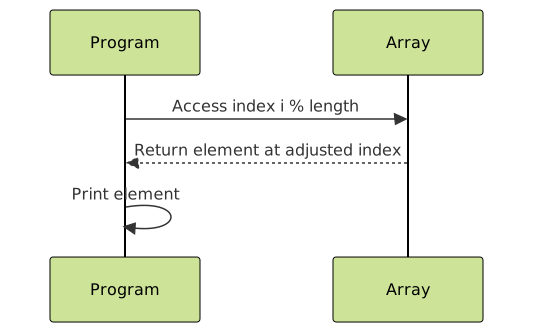
Example 2: Circular Array Indexing (Python)
Using modulus to cycle over an array index:
colors = ["red", "green", "blue"]
for i in range(7):
    print(colors[i % len(colors)])
Output:
red
green
blue
red
green
blue
red
Example 3: Extract Last Digit of an Integer (JavaScript)
function getLastDigit(num) {
    return num % 10;
}
console.log(getLastDigit(1234));  // Output: 4
This works because dividing by 10 and taking remainder isolates the last digit of a base-10 number.
Interactive Explanation: Modulus Calculations
Try the snippet below to see modulus results for your own inputs:
<input type="number" id="dividend" placeholder="Dividend" />
<input type="number" id="divisor" placeholder="Divisor" />
<button onclick="calculateModulus()">Calculate Modulus</button>
<div id="result"></div>

<script>
function calculateModulus() {
    let dividend = parseInt(document.getElementById('dividend').value);
    let divisor = parseInt(document.getElementById('divisor').value);
    if (isNaN(dividend) || isNaN(divisor) || divisor === 0) {
        document.getElementById('result').innerText = "Please enter valid numbers and divisor must not be zero.";
        return;
    }
    let remainder = dividend % divisor;
    document.getElementById('result').innerText = `${dividend} % ${divisor} = ${remainder}`;
}
</script>
Modulus Behavior with Negative Numbers
The behavior of modulus with negative operands varies between programming languages:
- In Python,
-7 % 3yields2because the result has the same sign as the divisor. - In JavaScript and C/C++,
-7 % 3returns-1because the sign follows the dividend.

Summary
The modulus operator (%) is an indispensable tool for programmers. It helps in computing remainders, cycling through fixed ranges, and implementing patterns that rely on divisibility and periodicity. Mastering its behavior, especially nuances involving negative values, leads to more robust and versatile code. Experiment with the operator in different languages to get comfortable with its syntax and peculiarities.
Use this article as a reference for both conceptual clarity and practical application of the modulus operator across programming contexts.