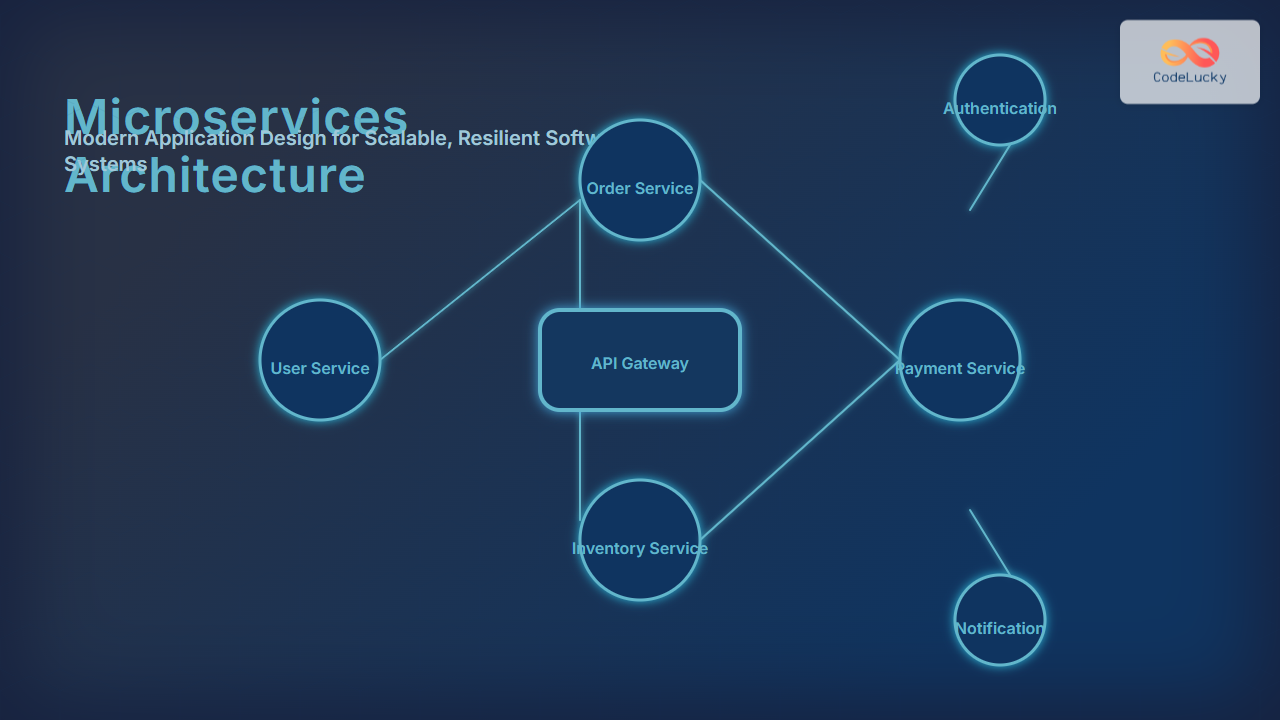
In the ever-evolving landscape of software development, Microservices Architecture has emerged as a powerful paradigm for building modern, scalable, and maintainable applications. Unlike traditional monolithic applications, microservices break down complex software into smaller, independent services that work together seamlessly. This article dives deep into the world of microservices, explaining the architecture, its advantages, design patterns, and practical examples, supported by clear visual diagrams for better understanding.
What is Microservices Architecture?
Microservices architecture is an approach to software design where an application is structured as a collection of loosely coupled, independently deployable services. Each microservice focuses on a specific business capability and communicates with others using lightweight protocols such as HTTP/REST or messaging queues.
This modularity enables teams to develop, test, deploy, and scale parts of the application independently, accelerating development cycles and improving resilience.

Key Characteristics of Microservices
- Single Responsibility: Each microservice is responsible for one specific business function.
- Independently Deployable: Microservices can be deployed without rebuilding or redeploying the entire application.
- Technology Diversity: Each service can be built using different technologies or languages.
- Decentralized Data Management: Each microservice manages its own database or data source.
- Inter-service Communication: Services communicate over lightweight protocols, typically REST, gRPC, or messaging.
Benefits of Microservices Architecture
The microservices model offers distinct advantages over monolithic architecture:
- Scalability: Scale only the services under heavy load rather than the entire application.
- Resilience: Failure in one service does not affect the entire system, improving fault tolerance.
- Faster Deployment: Smaller codebases lead to quicker development and continuous deployment.
- Flexible Technology Stack: Choose the best tool or language for each microservice.
- Improved Maintainability: Smaller services are easier to understand, maintain, and refactor.
Common Microservices Communication Patterns
Microservices require well-planned communication mechanisms to exchange data efficiently:
- HTTP/REST: The most common pattern using synchronous request-response, often via JSON.
- Message Brokers: Asynchronous communication using queues (e.g., RabbitMQ, Kafka) for event-driven design.
- gRPC: High-performance binary protocol for communication between services in different languages.
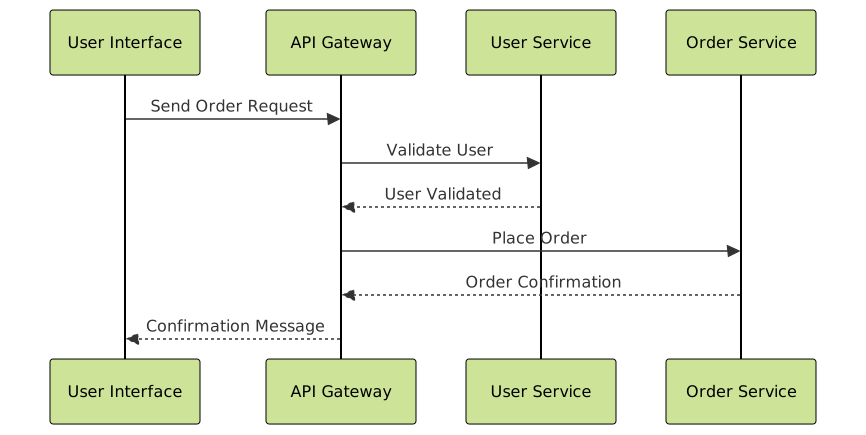
Design Principles in Microservices
Successful microservices systems adhere to foundational principles that guide design and development:
- Domain-Driven Design (DDD): Align microservices around business domains or subdomains to keep services focused and cohesive.
- API-First Design: Define clear, versioned APIs ensuring stable communication contracts between services.
- Database per Service: Each microservice owns its persistent storage to avoid tight coupling.
- Automation and CI/CD: Automate testing, deployment, and scaling to support continuous delivery in a microservices environment.
Example: Building a Simple E-commerce Microservice Setup
Consider an e-commerce platform where separate services handle distinct functions: User Management, Product Catalog, and Order Processing.
User Service (REST API Example)
GET /users/{id}
Response:
{
  "id": "123",
  "name": "John Doe",
  "email": "[email protected]"
}
Order Service (Event-based communication snippet)
When Order Created Event Happens:
  - Order Service consumes the event
  - Updates inventory via Inventory Service
  - Sends confirmation to User Service

Challenges and Considerations
While microservices offer many benefits, they also introduce challenges:
- Complexity: Managing multiple services requires sophisticated orchestration and monitoring.
- Data Consistency: Distributed data management complicates transactions and consistency guarantees.
- Network Latency: Inter-service calls add network overhead affecting performance.
- Security: More APIs and network endpoints must be secured properly.
Essential Tools & Technologies
Building and managing microservices is supported by various tools across development, deployment, and monitoring:
- Containerization: Docker to package services and Kubernetes for orchestration.
- API Gateway: NGINX, Kong, or AWS API Gateway for routing, rate-limiting, and security.
- Service Discovery: Consul, Eureka for dynamic service lookup.
- Monitoring: Prometheus, Grafana, ELK Stack for observability.
- CI/CD: Jenkins, GitHub Actions, GitLab CI for automation.

Conclusion
Microservices architecture is key to modern application design, offering unmatched flexibility, scalability, and development velocity. This modular approach aligns well with cloud-native trends and DevOps practices, empowering organizations to build resilient applications. Understanding microservices design principles, communication patterns, and suitable tooling is essential to harness its full benefits while mitigating challenges.
Start adopting microservices by identifying clear boundaries for services, automating deployments, and continuously monitoring their health for a robust, scalable software ecosystem.