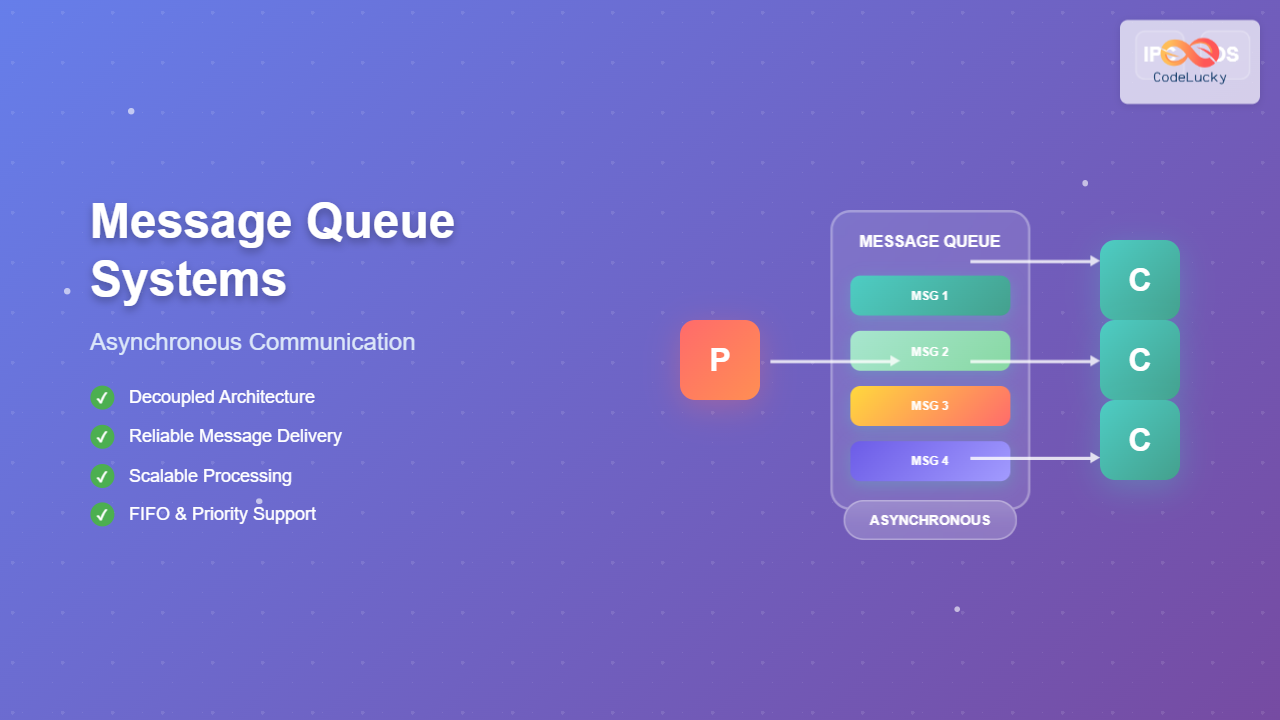
Message queue systems form the backbone of modern asynchronous communication in operating systems, enabling processes to communicate efficiently without blocking each other. This comprehensive guide explores the fundamental concepts, implementation strategies, and practical applications of message queues in system programming.
What are Message Queue Systems?
A message queue is an inter-process communication (IPC) mechanism that allows processes to exchange data through messages stored in a queue data structure. Unlike direct communication methods, message queues provide asynchronous communication where the sender and receiver don’t need to interact with the queue simultaneously.

Key Characteristics
- Asynchronous Nature: Processes can send and receive messages without waiting for each other
- Persistent Storage: Messages remain in the queue until consumed
- FIFO Ordering: First In, First Out message delivery (typically)
- Multiple Consumers: Multiple processes can read from the same queue
- Reliability: Messages are not lost if the receiver is temporarily unavailable
Types of Message Queue Systems
1. POSIX Message Queues
POSIX message queues provide a standardized interface for message passing in Unix-like systems. They offer priority-based message delivery and can be accessed by name.
#include <mqueue.h>
#include <fcntl.h>
#include <sys/stat.h>
#include <stdio.h>
#include <stdlib.h>
#include <string.h>

// Creating and opening a POSIX message queue
int main() {
    mqd_t mq;
    struct mq_attr attr;
    char buffer[1024];

    // Set queue attributes
    attr.mq_flags = 0;
    attr.mq_maxmsg = 10;
    attr.mq_msgsize = 1024;
    attr.mq_curmsgs = 0;

    // Create/open the queue
    mq = mq_open("/test_queue", O_CREAT | O_RDWR, 0664, &attr);

    if (mq == (mqd_t) -1) {
        perror("mq_open");
        exit(1);
    }

    // Send a message
    const char* message = "Hello from message queue!";
    if (mq_send(mq, message, strlen(message), 0) == -1) {
        perror("mq_send");
    }

    printf("Message sent successfully\n");

    mq_close(mq);
    return 0;
}
Output:
Message sent successfully
2. System V Message Queues
System V message queues are the traditional Unix IPC mechanism, identified by integer keys and offering message type-based filtering.
#include <sys/types.h>
#include <sys/ipc.h>
#include <sys/msg.h>
#include <stdio.h>
#include <stdlib.h>
#include <string.h>

struct msg_buffer {
    long msg_type;
    char msg_text[100];
};

int main() {
    key_t key;
    int msgid;
    struct msg_buffer message;

    // Generate unique key
    key = ftok("progfile", 65);

    // Create message queue
    msgid = msgget(key, 0666 | IPC_CREAT);

    if (msgid == -1) {
        perror("msgget");
        exit(1);
    }

    // Prepare message
    message.msg_type = 1;
    strcpy(message.msg_text, "System V Message Queue Example");

    // Send message
    if (msgsnd(msgid, &message, sizeof(message.msg_text), 0) == -1) {
        perror("msgsnd");
    } else {
        printf("Message sent: %s\n", message.msg_text);
    }

    return 0;
}
Output:
Message sent: System V Message Queue Example
Message Queue Implementation Architecture

Core Components
- Queue Manager: Handles queue creation, deletion, and access control
- Message Buffer: Stores actual message data in kernel memory
- Metadata Storage: Maintains queue attributes, permissions, and statistics
- Synchronization Mechanisms: Ensures thread-safe operations
Advanced Message Queue Features
Priority-Based Messaging
POSIX message queues support priority levels, allowing high-priority messages to be delivered before lower-priority ones.
#include <mqueue.h>
#include <stdio.h>
#include <stdlib.h>
#include <string.h>
#include <fcntl.h>

int priority_messaging_example() {
    mqd_t mq;
    struct mq_attr attr;

    // Configure queue for priority messaging
    attr.mq_flags = 0;
    attr.mq_maxmsg = 10;
    attr.mq_msgsize = 256;
    attr.mq_curmsgs = 0;

    mq = mq_open("/priority_queue", O_CREAT | O_RDWR, 0664, &attr);

    if (mq == (mqd_t) -1) {
        perror("mq_open");
        return -1;
    }

    // Send messages with different priorities
    mq_send(mq, "Low priority message", 20, 1);      // Priority 1
    mq_send(mq, "High priority message", 21, 10);    // Priority 10
    mq_send(mq, "Medium priority message", 23, 5);   // Priority 5

    printf("Messages sent with priorities: 1, 10, 5\n");

    // Receive messages (will be delivered by priority)
    char buffer[256];
    unsigned int priority;

    while (mq_receive(mq, buffer, 256, &priority) > 0) {
        printf("Received (priority %u): %s\n", priority, buffer);
    }

    mq_close(mq);
    mq_unlink("/priority_queue");
    return 0;
}
Expected Output:
Messages sent with priorities: 1, 10, 5
Received (priority 10): High priority message
Received (priority 5): Medium priority message
Received (priority 1): Low priority message
Non-blocking Operations
Message queues support both blocking and non-blocking operations, providing flexibility in application design.
#include <mqueue.h>
#include <fcntl.h>
#include <errno.h>
#include <stdio.h>
#include <string.h>

int nonblocking_example() {
    mqd_t mq;
    struct mq_attr attr;
    char buffer[256];

    attr.mq_flags = O_NONBLOCK;  // Non-blocking flag
    attr.mq_maxmsg = 5;
    attr.mq_msgsize = 256;
    attr.mq_curmsgs = 0;

    mq = mq_open("/nonblock_queue", O_CREAT | O_RDWR, 0664, &attr);

    // Try to receive from empty queue (non-blocking)
    ssize_t bytes = mq_receive(mq, buffer, 256, NULL);

    if (bytes == -1) {
        if (errno == EAGAIN) {
            printf("Queue is empty - no blocking occurred\n");
        } else {
            perror("mq_receive");
        }
    }

    mq_close(mq);
    mq_unlink("/nonblock_queue");
    return 0;
}
Output:
Queue is empty - no blocking occurred
Message Queue vs Other IPC Mechanisms

| Feature | Message Queues | Pipes | Shared Memory | Sockets |
|---|---|---|---|---|
| Persistence | ✅ Yes | ❌ No | ✅ Yes | ❌ No |
| Multiple Readers | ✅ Yes | ❌ No | ✅ Yes | ✅ Yes |
| Built-in Synchronization | ✅ Yes | ✅ Yes | ❌ No | ✅ Yes |
| Message Boundaries | ✅ Preserved | ❌ Stream | ❌ Manual | ✅ Preserved |
| Priority Support | ✅ Yes (POSIX) | ❌ No | ❌ No | ❌ No |
Practical Applications and Use Cases
Producer-Consumer Pattern
Message queues excel in implementing producer-consumer patterns where multiple producers generate work items for multiple consumers to process.
// Producer process
#include <mqueue.h>
#include <stdio.h>
#include <stdlib.h>
#include <unistd.h>
#include <string.h>

void producer_process() {
    mqd_t mq;
    char message[256];

    mq = mq_open("/work_queue", O_WRONLY);

    for (int i = 1; i <= 5; i++) {
        snprintf(message, sizeof(message), "Task #%d from producer", i);
        mq_send(mq, message, strlen(message), 0);
        printf("Producer: Sent %s\n", message);
        sleep(1);
    }

    mq_close(mq);
}

// Consumer process
void consumer_process(int consumer_id) {
    mqd_t mq;
    char buffer[256];
    ssize_t bytes_read;

    mq = mq_open("/work_queue", O_RDONLY);

    while ((bytes_read = mq_receive(mq, buffer, 256, NULL)) > 0) {
        buffer[bytes_read] = '\0';
        printf("Consumer %d: Processing %s\n", consumer_id, buffer);
        sleep(2); // Simulate processing time
    }

    mq_close(mq);
}
Expected Output:
Producer: Sent Task #1 from producer
Producer: Sent Task #2 from producer
Consumer 1: Processing Task #1 from producer
Producer: Sent Task #3 from producer
Consumer 2: Processing Task #2 from producer
Producer: Sent Task #4 from producer
Consumer 1: Processing Task #3 from producer
Producer: Sent Task #5 from producer
Consumer 2: Processing Task #4 from producer
Consumer 1: Processing Task #5 from producer
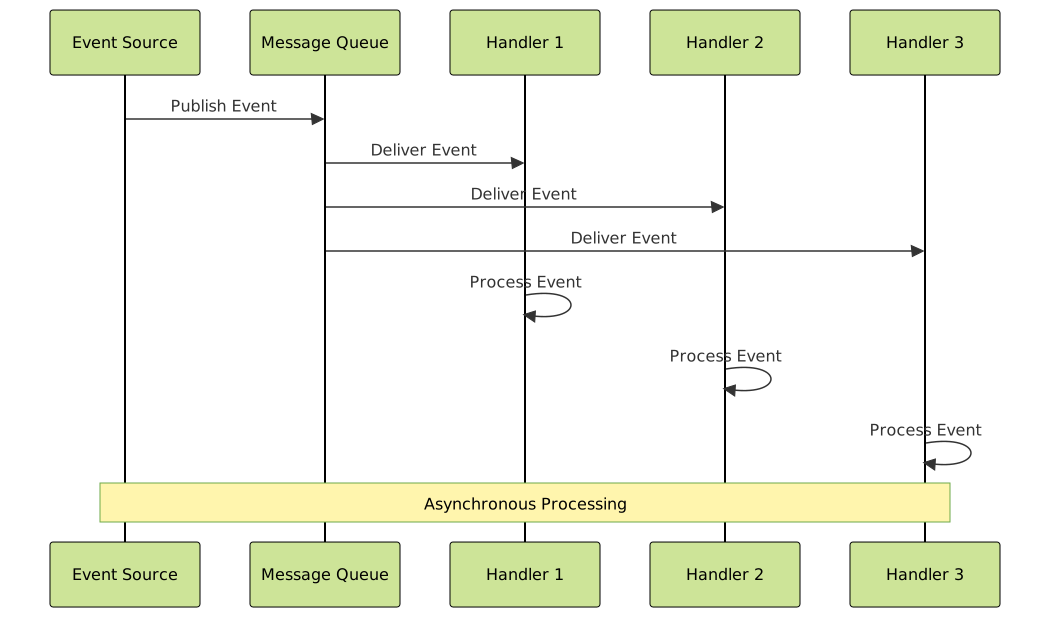
Event-Driven Architecture
Message queues enable event-driven architectures where system components react to events asynchronously.
Performance Considerations and Optimization
Queue Sizing and Memory Management
Proper queue configuration is crucial for optimal performance:
#include <mqueue.h>
#include <stdio.h>
#include <sys/resource.h>

void optimize_queue_settings() {
    struct mq_attr attr;
    struct rlimit rl;

    // Check system limits
    if (getrlimit(RLIMIT_MSGQUEUE, &rl) == 0) {
        printf("System message queue limits:\n");
        printf("Soft limit: %ld bytes\n", rl.rlim_cur);
        printf("Hard limit: %ld bytes\n", rl.rlim_max);
    }

    // Optimize queue attributes based on use case
    attr.mq_flags = 0;
    attr.mq_maxmsg = 100;        // Balance memory vs capacity
    attr.mq_msgsize = 1024;      // Match typical message size
    attr.mq_curmsgs = 0;

    // Calculate total memory usage
    long total_memory = attr.mq_maxmsg * attr.mq_msgsize;
    printf("Queue memory usage: %ld bytes\n", total_memory);

    // Create optimized queue
    mqd_t mq = mq_open("/optimized_queue", O_CREAT | O_RDWR, 0664, &attr);

    if (mq != (mqd_t) -1) {
        printf("Optimized queue created successfully\n");
        mq_close(mq);
        mq_unlink("/optimized_queue");
    }
}
Batch Processing for Higher Throughput
// Batch message processing for improved performance
void batch_processing_example() {
    mqd_t mq;
    char messages[10][256];  // Batch of 10 messages
    int batch_size = 10;

    mq = mq_open("/batch_queue", O_CREAT | O_RDWR, 0664, NULL);

    // Send messages in batch
    for (int i = 0; i < batch_size; i++) {
        snprintf(messages[i], 256, "Batch message %d", i + 1);
        mq_send(mq, messages[i], strlen(messages[i]), 0);
    }

    printf("Sent batch of %d messages\n", batch_size);

    // Receive and process in batch
    char buffer[256];
    int processed = 0;

    while (mq_receive(mq, buffer, 256, NULL) > 0 && processed < batch_size) {
        // Process message (simulate with print)
        printf("Processed: %s\n", buffer);
        processed++;
    }

    printf("Batch processing complete: %d messages\n", processed);

    mq_close(mq);
    mq_unlink("/batch_queue");
}
Error Handling and Debugging
Common Error Scenarios
#include <mqueue.h>
#include <errno.h>
#include <stdio.h>
#include <string.h>

void comprehensive_error_handling() {
    mqd_t mq;
    struct mq_attr attr;

    // Set queue attributes
    attr.mq_flags = 0;
    attr.mq_maxmsg = 10;
    attr.mq_msgsize = 1024;
    attr.mq_curmsgs = 0;

    // Attempt to open queue with error handling
    mq = mq_open("/error_test_queue", O_CREAT | O_RDWR, 0664, &attr);

    if (mq == (mqd_t) -1) {
        switch (errno) {
            case EACCES:
                printf("Error: Permission denied\n");
                break;
            case EEXIST:
                printf("Error: Queue already exists\n");
                break;
            case EMFILE:
                printf("Error: Too many open message queues\n");
                break;
            case ENOMEM:
                printf("Error: Insufficient memory\n");
                break;
            default:
                printf("Error: %s\n", strerror(errno));
        }
        return;
    }

    // Test message sending with error handling
    const char* test_message = "Error handling test";

    if (mq_send(mq, test_message, strlen(test_message), 0) == -1) {
        switch (errno) {
            case EAGAIN:
                printf("Error: Queue is full (non-blocking mode)\n");
                break;
            case EINVAL:
                printf("Error: Invalid message size or priority\n");
                break;
            case EMSGSIZE:
                printf("Error: Message too large\n");
                break;
            default:
                printf("Send error: %s\n", strerror(errno));
        }
    } else {
        printf("Message sent successfully with error handling\n");
    }

    mq_close(mq);
    mq_unlink("/error_test_queue");
}
Best Practices and Security Considerations
Security Guidelines
- Access Control: Set appropriate permissions using mode flags
- Input Validation: Always validate message content and size
- Resource Limits: Implement proper queue size limits
- Cleanup: Always close and unlink queues when done
// Secure message queue implementation
void secure_message_queue() {
    mqd_t mq;
    struct mq_attr attr;
    mode_t permissions = S_IRUSR | S_IWUSR | S_IRGRP;  // User RW, Group R

    attr.mq_flags = 0;
    attr.mq_maxmsg = 50;         // Reasonable limit
    attr.mq_msgsize = 512;       // Controlled message size
    attr.mq_curmsgs = 0;

    mq = mq_open("/secure_queue", O_CREAT | O_RDWR | O_EXCL, permissions, &attr);

    if (mq == (mqd_t) -1) {
        perror("Secure queue creation failed");
        return;
    }

    printf("Secure message queue created with restricted permissions\n");

    // Always cleanup
    mq_close(mq);
    mq_unlink("/secure_queue");
}
Monitoring and Debugging Tools
Queue Inspection
// Function to inspect queue status
void inspect_queue_status(const char* queue_name) {
    mqd_t mq;
    struct mq_attr attr;

    mq = mq_open(queue_name, O_RDONLY);

    if (mq == (mqd_t) -1) {
        perror("Failed to open queue for inspection");
        return;
    }

    if (mq_getattr(mq, &attr) == -1) {
        perror("Failed to get queue attributes");
        mq_close(mq);
        return;
    }

    printf("Queue Status for %s:\n", queue_name);
    printf("- Maximum messages: %ld\n", attr.mq_maxmsg);
    printf("- Maximum message size: %ld bytes\n", attr.mq_msgsize);
    printf("- Current messages: %ld\n", attr.mq_curmsgs);
    printf("- Queue flags: %ld\n", attr.mq_flags);

    // Calculate queue utilization
    double utilization = (double)attr.mq_curmsgs / attr.mq_maxmsg * 100;
    printf("- Queue utilization: %.1f%%\n", utilization);

    mq_close(mq);
}
Conclusion
Message queue systems provide a robust foundation for asynchronous communication in operating systems. They offer numerous advantages including decoupling of processes, built-in buffering, and reliable message delivery. Understanding the different types of message queues, their implementation patterns, and best practices is essential for building scalable and efficient system architectures.
Whether you’re implementing a simple producer-consumer pattern or building complex event-driven systems, message queues provide the reliability and flexibility needed for modern applications. By following proper error handling, security practices, and performance optimization techniques, you can leverage message queues to create robust inter-process communication solutions.
The choice between POSIX and System V message queues depends on your specific requirements, with POSIX queues offering modern features like priority messaging and better portability, while System V queues provide traditional Unix compatibility and message type filtering capabilities.
- What are Message Queue Systems?
- Types of Message Queue Systems
- Message Queue Implementation Architecture
- Advanced Message Queue Features
- Message Queue vs Other IPC Mechanisms
- Practical Applications and Use Cases
- Performance Considerations and Optimization
- Error Handling and Debugging
- Best Practices and Security Considerations
- Monitoring and Debugging Tools
- Conclusion