The Maximum Subarray Sum problem is a fundamental algorithmic challenge that often appears in computer science education and technical interviews. The problem requires us to find the contiguous subarray within a one-dimensional numeric array that has the largest sum. While several approaches exist, one elegant method is the Divide and Conquer approach, which breaks the problem into smaller parts and assembles the solution efficiently.
Understanding the Problem
Given an array of integers (which may include negative numbers), the task is to identify the subarray that maximizes the sum. For example:
Input: [-2, 1, -3, 4, -1, 2, 1, -5, 4]
Output: 6
Explanation: The subarray [4, -1, 2, 1] has the largest sum = 6.
This problem is closely tied to optimization and recurrence strategies, making it a perfect candidate for divide and conquer methodology.
Divide and Conquer Approach
The divide and conquer technique works by splitting the array into two halves and considering three possible cases for the maximum subarray:
- The maximum subarray lies entirely in the left half.
- The maximum subarray lies entirely in the right half.
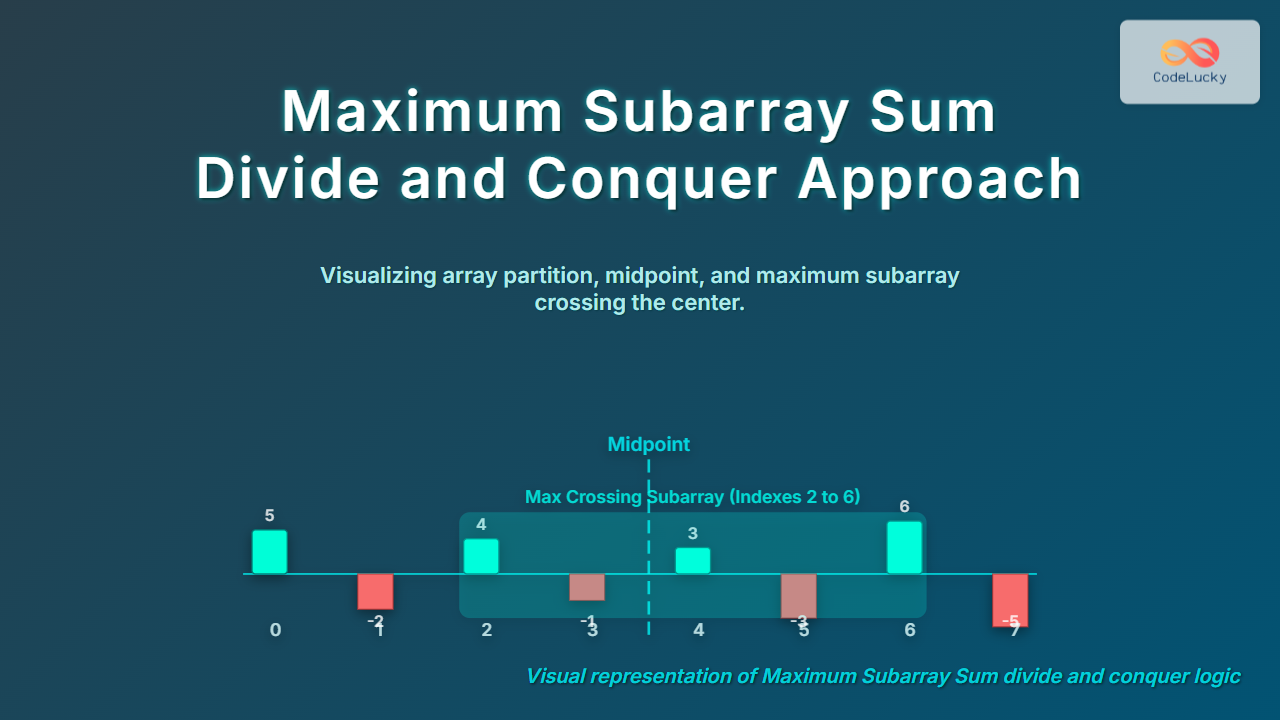
- The maximum subarray crosses the midpoint of the array.
By solving these recursively and combining results, we can compute the maximum subarray sum efficiently.

Recurrence Relation
If T(n) represents the time complexity for an array of size n:
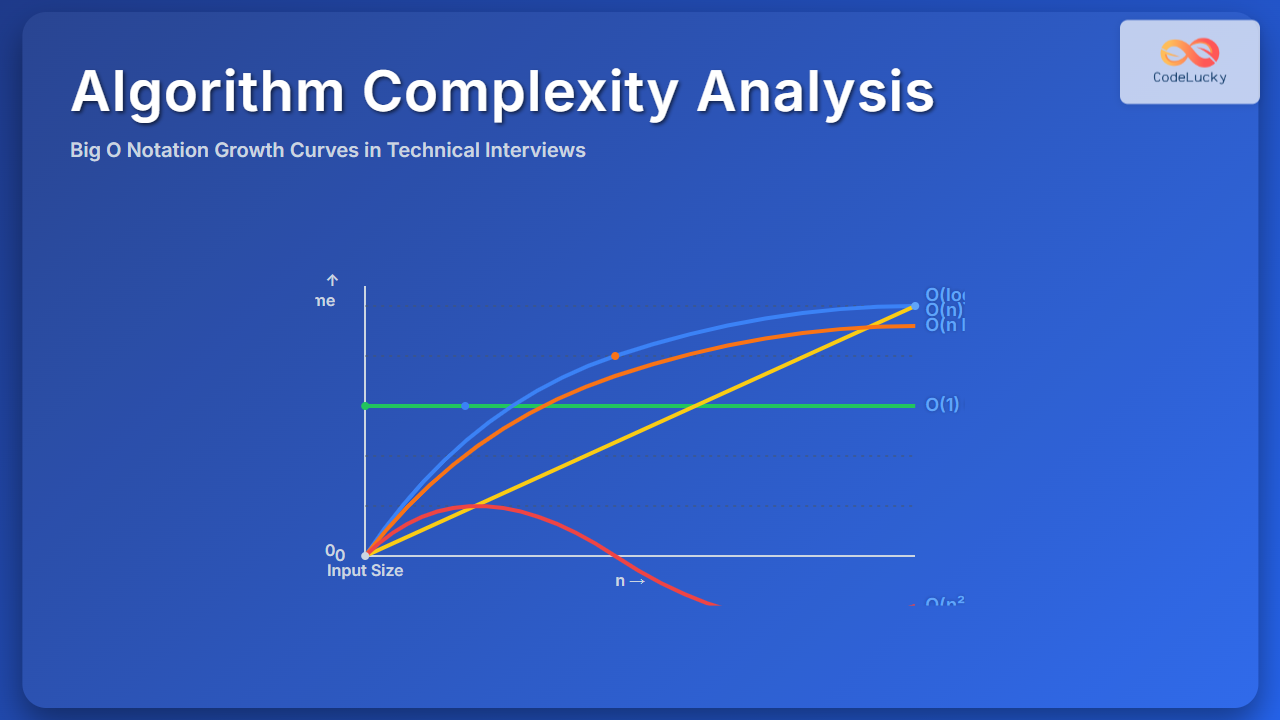
T(n) = 2T(n/2) + O(n)Here, O(n) comes from calculating the crossing subarray in linear time. Solving this recurrence using the Master Theorem gives T(n) = O(n log n).
Python Implementation
def max_crossing_sum(arr, left, mid, right):
    left_sum = float('-inf')
    total = 0
    for i in range(mid, left - 1, -1):
        total += arr[i]
        left_sum = max(left_sum, total)

    right_sum = float('-inf')
    total = 0
    for i in range(mid + 1, right + 1):
        total += arr[i]
        right_sum = max(right_sum, total)

    return left_sum + right_sum

def max_subarray_sum(arr, left, right):
    if left == right:
        return arr[left]

    mid = (left + right) // 2

    return max(
        max_subarray_sum(arr, left, mid),
        max_subarray_sum(arr, mid + 1, right),
        max_crossing_sum(arr, left, mid, right)
    )

# Example usage
arr = [-2, 1, -3, 4, -1, 2, 1, -5, 4]
print("Maximum Subarray Sum is:", max_subarray_sum(arr, 0, len(arr) - 1))
Step-by-Step Example
Consider the array: [2, -1, 3, -4, 5, 2, -6, 3]

By recursively solving the left and right halves and comparing with the crossing subarray, we arrive at the global maximum subarray sum.
Visualizing the Crossing Subarray

Complexity Analysis
- Time Complexity: O(n log n), from splitting and merging results recursively.
- Space Complexity: O(log n), due to recursive call stack depth.
Advantages of Divide and Conquer Method
- Simplifies the problem into smaller manageable parts.
- Efficiently combines results from subproblems.
- Solid foundation for understanding advanced techniques like Kadane’s Algorithm (O(n) solution).
Interactive Exploration
As an exercise, try modifying the array values and observe how the maximum subarray shifts. Mark down the recursive calls made and visualize how the maximum crossing sum is combined. This will deepen your understanding of divide and conquer strategies.
Conclusion
The Maximum Subarray Sum problem using Divide and Conquer is a classical illustration of recursive problem-solving. Although Kadane’s algorithm provides a linear-time optimal solution, the divide and conquer method is invaluable for learning recursion, recurrence relations, and algorithm design principles.