In Python programming, understanding the maximum and minimum values for integers (ints) is fundamental to writing robust code, especially when dealing with numeric computations, data validation, or interfacing with systems requiring fixed integer ranges. Unlike some languages, Python handles integers differently, making it essential for every Python developer to master these concepts fully.
How Python Handles Integers
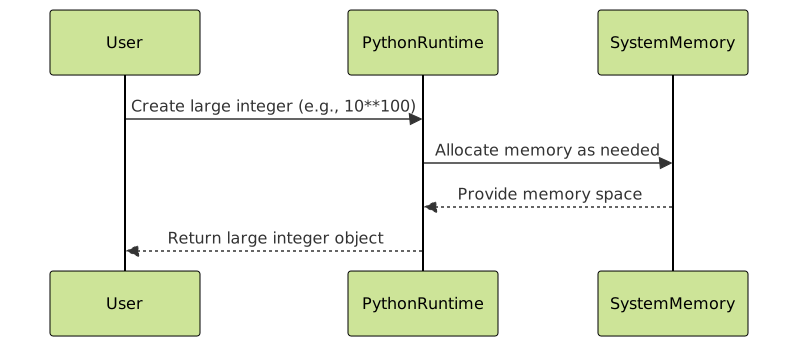
Python’s int type is unbounded, meaning it can grow arbitrarily large until the available memory is exhausted. This differs from many programming languages like C, Java, or C# that enforce fixed sizes (e.g., 32-bit or 64-bit) for integers, resulting in maximum and minimum value limits.
Because of this, Python’s handling of ints allows developers to work with very large numbers without overflow errors seen in fixed-width integer types.

Maximum and Minimum Values in Practice
While Python itself imposes no explicit limit on int, there are practical and implementation-based constraints to consider:
- Memory Limitations: The maximum size of an int is limited by the available memory of the system.
- Performance Implications: Very large integers take more time and memory for operations.
Example: Working with Very Large Integers
big_num = 10**100    # A googol
print(big_num)
print(type(big_num))
Output:
10000000000000000000000000000000000000000000000000000000000000000000000000000000000000000000000000000
<class 'int'>
Fixed-size Integers with the sys Module
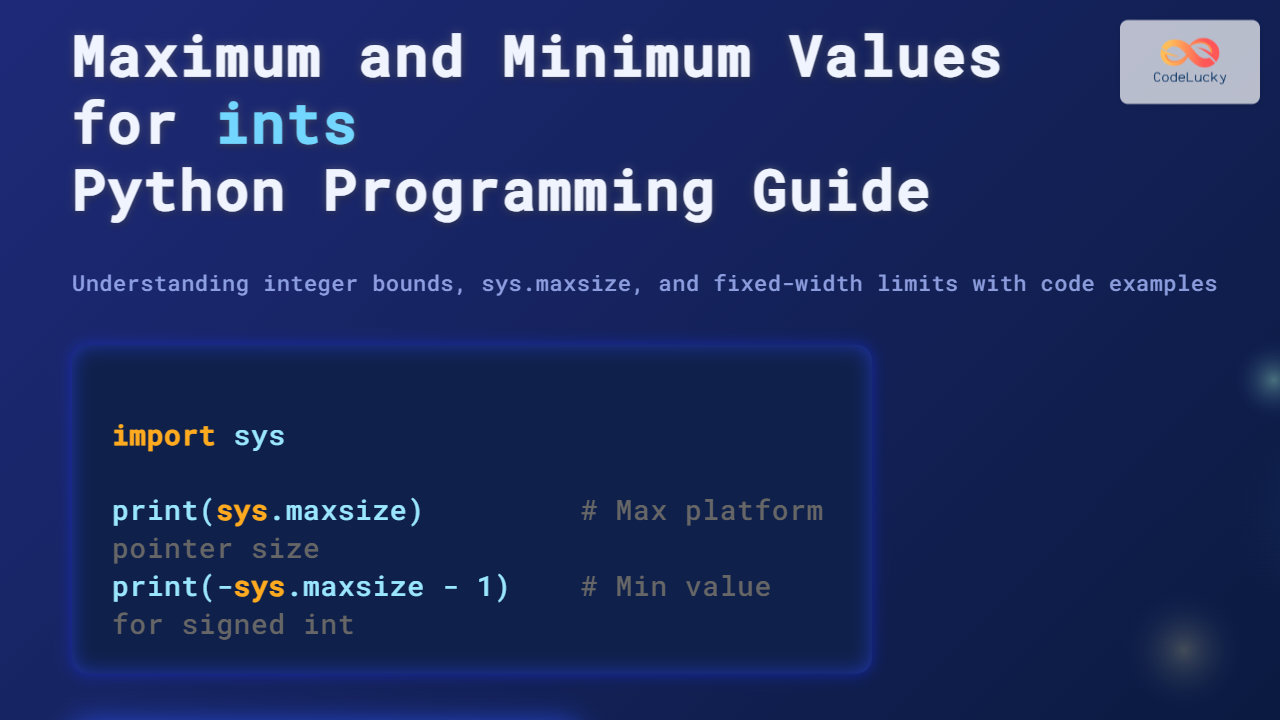
For compatibility or interfacing with C, developers often need to know the limits of fixed-width integers. Python’s sys module offers sys.maxsize which provides the platform’s pointer size limit for indexing and certain numeric operations.
import sys

print(sys.maxsize)         # Typical maximum value for a platform pointer
print(-sys.maxsize - 1)    # Minimum value for signed platform pointer
Output on 64-bit systems is typically:
9223372036854775807
-9223372036854775808
Note that this is not the maximum integer value Python can handle but rather an indicative limit closely tied to platform C pointer sizes or array indexing limits.

Using ctypes for C-style Fixed-width Int Limits
If exact fixed-width integers are needed, the ctypes module allows defining integers with specific bit widths, reflecting real min/max values.
import ctypes

print(ctypes.c_int32(-2147483648).value)   # Min for 32-bit signed int
print(ctypes.c_int32(2147483647).value)    # Max for 32-bit signed int
Output:
-2147483648
2147483647
Summary Table: Integer Limits in Python Context
| Type | Description | Min Value | Max Value |
|---|---|---|---|
| Python int (unbounded) | Arbitrarily large, limited by memory | – | – |
| sys.maxsize | Platform pointer size (typically 64-bit) | -9223372036854775808 | 9223372036854775807 |
| ctypes.c_int32 | 32-bit signed C int equivalent | -2147483648 | 2147483647 |
Interactive Example: Check Int Limits
This Python snippet checks platform integer limits dynamically:
import sys

def print_limits():
    print(f"sys.maxsize: {sys.maxsize}")
    print(f"Minimum (–sys.maxsize – 1): {-sys.maxsize - 1}")

print_limits()
When to Care About Int Limits
- Interfacing with C or hardware: Fixed-width integers are necessary for memory-mapped I/O or protocol implementation.
- Data serialization & databases: Often require bounded integer values consistent with fixed-size types.
- Performance tuning: Large ints use more memory and computing time.
Conclusion
Python’s int type is uniquely flexible with no fixed maximum or minimum values, making it powerful for large number calculations. However, when working with system limitations, interfacing with external libraries, or optimizing, understanding fixed-width integer limits using sys.maxsize and ctypes is crucial.
This guide offers clarity on these nuances with practical code examples and visualizations to help Python developers handle integers confidently and correctly.