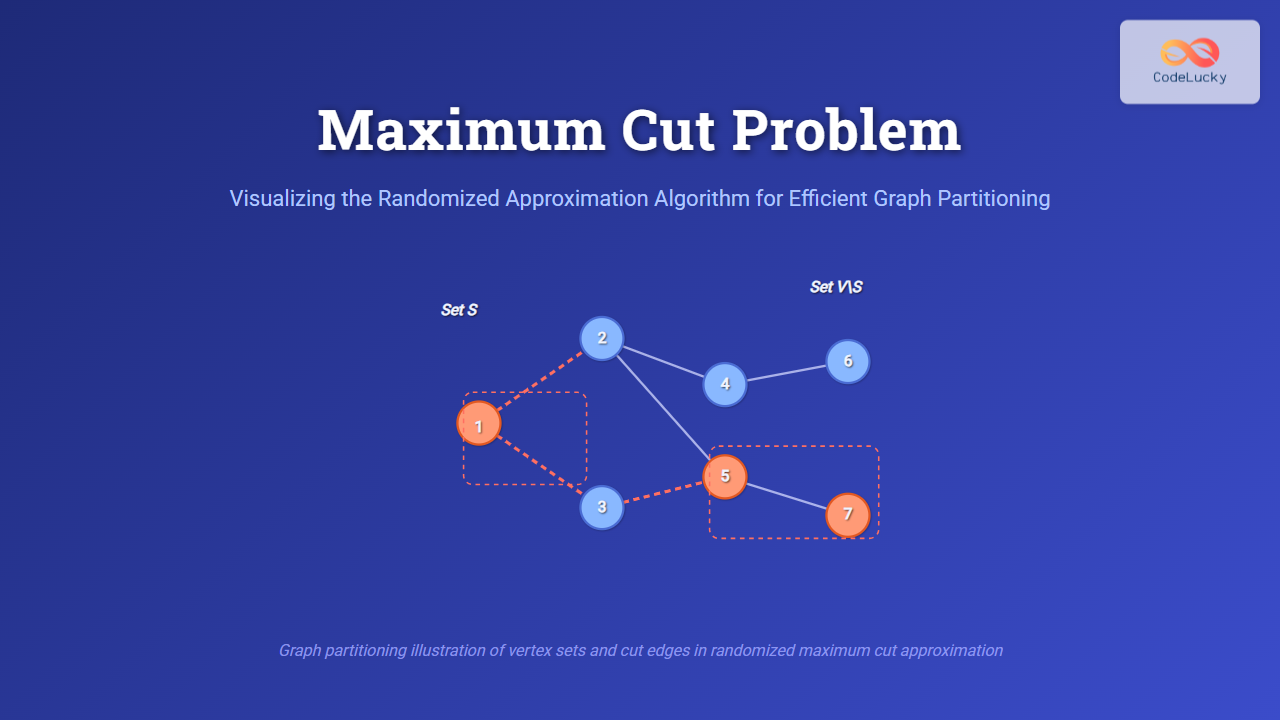
The Maximum Cut Problem is a fundamental challenge in computer science and combinatorial optimization. It involves partitioning the vertices of a graph into two sets to maximize the weight (or number) of edges crossing between the sets. Unfortunately, the problem is NP-hard, meaning no known algorithm can solve all instances exactly in polynomial time. To address this, randomized approximation algorithms offer efficient ways to find solutions that are close to the maximum cut with provable guarantees.
This article provides a detailed exploration of the Maximum Cut Problem along with an explanation of a popular randomized approximation algorithm. It includes examples, code snippets, and visualizations using Mermaid diagrams to clarify concepts for readers at all levels.
What is the Maximum Cut Problem?
Given an undirected graph G = (V, E), where V is the set of vertices and E is the set of edges (with optional weights), the Maximum Cut problem asks to split the vertices into two disjoint subsets S and V \ S such that the sum of weights of edges crossing between these subsets is maximized.
Formally, the objective is to find S ⊆ V that maximizes:
Cut(S, V \ S) = ∑(u,v) ∈ E w(u,v) where u ∈ S, v ∈ V \ S
Here, w(u,v) represents the weight of edge (u,v), or simply 1 if the graph is unweighted.

Why is Maximum Cut Hard?
The Maximum Cut problem is classified as NP-hard, meaning no efficient algorithm is known for solving it optimally on large graphs within polynomial time. This complexity motivates the use of approximation algorithms that provide near-optimal solutions efficiently.
Randomized Approximation Algorithm for Maximum Cut
A simple yet powerful approach is a randomized algorithm that assigns each vertex independently to one of the two sets with equal probability (50%). This random partitioning creates a cut, and surprisingly, the expected value of this cut is at least half of the maximum possible cut.
Algorithm steps:
- For each vertex in the graph, randomly assign it to set S or V \ S.
- Compute the edges crossing between the two sets.
- Return the partition as the approximate maximum cut.
This algorithm guarantees an expected cut value ≥ 1/2 the optimal maximum cut.

Example: Randomized Maximum Cut on a Sample Graph
Consider the following small graph with 5 vertices and edges:

Applying the randomized approximation:
- Assign vertices randomly: e.g., {1,4} in set S, and {2,3,5} in V \ S.
- Edges crossing between sets: (1,2), (1,3), (4,2), (4,5).
- Count edges crossing: 4 out of total 6 edges.
This cut value (4) is close to the maximum possible cut in this graph (which is 5). The randomized method thus provides a good approximate solution quickly.
Interactive JavaScript Example
Below is a simple interactive demonstration where vertices are randomly assigned upon clicking the button, simulating the randomized cut:
Performance and Guarantees
The randomized approximation algorithm offers a 1/2-approximation ratio, meaning its expected cut weight is at least 50% of the optimal maximum cut value.
This performance is efficient and easy to implement compared to other advanced algorithms like the Goemans-Williamson semidefinite programming method, which achieves approximately 0.878 approximation but is more complex.
Summary
The Maximum Cut Problem is a pivotal problem in graph theory and combinatorial optimization, known for its computational complexity. Randomized approximation algorithms provide an elegant and practical approach to find near-optimal solutions quickly with theoretical guarantees. Through the randomized vertex assignment method, one can expect to find a cut whose weight is at least half of the optimal solution.
By combining simple implementation with theoretical rigor and interactive examples, this approach makes the Maximum Cut problem approachable for learning and practical applications alike.