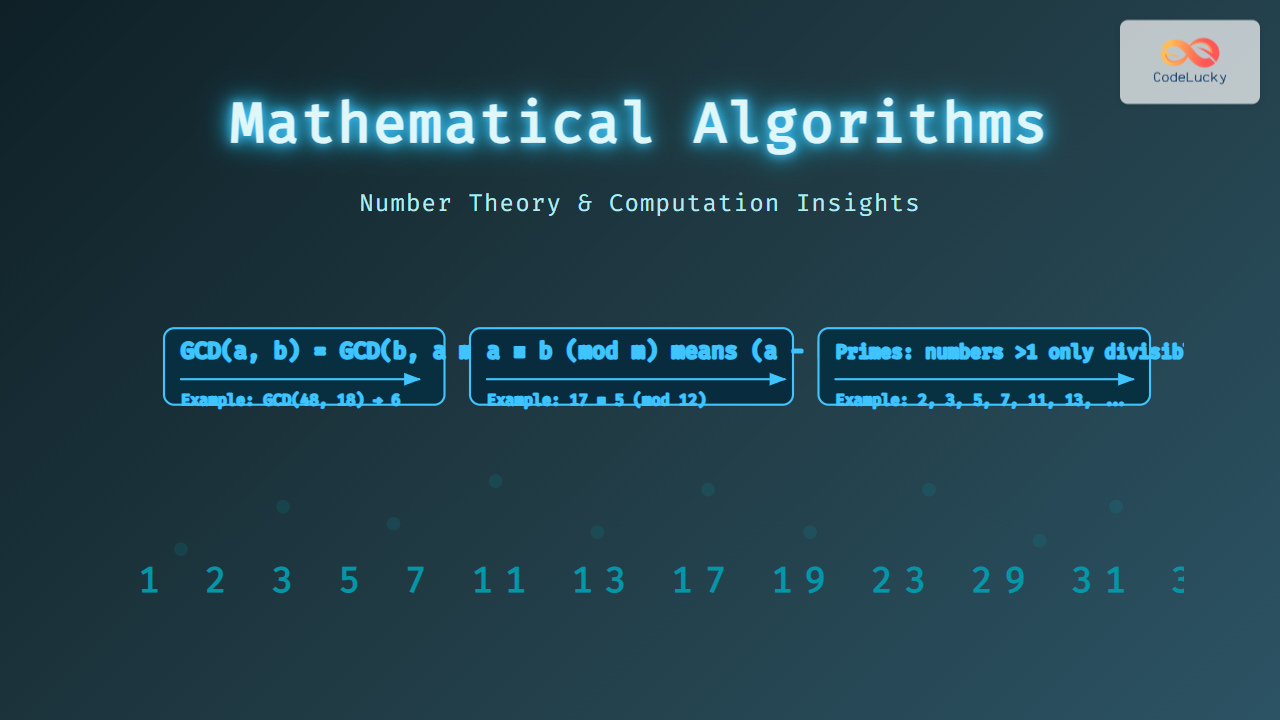
Mathematical algorithms form the backbone of many computational processes in computer science. Among these, number theory and associated computational algorithms represent essential pillars supporting fields as varied as cryptography, error detection, and algorithm design. This article covers foundational mathematical algorithms in number theory, illustrating their computation with clear examples and visual aids to deepen understanding. Whether for beginners or seasoned developers, this comprehensive guide enhances knowledge on the theory and practical implementation of number-theoretic algorithms.
Introduction to Mathematical Algorithms in Number Theory
Number theory is a branch of pure mathematics devoted to the study of integers and their properties. Its algorithms aid in solving problems related to divisibility, primes, congruences, and factorization. Key computational aspects include:
- Prime number detection and generation
- Greatest common divisor (GCD) calculations
- Modular arithmetic and inverse computations
- Integer factorization methods
- Cryptographic primitives
Understanding these algorithms enables the development of efficient computer programs that depend on numerical rigor.
Greatest Common Divisor (GCD) Algorithms
The GCD of two integers is the largest number dividing both without a remainder. The classic method for computing GCD is the Euclidean Algorithm, known for its efficiency and elegance.

Example: Calculate \(\mathrm{GCD}(48, 18)\).
function gcd(a, b) {
  while (b != 0) {
    let r = a % b;
    a = b;
    b = r;
  }
  return a;
}

// gcd(48, 18) => 6
Prime Number Algorithms
Detecting prime numbers is fundamental in number theory. The simplest is the Trial Division, checking divisibility up to \(\sqrt{n}\). For large-scale prime generation, the Sieve of Eratosthenes is preferred for its efficiency.

Example: Generate primes up to 30 using the Sieve of Eratosthenes.
function sieve(n) {
  let primes = Array(n + 1).fill(true);
  primes[0] = primes[1] = false;
  for (let p = 2; p * p <= n; p++) {
    if (primes[p]) {
      for (let i = p * p; i <= n; i += p) primes[i] = false;
    }
  }
  return primes.reduce((acc, val, idx) => val ? acc.concat(idx) : acc, []);
}

// sieve(30) => [2, 3, 5, 7, 11, 13, 17, 19, 23, 29]
Modular Arithmetic and Modular Inverse
Modular arithmetic handles computations within a set range using the modulus operator. A key operation is finding the modular inverse, often required in cryptography.
The Extended Euclidean Algorithm computes the modular inverse of \(a \pmod{m}\) when \(\gcd(a, m) = 1\).
Example: Find modular inverse of 3 mod 11.
function extendedGCD(a, b) {
  if (b == 0) return [a, 1, 0];
  let [g, x1, y1] = extendedGCD(b, a % b);
  let x = y1;
  let y = x1 - Math.floor(a / b) * y1;
  return [g, x, y];
}

function modInverse(a, m) {
  let [g, x] = extendedGCD(a, m);
  if (g != 1) return null; // No inverse
  return (x % m + m) % m;
}

// modInverse(3, 11) => 4
Integer Factorization Algorithms
Factorizing large integers into primes is a difficult problem fundamental to cryptography. Simple methods attempt trial division, but more advanced approaches include Pollard’s Rho algorithm for efficiency.
Pollard’s Rho Algorithm uses a pseudo-random sequence and the GCD test to find a divisor.
Interactive Algorithm Insight: Euclidean Algorithm Step-by-Step
The following snippet demonstrates the Euclidean Algorithm interactively using console output. It clarifies each division step showing the evolving pairs until the GCD is found.
function interactiveGCD(a, b) {
  console.log(`Computing GCD of ${a} and ${b}`);
  while (b != 0) {
    console.log(`${a} = ${b} * ${Math.floor(a/b)} + ${a % b}`);
    let r = a % b;
    a = b;
    b = r;
  }
  console.log(`GCD is ${a}`);
  return a;
}

// Run interactiveGCD(48, 18) in browser console for stepwise output
Conclusion
Mathematical algorithms rooted in number theory underpin many computational applications and security systems. From GCD computations to prime sieving and modular inverses, mastering these algorithms equips programmers with essential tools for solving real-world mathematical problems efficiently.
Integrating visual diagrams and interactive code amplifies comprehension of these sometimes complex algorithmic processes, making this knowledge accessible and practical.