Introduction to Lottery Scheduling
Lottery scheduling is a probabilistic CPU scheduling algorithm that provides proportional share resource allocation by assigning tickets to processes. Unlike traditional scheduling algorithms that rely on priority queues or time slices, lottery scheduling uses a randomized approach where each process receives CPU time proportional to the number of tickets it holds.
This innovative scheduling mechanism ensures fair resource distribution while maintaining system responsiveness and preventing starvation. The algorithm’s probabilistic nature makes it particularly effective for systems requiring guaranteed resource shares and flexible priority management.
Core Concepts and Principles
Ticket-Based Resource Allocation
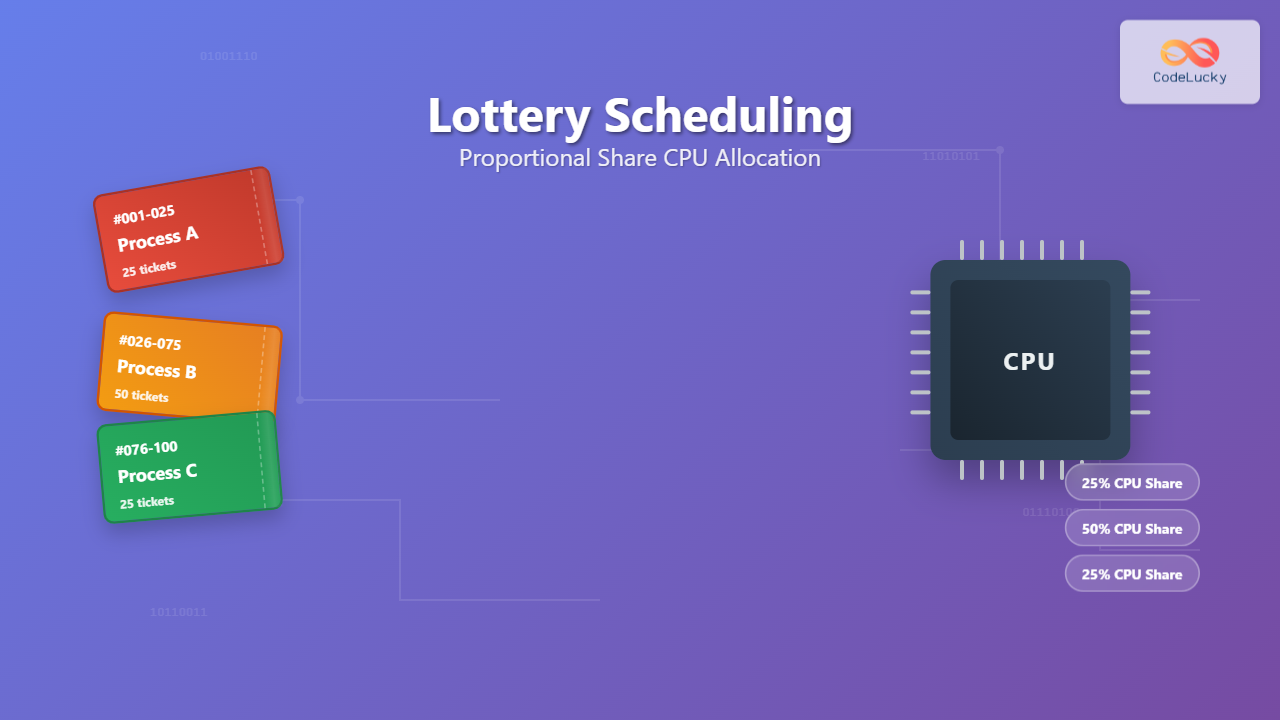
In lottery scheduling, the system allocates a certain number of tickets to each process based on its resource requirements or priority level. The total number of tickets represents the entire CPU capacity, and each process’s share is determined by the ratio of its tickets to the total tickets in the system.

Lottery Drawing Mechanism
The scheduler conducts a lottery drawing at each scheduling decision point by generating a random number between 1 and the total number of outstanding tickets. The process holding the ticket corresponding to this random number wins the lottery and receives CPU time.
Algorithm Implementation
Basic Lottery Scheduling Steps
- Ticket Assignment: Assign tickets to each process based on priority or resource requirements
- Random Number Generation: Generate a random number between 1 and total tickets
- Winner Selection: Identify the process holding the winning ticket
- Context Switch: Switch to the winning process and allocate CPU time
- Repeat Process: Continue the lottery for subsequent scheduling decisions
Pseudocode Implementation
function lottery_schedule():
    total_tickets = sum(all_process_tickets)
    winning_ticket = random(1, total_tickets)

    current_sum = 0
    for each process in ready_queue:
        current_sum += process.tickets
        if current_sum >= winning_ticket:
            return process

    return null  // Should never reach here
Practical Examples
Example 1: Basic Three-Process System
Consider a system with three processes where tickets are distributed as follows:
| Process | Tickets | Expected CPU Share | Ticket Range |
|---|---|---|---|
| Process A | 10 | 25% | 1-10 |
| Process B | 20 | 50% | 11-30 |
| Process C | 10 | 25% | 31-40 |
| Total | 40 | 100% | 1-40 |
Sample Lottery Drawings
Let’s simulate five consecutive lottery drawings:
- Drawing 1: Random number = 15 → Process B wins (tickets 11-30)
- Drawing 2: Random number = 5 → Process A wins (tickets 1-10)
- Drawing 3: Random number = 35 → Process C wins (tickets 31-40)
- Drawing 4: Random number = 22 → Process B wins (tickets 11-30)
- Drawing 5: Random number = 8 → Process A wins (tickets 1-10)

Example 2: Dynamic Ticket Adjustment
Lottery scheduling supports dynamic ticket redistribution during runtime. When a process completes or changes priority, tickets can be reallocated:
// Initial state
Process A: 100 tickets (33.3%)
Process B: 100 tickets (33.3%)
Process C: 100 tickets (33.3%)
Total: 300 tickets

// After Process C terminates
Process A: 100 tickets (50%)
Process B: 100 tickets (50%)
Total: 200 tickets

// After increasing Process A priority
Process A: 150 tickets (60%)
Process B: 100 tickets (40%)
Total: 250 tickets
Advanced Features and Variations
Ticket Transfers
Processes can transfer tickets to other processes, enabling sophisticated resource sharing mechanisms. This feature is particularly useful for client-server applications where a server process can temporarily donate tickets to handle client requests.

Ticket Inflation and Deflation
Trusted processes can perform ticket inflation by creating additional tickets for themselves, while ticket deflation destroys tickets to reduce a process’s share. These mechanisms require careful access control to prevent abuse.
Compensation Tickets
When a process doesn’t fully utilize its allocated time slice, the system can award compensation tickets to ensure the process receives its fair share over time. This mechanism helps maintain proportional sharing accuracy despite variable process behavior.
Implementation Considerations
Random Number Generation
The quality of random number generation significantly impacts lottery scheduling effectiveness. Poor randomness can lead to unfair CPU distribution and process starvation. Most implementations use high-quality pseudorandom number generators with sufficient entropy.
Ticket Granularity
The total number of tickets affects scheduling granularity. More tickets provide finer control over resource allocation but increase computational overhead. A common approach uses 1000-10000 total tickets to balance precision and performance.
Time Slice Management
Lottery scheduling typically combines with time slicing to prevent processes from monopolizing the CPU. When a process wins the lottery, it receives a fixed time quantum rather than unlimited CPU access.

Advantages and Benefits
Proportional Fairness
Lottery scheduling provides mathematically guaranteed proportional shares over time. Each process receives CPU time proportional to its ticket allocation, ensuring predictable resource distribution.
Starvation Prevention
Unlike priority-based scheduling, lottery scheduling eliminates starvation risk. Every process with at least one ticket has a non-zero probability of winning the lottery, guaranteeing eventual CPU access.
Simplicity and Flexibility
The algorithm’s conceptual simplicity makes it easy to implement and understand. Dynamic ticket adjustment enables flexible priority management without complex priority inheritance mechanisms.
Load Balancing
In multiprocessor systems, lottery scheduling naturally distributes processes across available CPUs, providing automatic load balancing without additional algorithms.
Disadvantages and Limitations
Short-term Unfairness
Due to its probabilistic nature, lottery scheduling may exhibit short-term unfairness where some processes receive more or less CPU time than expected in brief periods. This variance decreases over longer time intervals.
Random Number Generation Overhead
Frequent random number generation introduces computational overhead, particularly in systems with high scheduling frequency. This cost may outweigh benefits in some scenarios.
Ticket Management Complexity
Dynamic ticket allocation requires careful management to prevent ticket inflation attacks and ensure system security. Improper ticket distribution can lead to resource monopolization.
Performance Analysis
Response Time Characteristics
Lottery scheduling provides good average response times but may exhibit higher variance compared to deterministic algorithms. The expected response time for a process depends on its ticket share and system load.
Throughput Considerations
System throughput remains comparable to traditional scheduling algorithms while providing better fairness guarantees. The probabilistic nature doesn’t significantly impact overall system performance.

Real-world Applications
Virtual Machine Resource Management
Cloud computing platforms use lottery scheduling variants to allocate CPU resources among virtual machines, ensuring customers receive their purchased resource shares.
Network Bandwidth Allocation
Network quality of service (QoS) systems employ lottery-based algorithms to fairly distribute bandwidth among different traffic classes and users.
Database Query Processing
Database management systems use proportional share scheduling to balance resources between different types of queries and user sessions.
Comparison with Other Scheduling Algorithms
| Algorithm | Fairness | Complexity | Starvation Risk | Real-time Support |
|---|---|---|---|---|
| Lottery Scheduling | Excellent | Low | None | Limited |
| Round Robin | Good | Very Low | None | Poor |
| Priority Scheduling | Poor | Medium | High | Excellent |
| Completely Fair Scheduler | Excellent | High | None | Good |
Implementation Best Practices
Ticket Distribution Strategies
- Static Assignment: Allocate tickets based on process type or user privileges
- Dynamic Adjustment: Modify tickets based on system load and process behavior
- Adaptive Distribution: Use machine learning to optimize ticket allocation over time
Security Considerations
Implement proper access controls for ticket operations to prevent malicious processes from monopolizing system resources through unauthorized ticket manipulation.
Integration with Existing Systems
When integrating lottery scheduling into existing systems, consider compatibility with current process management infrastructure and gradual migration strategies.
Conclusion
Lottery scheduling represents an elegant solution to proportional share CPU allocation, combining mathematical fairness guarantees with implementation simplicity. While it may not be suitable for all scenarios, particularly hard real-time systems, its probabilistic approach offers unique advantages for fair resource distribution.
The algorithm’s strength lies in its ability to provide guaranteed proportional sharing while preventing starvation and maintaining flexibility through dynamic ticket management. Understanding lottery scheduling concepts is essential for system designers working with fair resource allocation requirements.
As computing systems become increasingly complex and resource sharing becomes more critical, lottery scheduling and its variants continue to find applications in cloud computing, virtualization, and distributed systems where fair resource allocation is paramount.
Related Posts
Fair Share Scheduling: Resource Allocation by User Groups in Operating Systems
Introduction to Fair Share Scheduling Fair Share Scheduling (FSS) is a sophisticated CPU scheduling algorithm designed to allocate computing resources...
Multilevel Queue Scheduling: Multiple Priority Levels in Operating Systems
Introduction to Multilevel Queue Scheduling Multilevel queue scheduling is a sophisticated CPU scheduling algorithm used in operating systems to manage...
Process Scheduling in Operating System: Algorithms, Types & Implementation Guide
Process scheduling is one of the most critical components of an operating system that determines how the CPU time is...
Priority Scheduling Algorithm: Complete Implementation Guide with Examples
What is Priority Scheduling Algorithm? Priority scheduling is a CPU scheduling algorithm where each process is assigned a priority value,...
Virtual CPU Scheduling: Complete Guide to Time-sharing Physical Processors
Virtual CPU scheduling is the cornerstone of modern operating systems, enabling multiple processes to share limited physical processors efficiently. This...
CPU Scheduling Algorithms: FCFS, SJF, Round Robin Complete Guide
CPU scheduling is a fundamental concept in operating systems that determines how processes are allocated processor time. The CPU scheduler...
Completely Fair Scheduler: Linux CFS Algorithm Deep Dive
The Linux Completely Fair Scheduler (CFS) revolutionized process scheduling in the Linux kernel when it was introduced in version 2.6.23....
Lamport’s Bakery Algorithm: Complete Guide to N-Process Mutual Exclusion
Lamport's Bakery Algorithm stands as one of the most elegant solutions to the N-process mutual exclusion problem in concurrent programming....

Shortest Job First Scheduling: SJF Algorithm Explained with Examples and Implementation
What is Shortest Job First (SJF) Scheduling? Shortest Job First (SJF) scheduling is a CPU scheduling algorithm that selects the...
Preemptive vs Non-Preemptive Scheduling: Complete Guide to CPU Scheduling in Operating Systems
Understanding CPU Scheduling in Operating Systems CPU scheduling is one of the most critical functions of an operating system, determining...
Thread in Operating System: Lightweight Processes and Multithreading Explained
What are Threads in Operating Systems? A thread is the smallest unit of execution within a process that can be...
Nice Command Linux: Complete Guide to Process Priority Management
The nice command in Linux is a powerful system administration tool that allows you to control the priority of processes,...