The Longest Repeated Substring problem is a classical problem in computer science and string algorithms. It focuses on finding the longest substring that occurs at least twice in a given string. These occurrences may overlap but must appear more than once. Practical applications of this problem can be found in text compression, plagiarism detection, DNA sequence analysis, and data mining.
What is the Longest Repeated Substring?
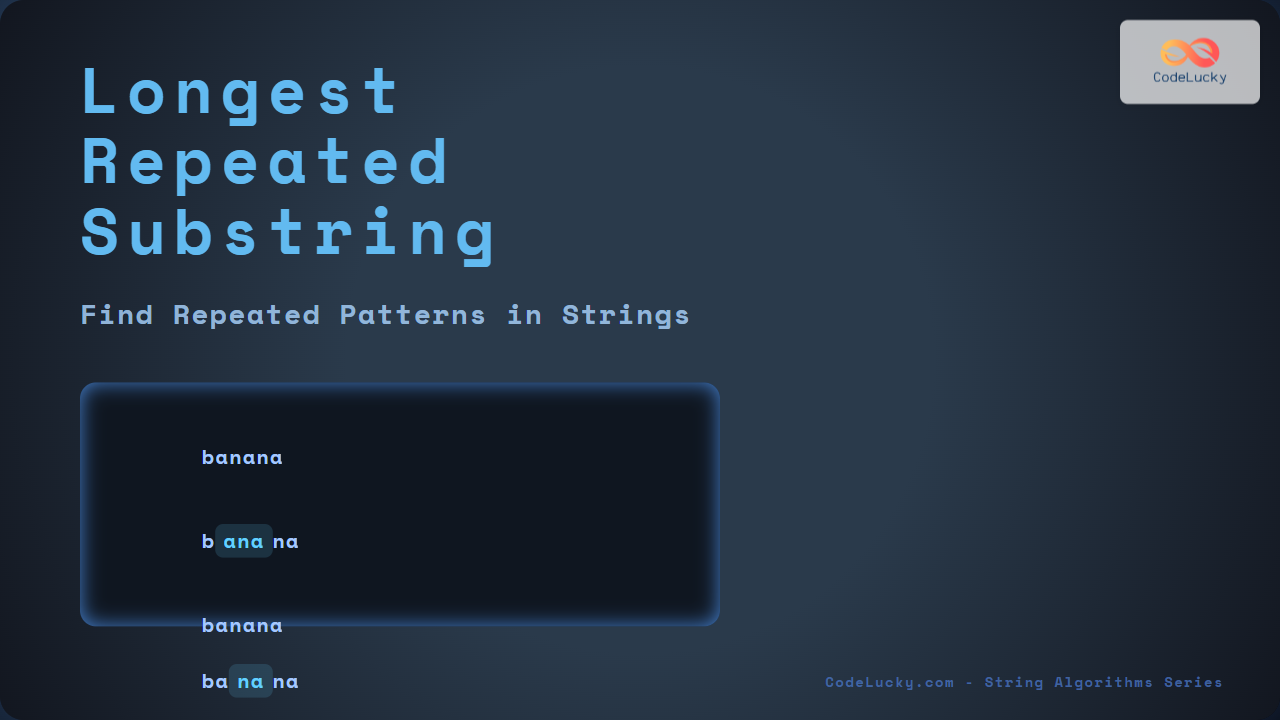
Given a string S, the task is to find the longest substring that appears multiple times in S. For example:
S = "banana"
Longest Repeated Substring = "ana"
Here, "ana" occurs twice in "banana": once at index 1 and once at index 3.
Why is this Problem Important?
- Data Compression: Detect repeating patterns to reduce redundancy.
- Bioinformatics: Analyze DNA sequences for repeated molecular structures.
- Plagiarism Detection: Identify recurring blocks of text across documents.
- Search Optimization: Improve search engines by preprocessing string data with suffix structures.
Approaches to Solve the Problem
There are multiple approaches to finding the longest repeated substring, each with different time and space complexities.
1. Brute Force Approach
Check every possible substring of S and count its occurrences. While conceptually simple, this approach is inefficient with a time complexity of O(n³) due to substring generation and repeated scanning.
2. Suffix Array Method
The most efficient way to solve this problem uses a suffix array combined with the Longest Common Prefix (LCP) array. The idea is:
- Construct all suffixes of the string.
- Sort them lexicographically into a suffix array.
- Compute the LCP array, which stores the length of the longest prefix between two adjacent suffixes.
- The maximum value in LCP reveals the length of the longest repeated substring.
3. Suffix Tree Method
A suffix tree stores all suffixes of a string in a compressed trie. The longest internal node with the deepest path that has at least two leaf nodes corresponds to the longest repeated substring. Building suffix trees can be done in O(n) time with Ukkonen’s algorithm.
This visual demonstrates overlapping suffixes branching into shared paths, where repeated substrings are the common prefixes of multiple suffixes.
Python Implementation Using Suffix Array
def build_suffix_array(s):
    n = len(s)
    suffixes = [(s[i:], i) for i in range(n)]
    suffixes.sort()
    suffix_array = [suffix[1] for suffix in suffixes]
    return suffix_array

def build_lcp_array(s, suffix_array):
    n = len(s)
    lcp = [0] * n
    rank = [0] * n
    for i in range(n):
        rank[suffix_array[i]] = i
    k = 0
    for i in range(n):
        if rank[i] == n - 1:
            k = 0
            continue
        j = suffix_array[rank[i] + 1]
        while i + k < n and j + k < n and s[i+k] == s[j+k]:
            k += 1
        lcp[rank[i]] = k
        if k > 0:
            k -= 1
    return lcp

def longest_repeated_substring(s):
    suffix_array = build_suffix_array(s)
    lcp = build_lcp_array(s, suffix_array)
    max_len = max(lcp)
    if max_len == 0:
        return ""
    index = lcp.index(max_len)
    start = suffix_array[index]
    return s[start:start+max_len]

# Example usage
print(longest_repeated_substring("banana"))  # Output: "ana"
Visual Output Example
Input: banana
Suffix Array: [5, 3, 1, 0, 4, 2]
Sorted Suffixes: ['a', 'ana', 'anana', 'banana', 'na', 'nana']
LCP Array: [0, 1, 3, 0, 0, 2]
Longest Repeated Substring = "ana"
Complexity Analysis
- Brute Force: O(n³)
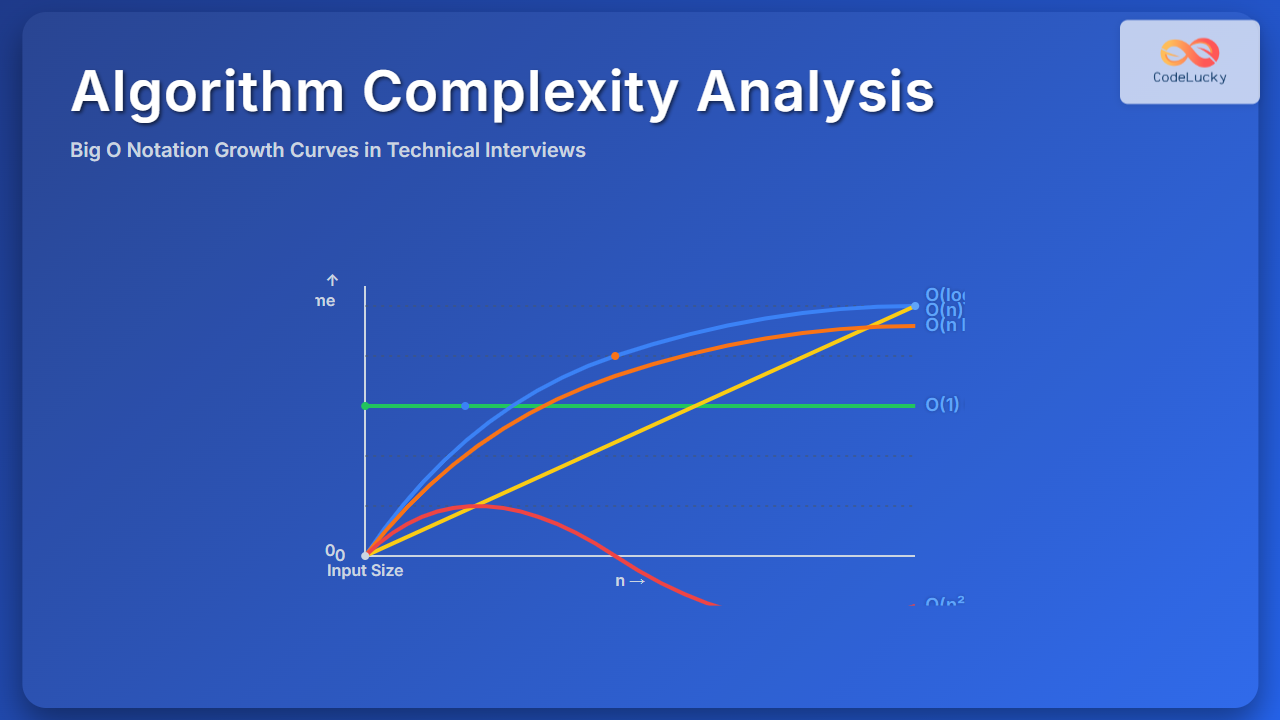
- Suffix Array + LCP: O(n log n)
- Suffix Tree: O(n) [using advanced construction]
Interactive Idea
You can make this topic interactive by allowing users to input any string in a web tool and dynamically generate its suffix array, sorted suffix list, and LCP visualization, helping them understand how repeated substrings are detected.
Conclusion
The Longest Repeated Substring problem is a cornerstone in string algorithms, bridging academic theory with real-world applications. Through suffix arrays and suffix trees, we achieve efficient solutions scalable to large datasets. As strings continue to dominate data in the digital world, mastering problems like this empowers developers and researchers to harness the hidden potential in repeating patterns.