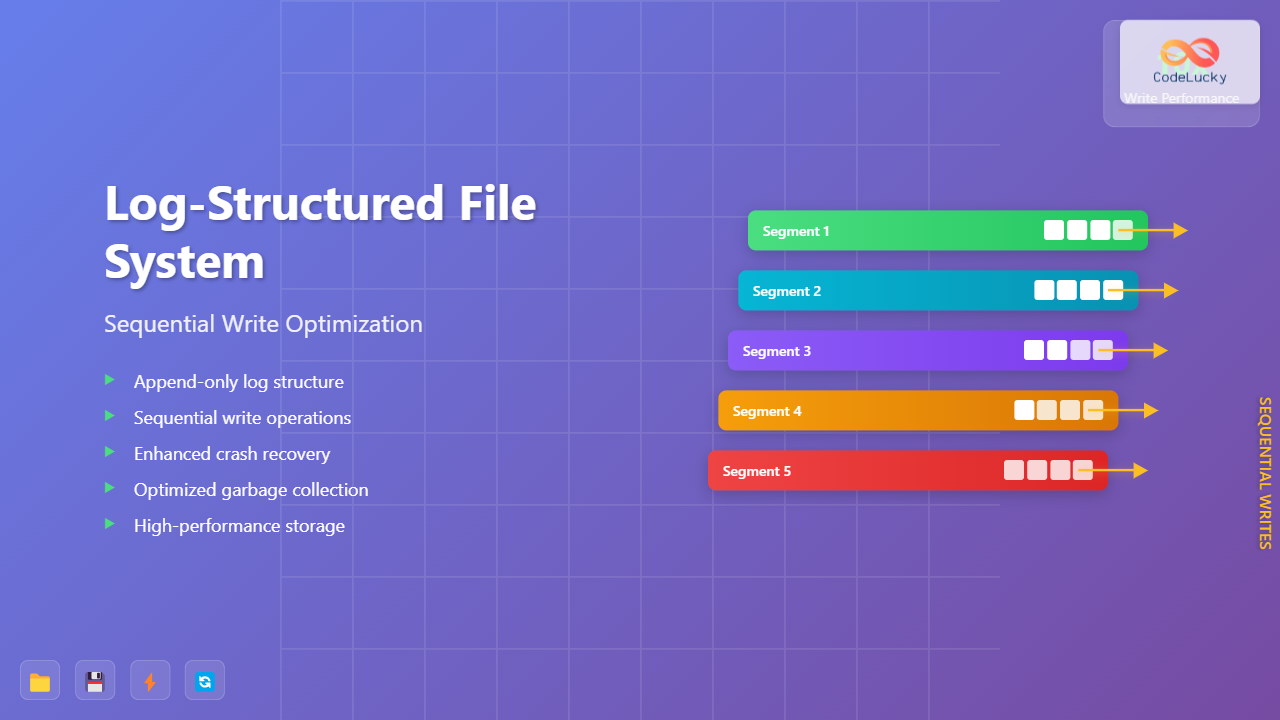
Log-structured File Systems (LFS) represent a revolutionary approach to data storage that fundamentally changes how operating systems handle file operations. Unlike traditional file systems that perform random writes across the disk, LFS treats the entire storage device as a sequential log, optimizing write performance and enabling better handling of modern workloads.
Understanding Log-structured File Systems
A log-structured file system organizes all data and metadata as a continuous sequence of log entries written to storage. This approach transforms the chaotic pattern of random disk writes into an ordered, sequential stream that maximizes write throughput and minimizes disk seek times.

The core principle behind LFS is simple yet powerful: all writes are sequential. When an application modifies a file, instead of updating the existing location on disk, the file system writes the new data to the end of the log and updates its internal indexes to point to the new location.
Sequential Write Optimization Benefits
Sequential write optimization in LFS provides several significant advantages over traditional file systems:
Improved Write Performance
Sequential writes eliminate the need for disk head movement in traditional hard drives, dramatically reducing seek times. For Solid State Drives (SSDs), sequential writes help minimize write amplification and extend device lifespan.
# Performance comparison example
# Traditional file system random write
$ dd if=/dev/zero of=random_file bs=4K count=1000 seek=$RANDOM
# Average: 50-100 IOPS

# Log-structured sequential write
$ dd if=/dev/zero of=log_file bs=4K count=1000
# Average: 500-1000+ IOPS
Enhanced Crash Recovery
The append-only nature of LFS creates an inherent versioning system. Each write operation creates a new version of data while preserving previous versions until garbage collection occurs. This design provides excellent crash recovery capabilities.
Better Handling of Small Writes
LFS excels at handling workloads with frequent small writes by batching them into larger sequential writes, reducing the overhead associated with numerous small disk operations.
LFS Architecture Components
Log Segments
The storage device is divided into fixed-size segments, typically ranging from 512KB to several megabytes. Each segment contains a sequence of log entries representing file data and metadata changes.

Inode Map
The inode map serves as the primary index structure, mapping file identifiers to their current locations in the log. This indirection layer enables efficient file lookups while supporting the dynamic nature of log-structured storage.
// Simplified inode map structure
typedef struct {
    uint32_t file_id;
    uint64_t log_address;    // Current location in log
    uint32_t version;        // For consistency checking
    uint64_t timestamp;      // Last modification time
} inode_map_entry_t;
Checkpoint Regions
Checkpoint regions store critical file system metadata, including the current state of the inode map and segment usage information. These regions are updated periodically to ensure file system consistency.
Write Process in Detail
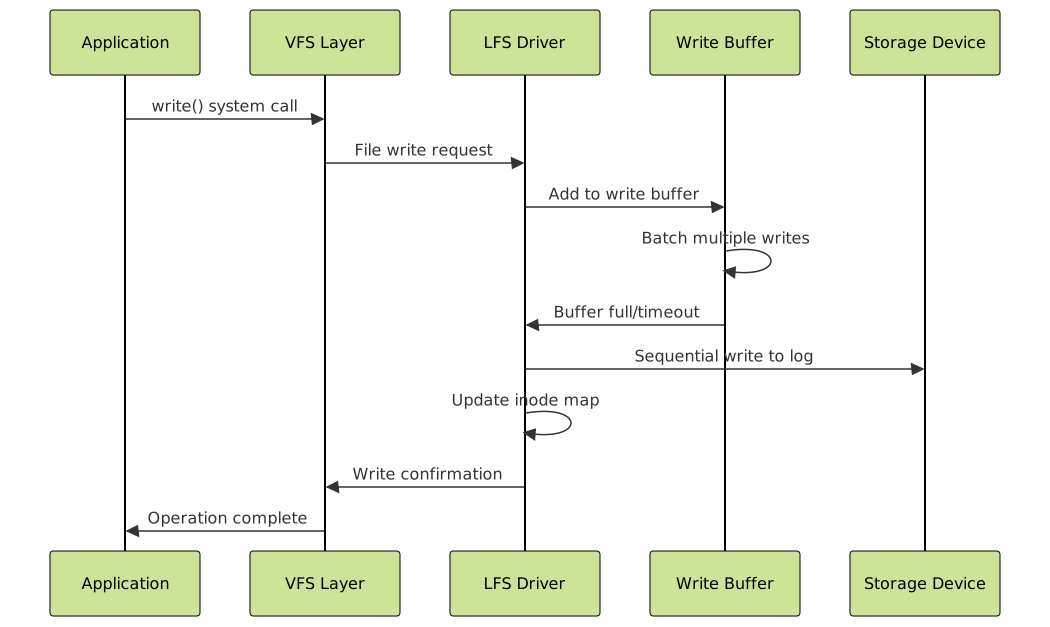
The write process in LFS follows a carefully orchestrated sequence that ensures data integrity while maximizing performance:
Write Buffering
LFS maintains an in-memory write buffer that accumulates multiple write operations before committing them to storage as a single sequential write. This batching mechanism significantly improves efficiency for workloads with many small writes.
# Conceptual write buffering implementation
class WriteBuffer:
    def __init__(self, max_size=1024*1024):  # 1MB buffer
        self.buffer = bytearray()
        self.max_size = max_size
        self.entries = []

    def add_write(self, file_id, offset, data):
        entry = {
            'file_id': file_id,
            'offset': offset,
            'data': data,
            'timestamp': time.time()
        }
        self.entries.append(entry)
        self.buffer.extend(data)

        if len(self.buffer) >= self.max_size:
            self.flush()

    def flush(self):
        if self.buffer:
            log_address = write_sequential(self.buffer)
            self.update_inode_map(self.entries, log_address)
            self.buffer.clear()
            self.entries.clear()
Garbage Collection Mechanism
One of the most critical aspects of LFS is garbage collection, which reclaims space from segments containing obsolete data. This process is essential for maintaining storage efficiency in a log-structured environment.
Segment Cleaning Process
The garbage collector identifies segments with low utilization, reads valid data from these segments, writes it to new segments, and marks the old segments as free for reuse.

Cleaning Policy
Effective garbage collection requires intelligent segment selection policies. Common approaches include:
- Greedy Policy: Always clean the segment with the least valid data
- Cost-Benefit Policy: Consider both space reclaimed and cleaning cost
- Age-Based Policy: Prioritize older segments that are less likely to be modified
// Cost-benefit calculation for segment cleaning
double calculate_cleaning_benefit(segment_t *seg) {
    double utilization = (double)seg->valid_bytes / seg->total_bytes;
    double age = current_time - seg->last_modified;

    // Higher benefit for low utilization and older segments
    return (1.0 - utilization) * age;
}
Performance Characteristics
Write Performance
LFS demonstrates exceptional write performance, particularly for workloads characterized by:
- High write-to-read ratios
- Frequent file creation and deletion
- Applications requiring high write throughput
Read Performance Considerations
While LFS optimizes write performance, read operations may experience some overhead due to indirection through the inode map. However, modern implementations mitigate this through aggressive caching and optimized index structures.
Space Utilization
The effectiveness of garbage collection directly impacts space utilization. Well-tuned systems typically maintain 70-80% space utilization under steady-state conditions.
Real-world Implementations
JFFS2 (Journaling Flash File System)
JFFS2 implements log-structured principles specifically for NAND flash memory in embedded systems. It provides wear leveling and bad block management while maintaining the sequential write benefits of LFS.
F2FS (Flash-Friendly File System)
F2FS, developed by Samsung, adapts log-structured concepts for modern SSDs. It incorporates multi-head logging and sophisticated garbage collection algorithms to maximize SSD performance and lifespan.
NILFS (New Implementation of Log-structured File System)
NILFS brings log-structured file system capabilities to Linux, providing continuous snapshotting and efficient backup capabilities through its append-only design.
Implementation Challenges and Solutions
Write Amplification
Garbage collection can cause write amplification, where the same data is written multiple times. Modern LFS implementations address this through:
- Intelligent cleaning policies that minimize data movement
- Hot/cold data separation to reduce cleaning frequency
- Adaptive algorithms that adjust cleaning parameters based on workload
Crash Consistency
Ensuring file system consistency after unexpected shutdowns requires careful design of checkpoint mechanisms and recovery procedures:

Memory Requirements
LFS typically requires more memory than traditional file systems due to write buffering and inode map caching. Modern implementations use techniques like lazy loading and LRU caching to manage memory efficiently.
Performance Tuning Guidelines
Segment Size Optimization
Choosing the appropriate segment size involves balancing several factors:
- Large segments: Reduce metadata overhead but may increase garbage collection cost
- Small segments: Enable fine-grained garbage collection but increase management overhead
Buffer Management
Effective write buffer management is crucial for optimal performance:
# Example configuration for LFS parameters
echo 2048 > /sys/fs/lfs/write_buffer_size_kb    # 2MB write buffer
echo 30 > /sys/fs/lfs/gc_threshold_percent      # Start GC at 30% utilization
echo 10 > /sys/fs/lfs/checkpoint_interval_sec   # Checkpoint every 10 seconds
Future Developments
Log-structured file systems continue to evolve with advances in storage technology:
- NVMe Integration: Optimized implementations for high-speed NVMe SSDs
- Persistent Memory Support: Adaptations for byte-addressable persistent memory
- Machine Learning: AI-driven garbage collection and caching policies
- Distributed LFS: Scaling log-structured concepts to distributed storage systems
Log-structured file systems represent a paradigm shift in storage system design, prioritizing write performance through sequential operations while providing robust data protection and efficient space management. As storage technologies continue to evolve, LFS principles remain highly relevant for applications requiring high write throughput and strong consistency guarantees.
Understanding LFS concepts is essential for system administrators, developers, and anyone working with high-performance storage systems. The sequential write optimization at the heart of LFS provides a foundation for building efficient, scalable storage solutions that can handle the demanding requirements of modern computing environments.
Related Posts
Copy-on-Write File System: Complete Guide to ZFS and Btrfs Implementation
Copy-on-Write (COW) file systems represent a revolutionary approach to data storage and management, fundamentally changing how operating systems handle file...
File System Journaling: Complete Guide to Crash Recovery and Data Integrity
Understanding File System Journaling File system journaling is a critical mechanism that ensures data integrity and enables rapid crash recovery...
Storage Management: Complete Guide to Primary, Secondary and Tertiary Storage Systems
Storage management is one of the most critical components of an operating system, responsible for efficiently organizing, accessing, and maintaining...
File System Implementation: Boot Block, Super Block and Inodes Explained
Understanding File System Implementation File system implementation is a critical component of operating systems that manages how data is stored,...
File System in Operating System: Complete Guide to Structure and Organization
Introduction to File Systems A file system is a fundamental component of any operating system that provides a structured way...

File Allocation Methods: Contiguous, Linked and Indexed Storage Techniques
Understanding File Allocation Methods in Operating Systems File allocation methods are fundamental techniques used by operating systems to organize and...

Device Scheduling: Complete Guide to I/O Request Scheduling Algorithms
Device scheduling is a critical component of operating system design that determines how I/O requests are ordered and executed to...

Disk Scheduling Algorithms: FCFS, SSTF, SCAN, C-SCAN – Complete Implementation Guide
Disk scheduling algorithms are fundamental components of operating systems that determine the order in which disk I/O requests are processed....

Storage Virtualization: Complete Guide to Logical Volume Management in Linux
Storage virtualization through Logical Volume Management (LVM) represents one of the most powerful features in modern Linux systems, providing administrators...

File System Types: FAT32, NTFS, ext4 and Modern Linux Filesystems Explained
Understanding File Systems: The Foundation of Data Storage A file system is the method and data structure that an operating...
btrfs Command Linux: Complete Guide to Advanced Filesystem Management
The btrfs command is a powerful utility for managing the B-tree filesystem (Btrfs) in Linux, offering advanced features like snapshots,...

zfs Command Linux: Complete Guide to ZFS Filesystem Administration
The ZFS (Zettabyte File System) is a revolutionary filesystem that combines traditional filesystem capabilities with logical volume management, RAID functionality,...