In modern software systems where performance and scalability are critical, concurrent programming stands as a vital paradigm. Traditional approaches often rely on locks and mutexes to synchronize access to shared memory. However, these methods come with drawbacks like deadlocks, contention, and scalability bottlenecks. This is where lock-free data structures come into play, enabling safe concurrent programming without the overhead of locks.
This article explores the idea behind lock-free data structures, explains their advantages and challenges, and provides practical examples with visual explanations. By the end, you’ll understand why lock-free programming is essential in building scalable distributed systems, databases, and high-performance computing applications.
What Are Lock-Free Data Structures?
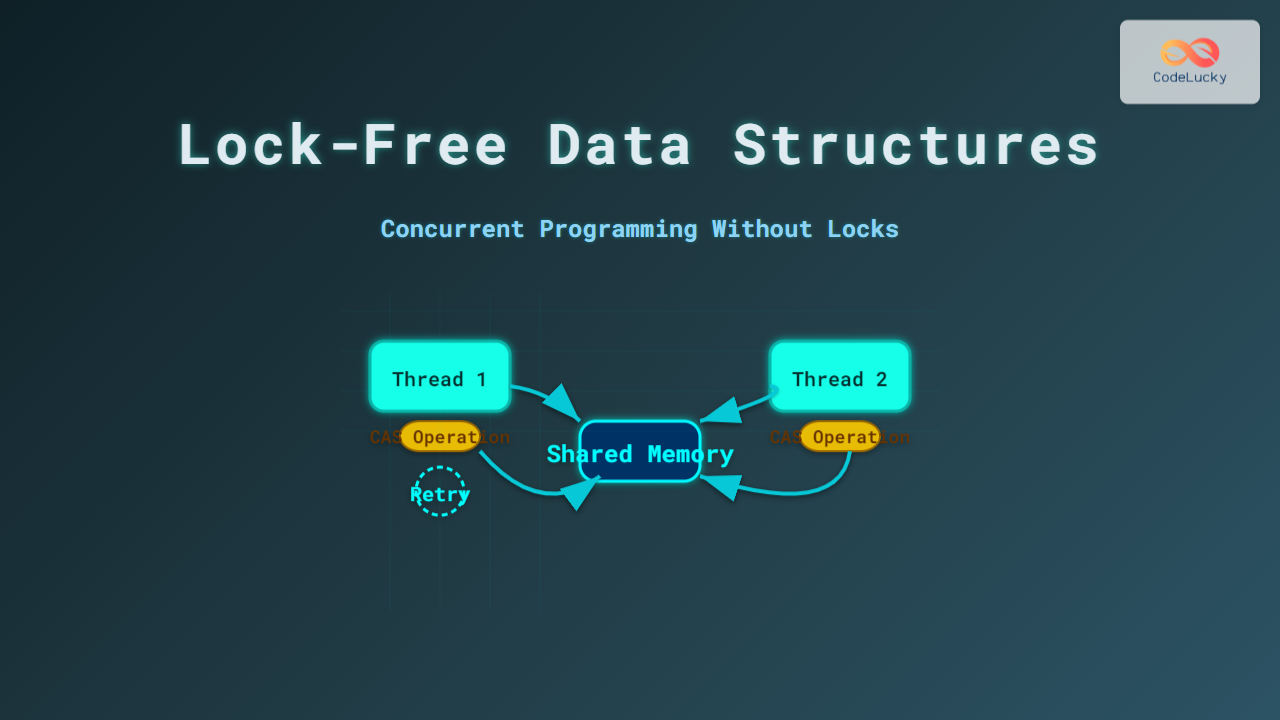
Lock-free data structures allow multiple threads to operate simultaneously on shared data without using mutex locks. Instead of serializing threads through locks, they use low-level atomic operations like Compare-And-Swap (CAS) or Load-Link/Store-Conditional (LL/SC). These instructions guarantee progress without blocking other threads.
A lock-free algorithm ensures that at least one thread completes its operation in a finite number of steps, avoiding deadlocks and priority inversion issues common in lock-based systems.

Why Use Lock-Free Data Structures?
Lock-free designs provide several advantages over traditional locking mechanisms:
- No Deadlocks – Threads cannot block each other indefinitely.
- Improved Scalability – Multiple threads can perform operations in parallel without waiting for locks.
- Better Performance – Reduction of context-switching and contention overhead.
- Responsive Systems – Useful for real-time applications where delays are unacceptable.
Core Concept: Compare-And-Swap (CAS)
The heart of lock-free data structures lies in the atomic Compare-And-Swap instruction. CAS compares a memory location’s current value with an expected value, and if they match, replaces it with a new desired value atomically.
// Example: CAS-based atomic update in C++
std::atomic counter(0);

void increment() {
    int old_value = counter.load();
    while (!counter.compare_exchange_weak(old_value, old_value + 1)) {
        // retry until successful
    }
}
This ensures concurrent threads can update shared variables safely without locks.
Example: Lock-Free Stack
A commonly studied lock-free data structure is a stack implemented using CAS. Multiple threads can push and pop from it concurrently without synchronization overhead.
#include <atomic>
#include <memory>

template<typename T>
class LockFreeStack {
    struct Node {
        T data;
        Node* next;
        Node(T d) : data(d), next(nullptr) {}
    };

    std::atomic<Node*> head;

public:
    LockFreeStack() : head(nullptr) {}

    void push(T value) {
        Node* new_node = new Node(value);
        new_node->next = head.load();
        while (!head.compare_exchange_weak(new_node->next, new_node)) {
            // retry
        }
    }

    bool pop(T &result) {
        Node* old_head = head.load();
        while (old_head && !head.compare_exchange_weak(old_head, old_head->next)) {
            // retry
        }
        if (old_head) {
            result = old_head->data;
            delete old_head;
            return true;
        }
        return false;
    }
};

Execution Visualization
When Thread A pushes an element while Thread B pops concurrently, both perform non-blocking CAS retries until successful, ensuring progress without locks.
Interactive Example: Lock-Free Counter
Below is a simple JavaScript interactive example simulating lock-free counter increments using CAS-like behavior for demonstration.
<!DOCTYPE html>
<html>
<body>
  <p>Counter Value: <span id="counter">0</span></p>
  <button onclick="incrementCounter()">Increment (CAS Simulation)</button>

  <script>
    let counter = 0;
    function compareAndSwap(expected, newValue) {
      if (counter === expected) {
        counter = newValue;
        return true;
      }
      return false;
    }
    function incrementCounter() {
      let oldVal;
      do {
        oldVal = counter;
      } while (!compareAndSwap(oldVal, oldVal + 1));
      document.getElementById("counter").innerText = counter;
    }
  </script>
</body>
</html>
Challenges of Lock-Free Programming
- Complexity – Designing correct lock-free algorithms requires deep understanding of memory ordering and atomic operations.
- ABA Problem – CAS may falsely succeed when memory values change back to an old state. Solutions include version counters or hazard pointers.
- Memory Reclamation – Ensuring freed memory is not accessed by other threads requires specialized techniques like epoch-based reclamation.

Applications of Lock-Free Data Structures
Lock-free techniques are heavily used in performance-critical areas:
- High-performance databases and key-value stores.
- Real-time operating systems and embedded systems.
- Concurrent garbage collectors.
- Networking and message-passing systems.
Conclusion
Lock-free data structures are a powerful approach to building scalable and efficient concurrent systems. By replacing traditional locks with atomic instructions like CAS, they avoid deadlocks, contention, and context-switch overhead. Although designing lock-free systems is challenging, their benefits make them indispensable for modern concurrent programming.
As computing continues to scale with multi-core and distributed architectures, mastering lock-free data structures will remain a crucial skill for system designers and software engineers.