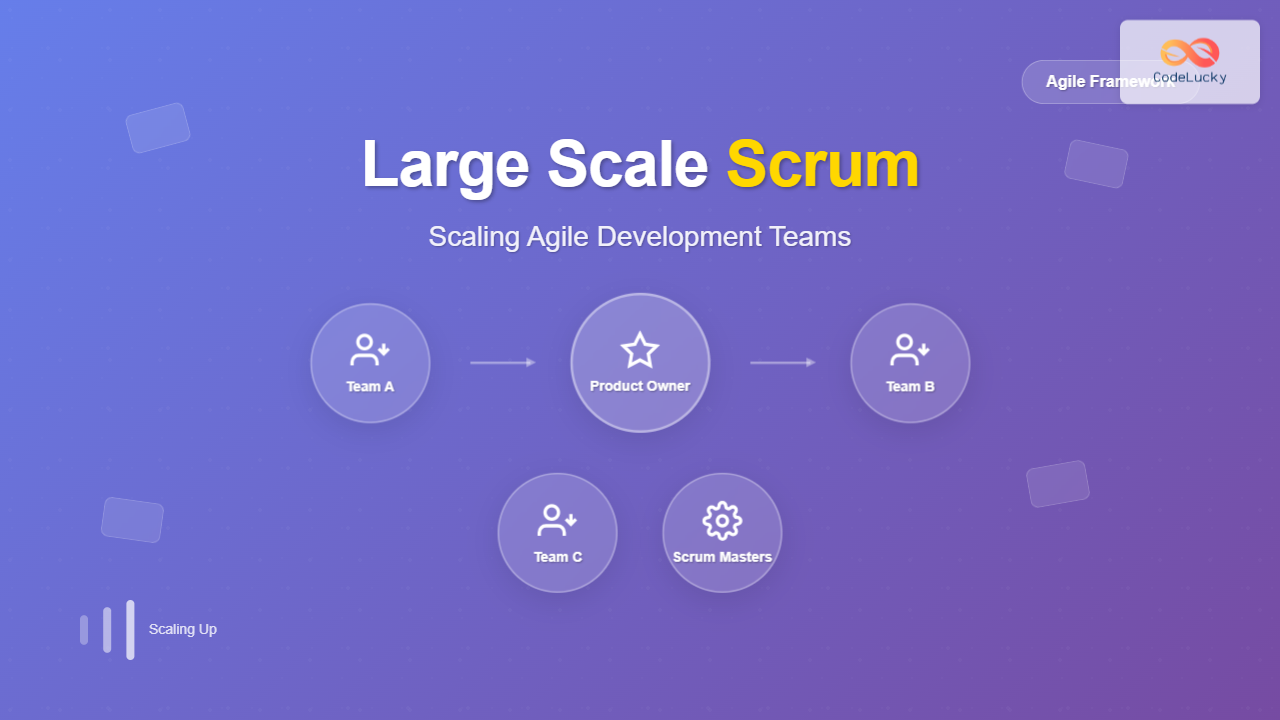
Large Scale Scrum (LeSS) represents a revolutionary approach to scaling Scrum practices across multiple development teams without losing the core agile principles that make Scrum effective. As organizations grow and projects become more complex, the need to coordinate multiple Scrum teams becomes critical for maintaining velocity and quality.
What is Large Scale Scrum (LeSS)?
Large Scale Scrum (LeSS) is a framework that extends traditional Scrum practices to work effectively with multiple teams developing a single product. Created by Craig Larman and Bas Vodde, LeSS maintains the simplicity and transparency of Scrum while providing structure for coordination across teams.
Unlike other scaling frameworks that add layers of complexity, LeSS follows the principle of “more with LeSS” – achieving more by doing less. The framework emphasizes descaling organizational complexity rather than adding new processes or roles.
Core Philosophy of LeSS
The LeSS framework is built on several fundamental principles:
- Large-Scale Scrum is Scrum: LeSS maintains all the rules, roles, and events of single-team Scrum
- Empirical Process Control: Transparency, inspection, and adaptation remain central
- Lean Thinking: Eliminate waste and optimize the whole system
- Systems Thinking: Focus on the entire system rather than individual parts
- Customer-Centric: Prioritize customer value over internal efficiency
LeSS Framework Structure
The LeSS framework comes in two main variants designed for different organizational scales:
LeSS (Basic)
LeSS Basic is designed for 2-8 teams working on a single product. This variant maintains the simplicity of single-team Scrum while adding minimal coordination mechanisms:
- One Product Owner for all teams
- One Product Backlog shared across teams
- One potentially shippable product increment
- Cross-team coordination through shared Sprint Planning and Review
LeSS Huge
LeSS Huge accommodates organizations with hundreds of developers across multiple product areas. It introduces additional structure while maintaining LeSS principles:
- Area Product Owners working under a Chief Product Owner
- Area Backlogs focusing on specific customer areas
- Area-specific Sprint Planning and Reviews
- Overall Product Backlog Refinement across areas
LeSS Roles and Responsibilities
Product Owner
In LeSS, the Product Owner role becomes more challenging as they must:
- Manage a single Product Backlog for multiple teams
- Prioritize features across different team capabilities
- Coordinate with stakeholders from multiple business areas
- Ensure consistent product vision across all teams
- Balance feature delivery with technical debt management
Scrum Masters
LeSS typically employs multiple Scrum Masters, with each serving 1-3 teams. Their responsibilities expand to include:
- Facilitating cross-team coordination and communication
- Coaching teams on LeSS practices and principles
- Removing organizational impediments affecting multiple teams
- Supporting the Product Owner in backlog management
- Promoting continuous improvement across the organization
Development Teams
Development teams in LeSS maintain their self-organizing nature while taking on additional responsibilities:
- Coordinating directly with other teams when needed
- Participating in cross-team refinement activities
- Sharing knowledge and best practices across teams
- Contributing to overall product architecture decisions
- Taking collective ownership of the entire product
LeSS Events and Ceremonies
Sprint Planning
LeSS Sprint Planning occurs in two parts:
Sprint Planning One: All teams meet together with the Product Owner to understand the overall Sprint Goal and select Product Backlog items. This ensures alignment and prevents conflicts between teams.
Sprint Planning Two: Each team meets separately to plan their specific implementation approach, task breakdown, and coordinate any cross-team dependencies.
Daily Scrum
Each team conducts their own Daily Scrum as in traditional Scrum. However, teams may also organize:
- Cross-team Daily Scrums when working on shared components
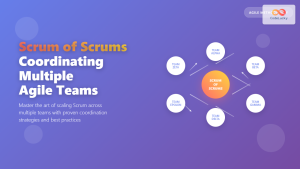
- Scrum of Scrums for coordination between teams
- Technical coordination meetings for architecture discussions
Sprint Review
The Sprint Review in LeSS brings together all teams, stakeholders, and the Product Owner to:
- Demonstrate the integrated product increment
- Gather feedback from stakeholders across all product areas
- Inspect market conditions and adjust product direction
- Celebrate achievements and learn from challenges
Sprint Retrospective
LeSS implements multi-level retrospectives:
Team Retrospectives: Each team conducts their own retrospective focusing on team-specific improvements.
Overall Retrospective: Representatives from all teams, Scrum Masters, and the Product Owner discuss system-wide improvements and organizational impediments.
Product Backlog Refinement
Backlog refinement in LeSS involves:
- Multi-team refinement sessions for items requiring coordination
- Single-team refinement for team-specific items
- Product Owner working with subject matter experts
- Technical coordination for architectural decisions
Benefits of Implementing LeSS
Organizational Benefits
Organizations implementing LeSS typically experience:
- Reduced Complexity: Fewer roles, meetings, and artifacts compared to other scaling frameworks
- Faster Time-to-Market: Direct coordination between teams eliminates communication delays
- Improved Quality: Shared ownership and cross-team collaboration improve overall product quality
- Better Alignment: Single Product Owner ensures consistent prioritization and vision
- Organizational Learning: Focus on system-wide improvements drives continuous organizational improvement
Technical Benefits
From a technical perspective, LeSS promotes:
- Better software architecture through cross-team technical coordination
- Reduced technical debt through shared ownership
- Knowledge sharing and skill development across teams
- Consistent development practices and standards
- Improved code quality through peer review and collaboration
Common LeSS Implementation Challenges
Organizational Resistance
Many organizations struggle with LeSS adoption due to:
- Resistance to removing traditional management layers
- Difficulty in finding qualified Product Owners for large-scale coordination
- Cultural resistance to increased transparency and accountability
- Fear of losing control over individual team performance
Technical Challenges
Technical implementation challenges include:
- Legacy system architecture preventing effective team coordination
- Lack of continuous integration and deployment practices
- Insufficient test automation for rapid feedback
- Database and infrastructure constraints limiting team autonomy
Coordination Difficulties
Teams often face challenges in:
- Balancing team autonomy with cross-team coordination needs
- Managing dependencies between teams effectively
- Maintaining consistent communication across distributed teams
- Resolving conflicts in technical approach or priorities
Best Practices for LeSS Success
Preparation and Training
Successful LeSS implementation requires:
- Comprehensive training for all roles, especially Product Owners and Scrum Masters
- Executive support and commitment to organizational change
- Clear communication of the transformation rationale and goals
- Gradual implementation starting with willing teams and areas
Technical Excellence
Organizations should focus on:
- Investing in continuous integration and deployment infrastructure
- Establishing comprehensive automated testing practices
- Refactoring legacy systems to support team autonomy
- Creating shared technical standards and practices
Cultural Transformation
LeSS success depends on:
- Promoting psychological safety for experimentation and learning
- Encouraging direct communication between teams
- Focusing on customer value over internal metrics
- Embracing failure as a learning opportunity
LeSS vs Other Scaling Frameworks
LeSS vs SAFe (Scaled Agile Framework)
While SAFe adds multiple layers of coordination, LeSS maintains simplicity:
- LeSS has fewer roles and ceremonies
- LeSS emphasizes descaling rather than adding structure
- LeSS maintains stronger focus on technical practices
- LeSS provides more team autonomy and less prescribed processes
LeSS vs Spotify Model
Compared to the Spotify Model, LeSS offers:
- More structured approach to coordination
- Clearer definition of roles and responsibilities
- Stronger emphasis on single product development
- More prescriptive practices for scaling Scrum specifically
Measuring Success in LeSS
Key Performance Indicators
Organizations should track:
- Cycle Time: Time from idea to customer delivery
- Customer Satisfaction: Direct feedback and usage metrics
- Team Morale: Employee satisfaction and retention
- Quality Metrics: Defect rates and customer-reported issues
- Delivery Predictability: Consistency in meeting commitments
Organizational Health Metrics
Monitor organizational improvements through:
- Reduction in management layers and overhead
- Increase in direct customer interaction
- Improvement in cross-team collaboration
- Growth in technical capabilities and practices
- Enhanced organizational learning and adaptation
Getting Started with LeSS
Assessment and Readiness
Before implementing LeSS, organizations should:
- Assess current Scrum maturity and identify gaps
- Evaluate organizational culture and change readiness
- Identify potential Product Owners and Scrum Masters
- Review technical infrastructure and practices
- Secure leadership commitment and support
Implementation Roadmap
A typical LeSS implementation follows these phases:
- Education and Training: Train key personnel in LeSS principles and practices
- Pilot Implementation: Start with 2-3 teams on a single product
- Iteration and Learning: Conduct regular retrospectives and adjust practices
- Gradual Expansion: Add teams incrementally based on lessons learned
- Organizational Transformation: Adapt organizational structure to support LeSS
Conclusion
Large Scale Scrum (LeSS) offers a powerful framework for organizations seeking to scale agile practices without sacrificing the principles that make Scrum effective. By emphasizing simplicity, transparency, and customer focus, LeSS enables organizations to coordinate multiple development teams while maintaining the agility and responsiveness that customers demand.
Success with LeSS requires commitment to organizational change, investment in technical excellence, and patience during the transformation process. Organizations that embrace these challenges often find themselves better positioned to respond to market changes, deliver higher quality products, and maintain engaged, productive development teams.
The journey to implement LeSS may be challenging, but the benefits of improved coordination, reduced complexity, and enhanced customer focus make it a worthwhile investment for organizations serious about scaling their agile practices effectively.
Related Posts
Nexus Framework: Master Scaling Scrum with Minimal Overhead for Large Teams
The Nexus Framework represents a revolutionary approach to scaling Scrum that maintains the core principles of agility while enabling multiple...
Scrum of Scrums: Complete Guide to Coordinating Multiple Agile Teams
When organizations scale their Agile practices beyond a single team, coordinating multiple Scrum teams becomes a critical challenge. Scrum of...
Scaling Agile Adoption: Complete Guide to Enterprise-Wide Transformation Success
Scaling Agile adoption from a single team to an entire enterprise represents one of the most challenging yet rewarding transformations...
Introduction to Scrum Framework: Complete Guide for Agile Project Management
The Scrum framework has revolutionized how teams approach project management and software development. As one of the most popular agile...
Agile Philosophy: Understanding Core Principles and Values for Modern Software Development
Introduction to Agile Philosophy Agile philosophy represents a fundamental shift in how software development teams approach project management, collaboration, and...
Dependencies Management in Scaled Agile: Complete Guide to Cross-Team Coordination
Understanding Dependencies in Scaled Agile Environments Dependencies management represents one of the most critical challenges in scaled agile environments. When...
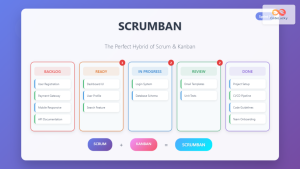
Scrumban: The Ultimate Hybrid Methodology for Agile Teams
What is Scrumban? Scrumban is a hybrid agile methodology that combines the structured framework of Scrum with the visual workflow...
Scrum Development Team: Complete Guide to Roles, Responsibilities and Best Practices
What is a Scrum Development Team? The Scrum Development Team is the heart of any successful Agile project, consisting of...
Spotify Model: Scaling Agile Culture for Modern Software Development Teams
The Spotify Model has emerged as one of the most influential approaches to scaling agile methodologies in modern software development....
Agile Transformation: Complete Guide to Organizational Change Management
Agile transformation represents one of the most significant organizational changes companies undertake today. This comprehensive shift from traditional project management...
Benefits of Agile Methodology: Why Teams Choose Agile for Project Success
Agile methodology has revolutionized how teams approach project management and software development. Since its introduction through the Agile Manifesto in...
Remote Agile Teams: Complete Guide to Distributed Development Success
Remote Agile teams have become the backbone of modern software development, enabling organizations to tap into global talent while maintaining...