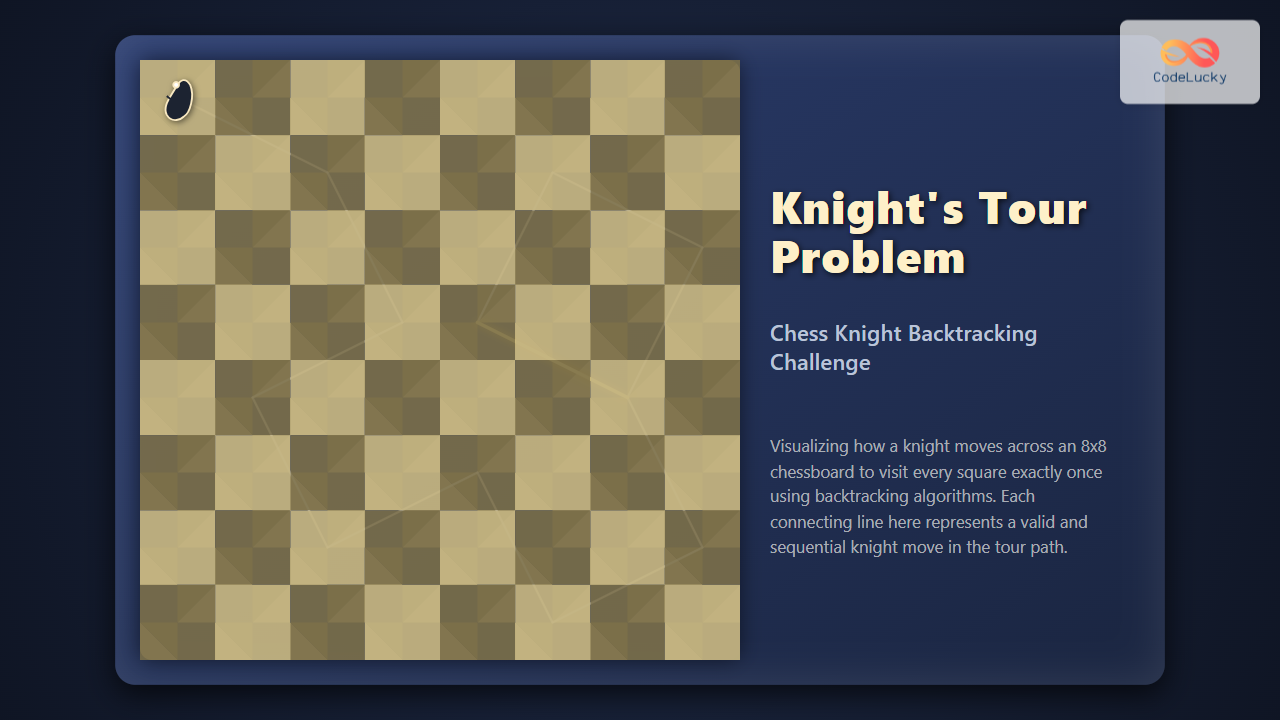
The Knight’s Tour problem is one of the most fascinating backtracking puzzles in computer science and mathematics. Rooted in the game of chess, this challenge asks: Can a knight visit every square on a chessboard exactly once? While the question sounds simple, the underlying logic blends recursion, graph traversal, and optimization—all essential concepts in algorithms.
In this article, we will explore the Knight’s Tour problem step by step, understand its backtracking approach, visualize its path, and implement a working Python solution. By the end, you’ll see how this problem is more than just a chess curiosity—it’s a real-world algorithmic pattern useful in robotics, puzzles, and AI pathfinding.
What is the Knight’s Tour Problem?
A knight in chess moves in an L-shape: two squares in one direction followed by one square perpendicularly. The Knight’s Tour problem asks us to find a sequence of moves so that the knight visits all N x N chessboard squares exactly one time.
There are two types of tours:
- Open Tour: The knight completes the path without returning to the starting square.
- Closed Tour: The knight finishes the tour such that the final move returns to the starting square, completing a cycle.
Why is Knight’s Tour Important?
The Knight’s Tour is not just a puzzle—it has strong implications in:
- Algorithm Design: Teaches recursion, backtracking, and pruning search spaces.
- Graph Theory: The chessboard can be treated as a graph where nodes are squares and edges represent knight moves.
- AI in Games: Used in designing chess engines and move generation algorithms.
- Robotics and Pathfinding: The challenge is analogous to covering an area efficiently without revisiting spots.
Understanding the Backtracking Approach
Backtracking systematically explores all knight moves, backtracking when the path fails. At each step:
- Check if the current move is within the board and not visited.
- If valid, mark the square and proceed to the next move.
- If we visit all squares successfully, the tour is complete.
- If a move fails, undo (backtrack) and try the next possible move.
This recursive exploration ensures that every possibility is tested until a correct solution is found.
Python Implementation of Knight’s Tour
N = 8  # Chessboard size

def is_safe(x, y, board):
    return 0 <= x < N and 0 <= y < N and board[x][y] == -1

def print_solution(board):
    for row in board:
        print(' '.join(str(c).zfill(2) for c in row))
    print()

# Possible moves for a knight
moves_x = [2, 1, -1, -2, -2, -1, 1, 2]
moves_y = [1, 2, 2, 1, -1, -2, -2, -1]

def solve_knight_tour():
    board = [[-1 for _ in range(N)] for _ in range(N)]
    board[0][0] = 0  # start position

    if not solve_util(0, 0, 1, board):
        print("Solution does not exist")
    else:
        print_solution(board)

def solve_util(x, y, move_count, board):
    if move_count == N * N:
        return True

    for i in range(8):
        next_x, next_y = x + moves_x[i], y + moves_y[i]
        if is_safe(next_x, next_y, board):
            board[next_x][next_y] = move_count
            if solve_util(next_x, next_y, move_count + 1, board):
                return True
            board[next_x][next_y] = -1  # backtrack
    return False

solve_knight_tour()
Sample Output (8×8 board)
00 59 38 33 30 17 08 63
37 34 31 60 09 62 29 16
58 01 36 39 32 27 18 07
35 48 41 26 61 10 15 28
42 57 02 49 40 23 06 19
47 50 45 54 25 20 11 14
56 43 52 03 22 13 24 05
51 46 55 44 53 04 21 12
Each number denotes the order in which the knight visits that square, starting from (0,0).
Visualizing the Knight’s Moves
We can think of the board as a graph where each square links to possible knight moves:

This view highlights how the knight’s legal moves form a highly connected graph that requires careful traversal.
Complexity Analysis
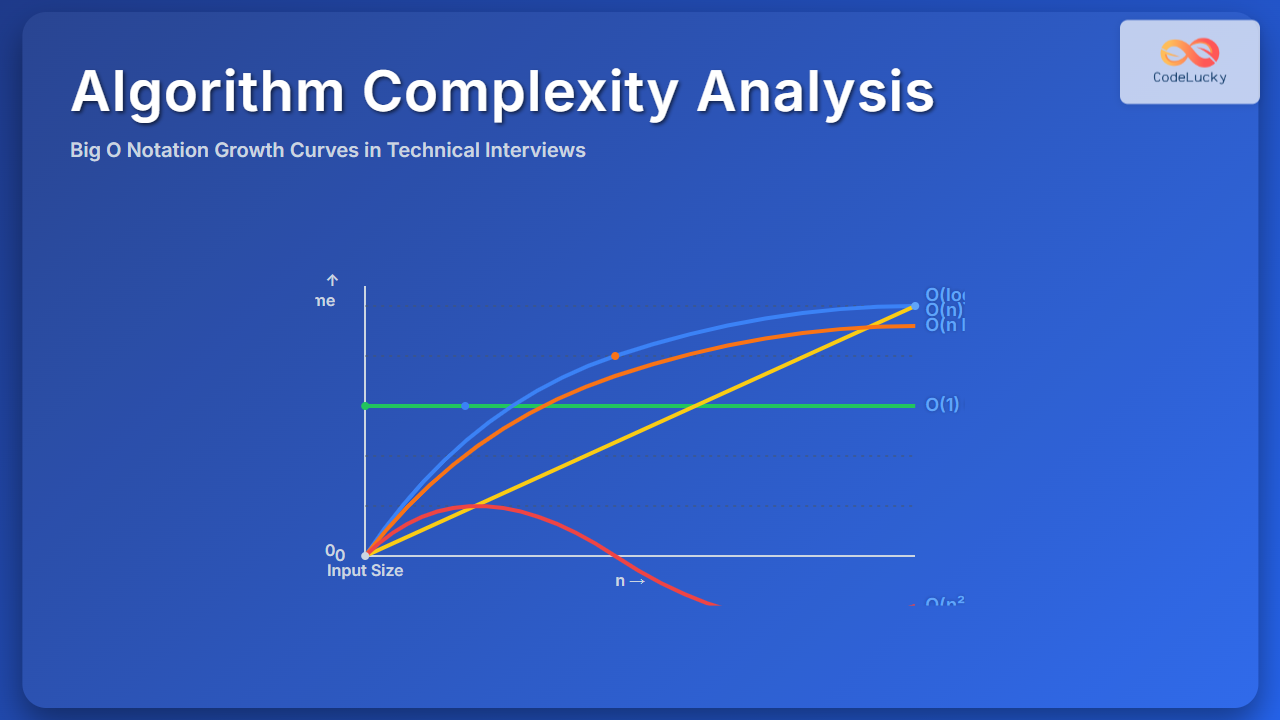
- Time Complexity: Worst case is
O(8^(N*N)), because each move branches into up to 8 possibilities. However, heuristics (like Warnsdorff’s rule) drastically optimize this. - Space Complexity:
O(N^2)for storing the board (visited states).
Optimizations: Warnsdorff’s Rule
Warnsdorff’s rule is a heuristic that reduces backtracking significantly. It chooses the next move with the least number of onward moves, drastically improving efficiency. In practice, this often solves an 8x8 board in milliseconds without extensive recursion.

Real-World Applications
- Path planning in AI – Robotics use similar coverage strategies for exploration.
- Puzzle games – Many app-based puzzles use Knight’s Tour as inspiration.
- Hamiltonian path in graph theory – The Knight’s Tour is a Hamiltonian path problem on a knight move graph.
Conclusion
The Knight’s Tour problem is an elegant way to study backtracking, recursion, graph traversal, and heuristics. Understanding its algorithm builds a strong foundation in algorithm design and problem-solving. Whether you solve the classical chess puzzle or apply the logic to robotics and AI, the Knight’s Tour remains a timeless programming challenge.
Try modifying the Python code to different N x N boards and see how the knight’s tour adapts!