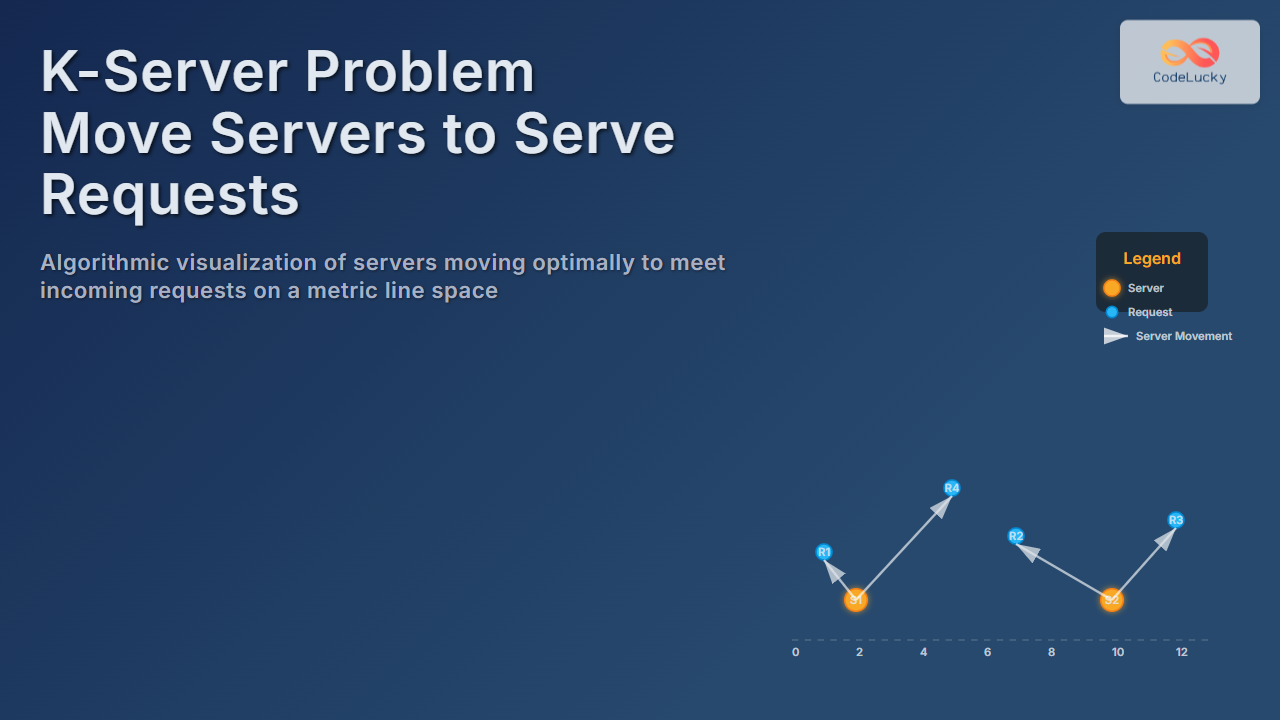
The K-Server Problem is a classic challenge in the field of online algorithms and computational geometry. It involves managing k servers located in a metric space and serving a sequence of requests appearing at points in the same space. The task is to decide which servers to move to which requests, minimizing the total movement cost while serving all requests.
This problem models real-world scenarios like caching, load balancing, and network resource allocation. It is central to understanding competitive analysis in online computing, where decisions must be made without knowledge of future requests.
Understanding the K-Server Problem
Given k servers initially placed at certain points in a metric space, requests arrive sequentially at different points. The problem requires moving one server to the requested point to serve it. Each move incurs a cost equal to the distance traveled by the server.
The objective is to serve all n requests in sequence, minimizing the total cost of all server movements. The challenge arises because the algorithm must operate online, making decisions in realtime as requests appear.
Formal Problem Statement
- A metric space \( (X, d) \) where \( X \) is a set of points and \( d \) is the distance metric.
- \( k \) servers located at points \( s_1, s_2, …, s_k \in X \).
- A sequence of requests \( r_1, r_2, …, r_n \), where each \( r_i \in X \).
- For each request, move exactly one server to \( r_i \).
- Cost is the sum of all distances moved by servers.
- Goal: minimize total cost.
Example and Visual Explanation
Consider a simple line metric with points labeled 0 through 9. Suppose \(k=2\) servers start at positions 2 and 7. You receive requests at positions 1, 5, 8, and 4. The question: which server moves to each request to minimize total travel?

In this scenario, moving server 1 from 2→1 (cost 1), server 2 from 7→5 (cost 2), then 5→8 (cost 3), and finally server 1 from 1→4 (cost 3) gives a total movement cost of 9. Other strategies might increase cost, demonstrating the need for an efficient decision-making process.
Key Strategies and Algorithms
The K-Server Problem is challenging because it requires balancing immediate servicing cost against future flexibility. Several classical algorithms and strategies have been proposed:
Greedy Algorithm
Always move the closest server to the request. Simple but often suboptimal in long-term cost.
Work Function Algorithm (WFA)
One of the best-known solutions that maintains a potential function representing the minimal cost to serve up to the current request and computes optimal moves accordingly. WFA achieves the best known competitive ratios but is computationally intensive.
Double Coverage Algorithm (for line metrics)
Used for line metrics with \(k=2\), moves servers simultaneously towards the request from both sides. Proven to be \(k\)-competitive.
Competitive Analysis
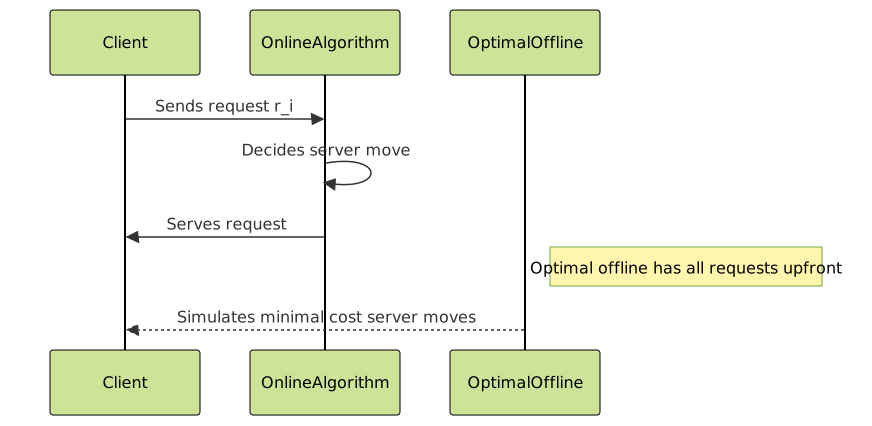
The quality of online algorithms for the K-Server Problem is usually measured by their competitive ratio—the worst-case ratio between online algorithm cost and an optimal offline algorithm with full request knowledge.
The K-Server Conjecture states that a deterministic online algorithm exists achieving a competitive ratio of exactly \(k\) for any metric space, a major open problem in computer science.
Interactive Example: Simulating Server Moves
Below is a simple interactive example in HTML+JS that allows choosing server moves on a line metric with 3 servers and a sequence of requests:
<div id="kServerSim" style="font-family:sans-serif; margin:1em 0;">
  <div>Servers: <span id="serversPos">[1, 5, 9]</span></div>
  <div>Requests Queue: <span id="requestsQueue">[2, 7, 3]</span></div>
  <div>Choose server to move:</div>
  <button onclick="moveServer(0)">Server 1 (Pos: 1)</button>
  <button onclick="moveServer(1)">Server 2 (Pos: 5)</button>
  <button onclick="moveServer(2)">Server 3 (Pos: 9)</button>
  <div>Total Cost: <span id="totalCost">0</span></div>
</div>

<script>
  let servers = [1,5,9];
  let requests = [2,7,3];
  let totalCost = 0;

  function moveServer(s) {
    if(requests.length === 0) {
      alert('All requests served');
      return;
    }
    const req = requests[0];
    const moveCost = Math.abs(servers[s] - req);
    totalCost += moveCost;
    servers[s] = req;
    requests.shift();
    document.getElementById('serversPos').textContent = JSON.stringify(servers);
    document.getElementById('requestsQueue').textContent = JSON.stringify(requests);
    document.getElementById('totalCost').textContent = totalCost;
  }
</script>
Variants and Extensions
There are multiple variants of the K-Server Problem, including:
- Weighted Servers: Where servers have different weights affecting movement cost.
- Randomized Algorithms: Using randomness to achieve better expected competitive ratios.
- Resource Augmentation: Allowing extra servers or faster servers to improve competitiveness.
Summary
The K-Server Problem is a foundational topic in online algorithms, illustrating the complexities in making real-time decisions without future knowledge. It highlights tradeoffs in cost, responsiveness, and strategy robustness.
While exact solutions remain challenging, understanding key algorithms like the Work Function Algorithm and Double Coverage provides insight into the problem’s mechanics and applications across computing domains.