The Job Scheduling Algorithm focused on maximizing profit with deadlines is a fundamental problem in computer science, widely applicable in resource allocation, project management, and operating systems. This article provides an in-depth explanation of the algorithm using a clear step-by-step approach, complete with code examples, visualizations, and interactive ideas to facilitate deep understanding.
Understanding the Job Scheduling Problem with Deadlines
In this problem, we are given n jobs where each job has three attributes:
- Job ID: Unique identifier
- Deadline: The latest time by which the job should be completed
- Profit: The profit gained if the job is completed before or on its deadline
The goal is to find a sequence of jobs to maximize total profit while ensuring that no job misses its deadline.
Why Focus on Profit and Deadlines?
Real-world applications often require scheduling tasks where failing to meet deadlines results in loss or penalty. Businesses want to maximize returns by choosing the right subset of tasks within given timings.
Approach: The Greedy Algorithm
The most effective way to solve this problem is a greedy strategy. The core idea is:
- Sort jobs based on decreasing profit.
- Iteratively assign each job to the latest available slot before its deadline.
- If no slot is available, skip the job.
This strategy ensures we pick the most profitable jobs first while respecting deadlines.

Step-by-Step Example
Consider the following jobs:
| Job ID | Deadline | Profit |
|---|---|---|
| 1 | 4 | 70 |
| 2 | 1 | 80 |
| 3 | 1 | 30 |
| 4 | 2 | 100 |
| 5 | 3 | 40 |
Algorithm Execution
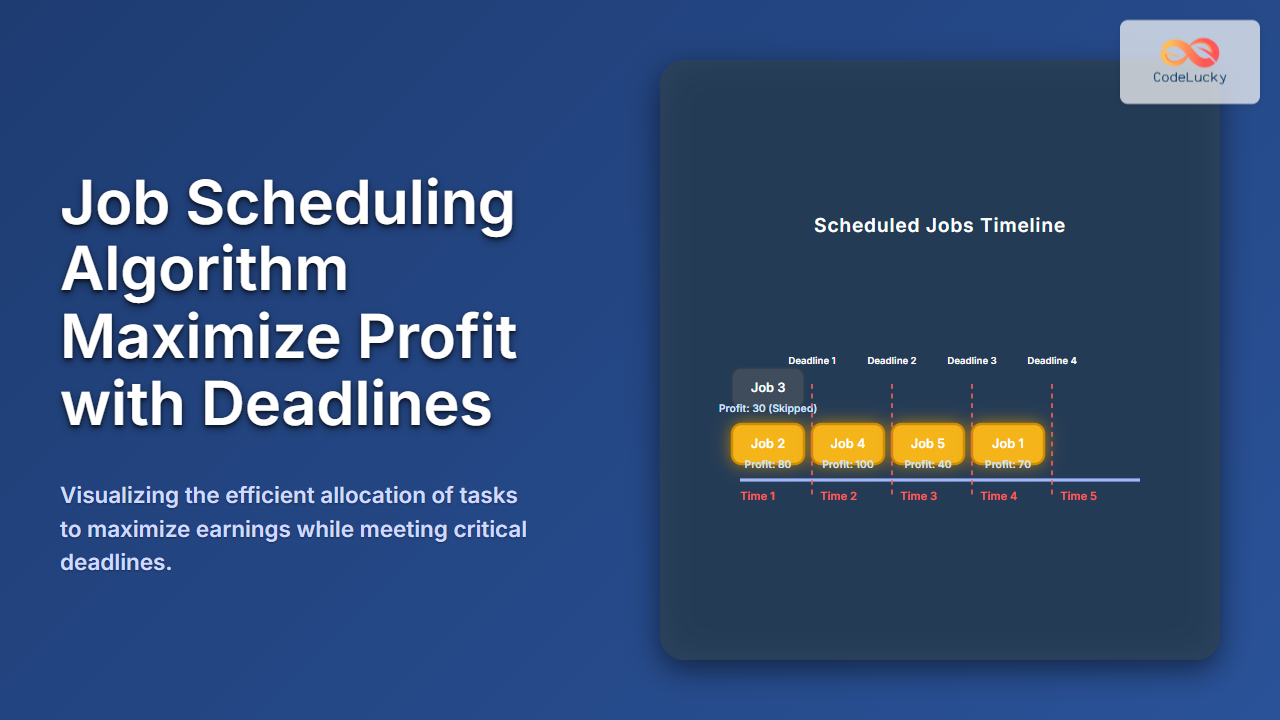
- Sort jobs by profit: Job 4 (100), Job 2 (80), Job 1 (70), Job 5 (40), Job 3 (30)
- Check Job 4 (deadline 2): assign slot 2 → Schedule Job 4
- Check Job 2 (deadline 1): assign slot 1 → Schedule Job 2
- Check Job 1 (deadline 4): assign slot 4 → Schedule Job 1
- Check Job 5 (deadline 3): assign slot 3 → Schedule Job 5
- Check Job 3 (deadline 1): slot 1 occupied → Skip Job 3
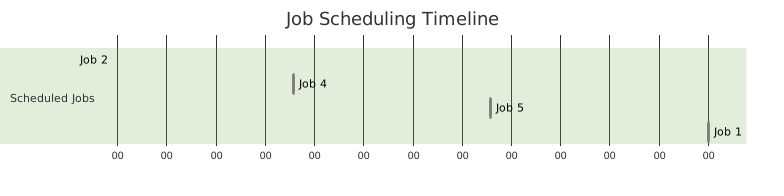
Final schedule: Jobs 2, 4, 5, 1 with total profit = 80 + 100 + 40 + 70 = 290
Code Implementation in Python
class Job:
    def __init__(self, job_id, deadline, profit):
        self.job_id = job_id
        self.deadline = deadline
        self.profit = profit

def job_scheduling(jobs):
    # Sort jobs in descending order of profit
    jobs.sort(key=lambda x: x.profit, reverse=True)

    n = len(jobs)
    result = [None] * n  # Slots for jobs
    slot_filled = [False] * n  # Track filled slots

    total_profit = 0

    for job in jobs:
        # Find a free slot for this job, starting from the latest slot before deadline
        for j in range(min(n, job.deadline) - 1, -1, -1):
            if not slot_filled[j]:
                result[j] = job.job_id
                slot_filled[j] = True
                total_profit += job.profit
                break

    scheduled_jobs = [job_id for job_id in result if job_id is not None]
    return scheduled_jobs, total_profit

# Example usage
jobs = [Job(1,4,70), Job(2,1,80), Job(3,1,30), Job(4,2,100), Job(5,3,40)]
schedule, profit = job_scheduling(jobs)
print(f"Scheduled jobs: {schedule}")
print(f"Total profit: {profit}")
Time Complexity
The sorting step takes \(O(n \log n)\) and scheduling each job takes \(O(n)\) in the worst case, leading to an overall complexity of O(n²) for the naive approach. This can be optimized using data structures such as Disjoint Set Union (DSU) to near \(O(n \log n)\).
When to Use Job Scheduling Algorithm
- Maximizing profit with time/resource constraints
- Project planning with deadlines and penalties
- Task prioritization in computing systems
Summary
The Job Scheduling Algorithm to maximize profit with deadlines is a classic greedy algorithmic solution, useful in many real-life and computational scenarios where tasks are deadline-sensitive and profitable. Sorting jobs by profit and choosing the latest free slot ensures optimal profit maximization.