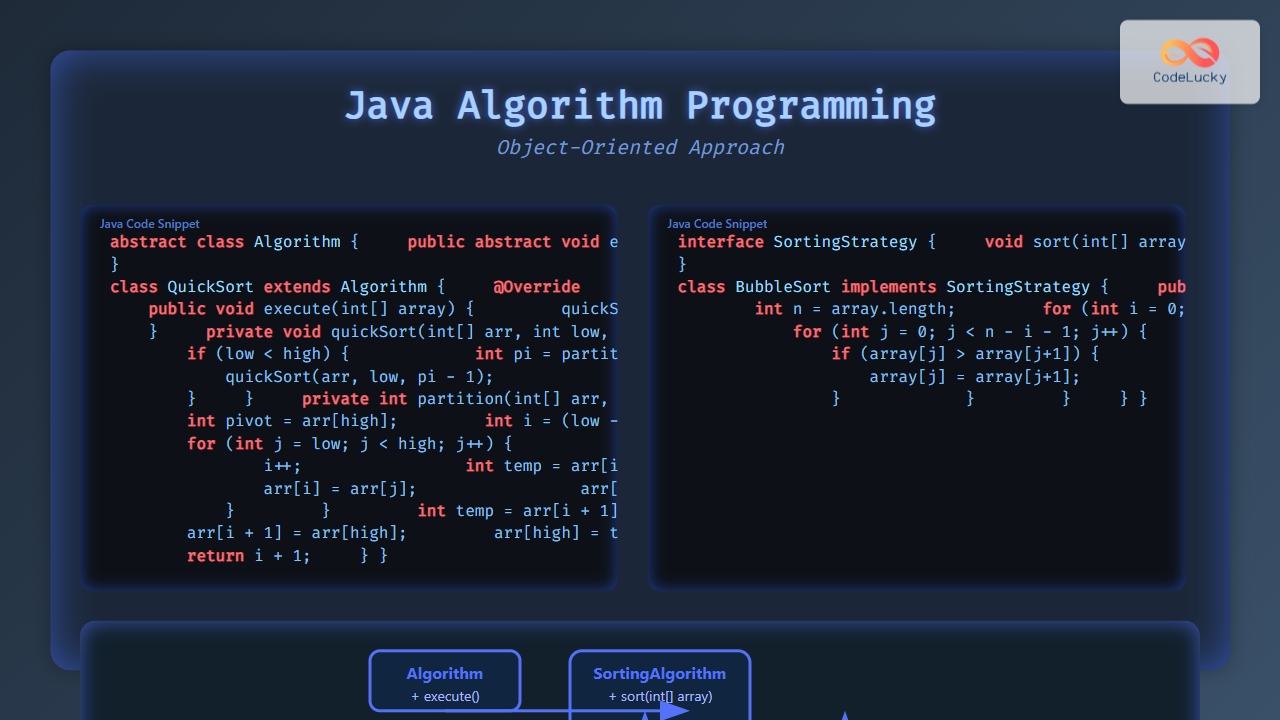
Java is one of the most popular programming languages in the domain of algorithm design and problem solving. Its object-oriented approach makes it highly suitable for modeling complex real-world problems. This article explores Java Algorithm Programming using Object-Oriented principles such as encapsulation, inheritance, abstraction, and polymorphism. By combining OOP with algorithmic design, developers can build efficient, maintainable, and reusable code.
Why Object-Oriented Approach for Algorithms?
Traditionally, algorithms are taught in a procedural way. However, using Java’s object-oriented features provides several advantages:
- Encapsulation: Algorithms can be wrapped inside classes with clear interfaces.
- Reusability: Common algorithm components can be reused across projects.
- Scalability: Complex algorithms can be broken down into multiple classes.
- Extensibility: New variations of algorithms can be implemented by extending existing classes.
Designing Algorithms with Classes and Objects
When representing an algorithm in Java, classes can define the algorithm itself or represent the problem domain. For example, sorting algorithms can be encapsulated in a Sorter class, while graphs or trees can be modeled as objects.

Example: Object-Oriented QuickSort Algorithm
Below is an example of implementing QuickSort using object-oriented principles in Java:
abstract class Algorithm {
    public abstract void execute(int[] array);
}

class QuickSort extends Algorithm {

    @Override
    public void execute(int[] array) {
        quickSort(array, 0, array.length - 1);
    }

    private void quickSort(int[] arr, int low, int high) {
        if (low < high) {
            int pi = partition(arr, low, high);
            quickSort(arr, low, pi - 1);
            quickSort(arr, pi + 1, high);
        }
    }

    private int partition(int[] arr, int low, int high) {
        int pivot = arr[high];
        int i = (low - 1);
        for (int j = low; j < high; j++) {
            if (arr[j] <= pivot) {
                i++;
                int temp = arr[i];
                arr[i] = arr[j];
                arr[j] = temp;
            }
        }
        int temp = arr[i + 1];
        arr[i + 1] = arr[high];
        arr[high] = temp;
        return i + 1;
    }
}

public class Main {
    public static void main(String[] args) {
        int[] data = {38, 27, 43, 3, 9, 82, 10};
        Algorithm sorter = new QuickSort();
        sorter.execute(data);

        System.out.print("Sorted Array: ");
        for (int val : data) {
            System.out.print(val + " ");
        }
    }
}
Output:
Sorted Array: 3 9 10 27 38 43 82
Interactive Example: Sorting with Strategy Pattern
We can extend the object-oriented design using the Strategy Pattern. This allows switching between different sorting algorithms at runtime.
interface SortingStrategy {
    void sort(int[] array);
}

class BubbleSort implements SortingStrategy {
    public void sort(int[] array) {
        int n = array.length;
        for (int i = 0; i < n - 1; i++) {
            for (int j = 0; j < n - i - 1; j++) {
                if (array[j] > array[j+1]) {
                    int temp = array[j];
                    array[j] = array[j+1];
                    array[j+1] = temp;
                }
            }
        }
    }
}

class QuickSortStrategy implements SortingStrategy {
    public void sort(int[] array) {
        quickSort(array, 0, array.length - 1);
    }
    private void quickSort(int[] arr, int low, int high) {
        if (low < high) {
            int pi = partition(arr, low, high);
            quickSort(arr, low, pi - 1);
            quickSort(arr, pi + 1, high);
        }
    }
    private int partition(int[] arr, int low, int high) {
        int pivot = arr[high];
        int i = low - 1;
        for (int j = low; j < high; j++) {
            if (arr[j] <= pivot) {
                i++;
                int temp = arr[i];
                arr[i] = arr[j];
                arr[j] = temp;
            }
        }
        int temp = arr[i+1];
        arr[i+1] = arr[high];
        arr[high] = temp;
        return i+1;
    }
}

class SortContext {
    private SortingStrategy strategy;
    public void setStrategy(SortingStrategy strategy) {
        this.strategy = strategy;
    }
    public void executeStrategy(int[] array) {
        strategy.sort(array);
    }
}

public class MainStrategy {
    public static void main(String[] args) {
        int[] data = {34, 7, 23, 32, 5, 62};
        SortContext context = new SortContext();

        context.setStrategy(new BubbleSort());
        context.executeStrategy(data);
        System.out.println("BubbleSort Result: " + java.util.Arrays.toString(data));

        data = new int[]{34, 7, 23, 32, 5, 62}; // resetting
        context.setStrategy(new QuickSortStrategy());
        context.executeStrategy(data);
        System.out.println("QuickSort Result: " + java.util.Arrays.toString(data));
    }
}
Output:
BubbleSort Result: [5, 7, 23, 32, 34, 62]
QuickSort Result: [5, 7, 23, 32, 34, 62]

Algorithms as Reusable Components
Encapsulating algorithms in object-oriented designs allows developers to create libraries of reusable algorithmic components. Examples include graph traversal, search algorithms, dynamic programming solvers, and optimization frameworks.
Example: Graph Traversal with OOP
import java.util.*;

class Graph {
    private Map<Integer, List<Integer>> adjList = new HashMap<>();

    public void addEdge(int src, int dest) {
        adjList.putIfAbsent(src, new ArrayList<>());
        adjList.putIfAbsent(dest, new ArrayList<>());
        adjList.get(src).add(dest);
    }

    public void bfs(int start) {
        Queue<Integer> queue = new LinkedList<>();
        Set<Integer> visited = new HashSet<>();

        queue.add(start);
        visited.add(start);

        while (!queue.isEmpty()) {
            int node = queue.poll();
            System.out.print(node + " ");
            for (int neighbor : adjList.get(node)) {
                if (!visited.contains(neighbor)) {
                    queue.add(neighbor);
                    visited.add(neighbor);
                }
            }
        }
    }
}
public class MainGraph {
    public static void main(String[] args) {
        Graph g = new Graph();
        g.addEdge(0, 1);
        g.addEdge(0, 2);
        g.addEdge(1, 2);
        g.addEdge(2, 0);
        g.addEdge(2, 3);
        g.addEdge(3, 3);

        System.out.println("Breadth First Traversal starting from node 2:");
        g.bfs(2);
    }
}
Output:
Breadth First Traversal starting from node 2:
2 0 3 1

Conclusion
Java Algorithm Programming with an Object-Oriented Approach allows developers to merge strong algorithmic foundations with clean, modular, and extendable code design. By organizing algorithms into strategies, classes, and reusable modules, programmers can solve complex problems while keeping solutions flexible and maintainable. This OOP approach makes Java an excellent language for both academic learning and real-world software engineering.