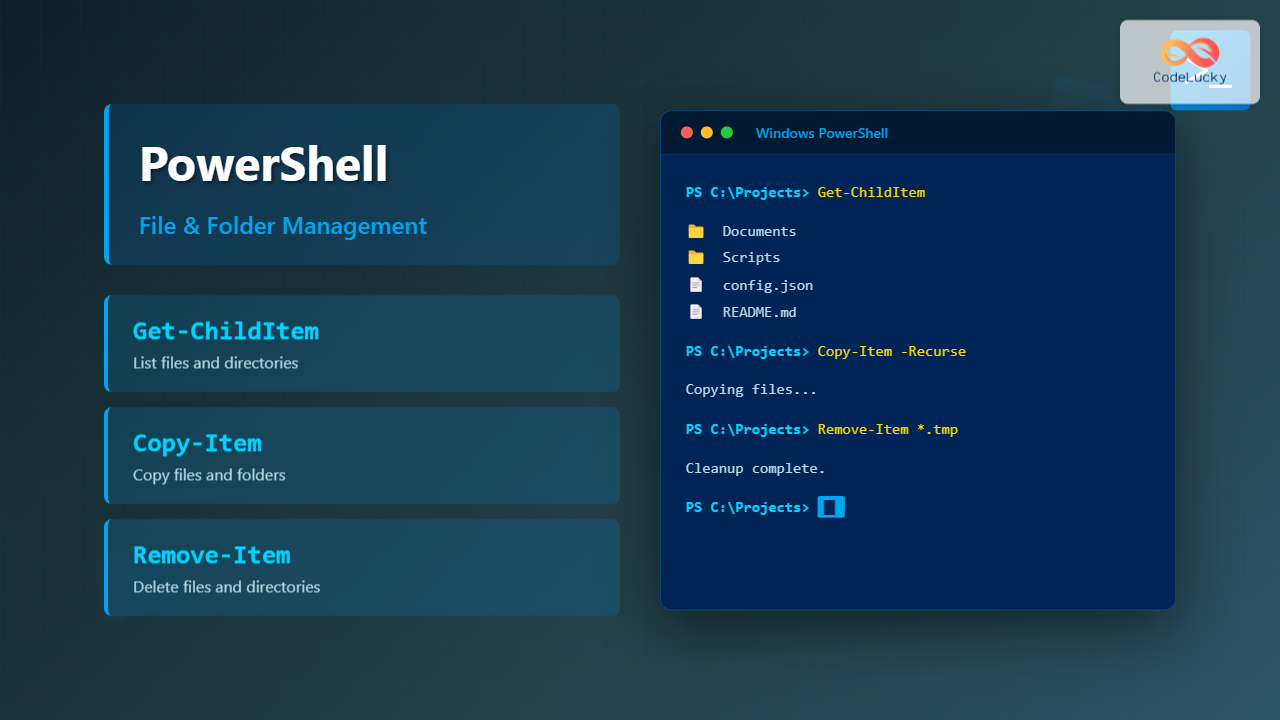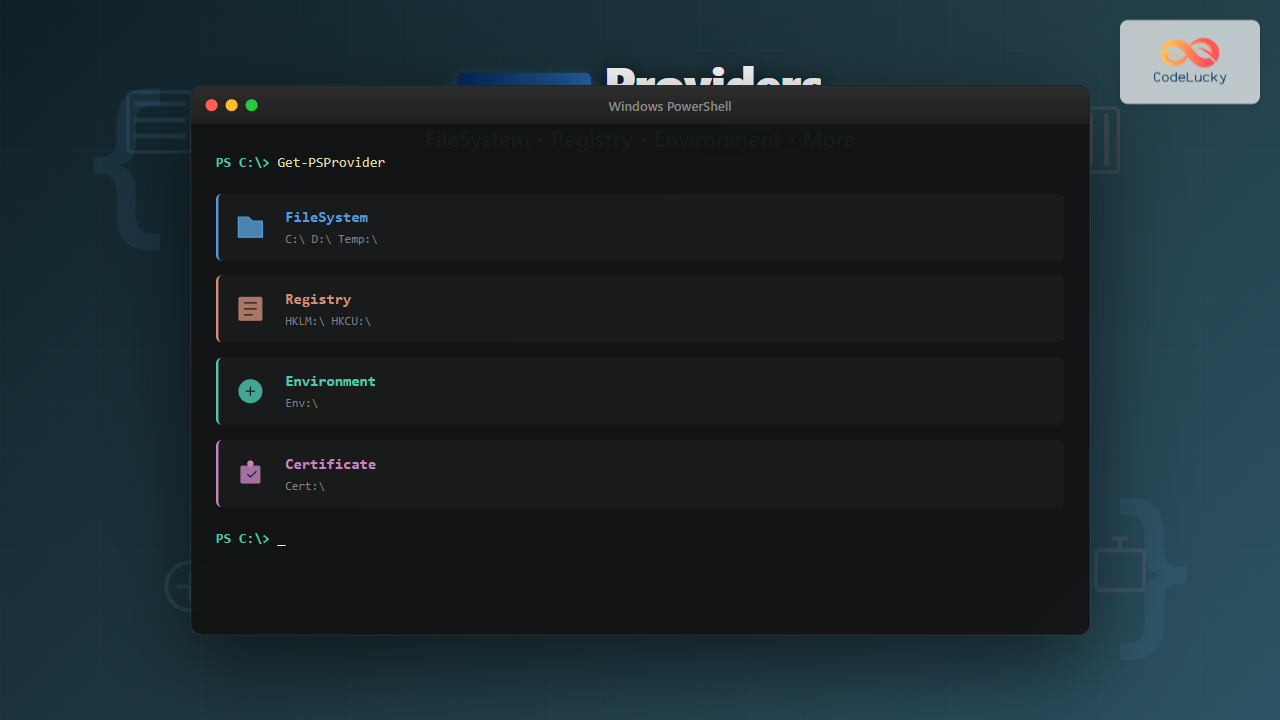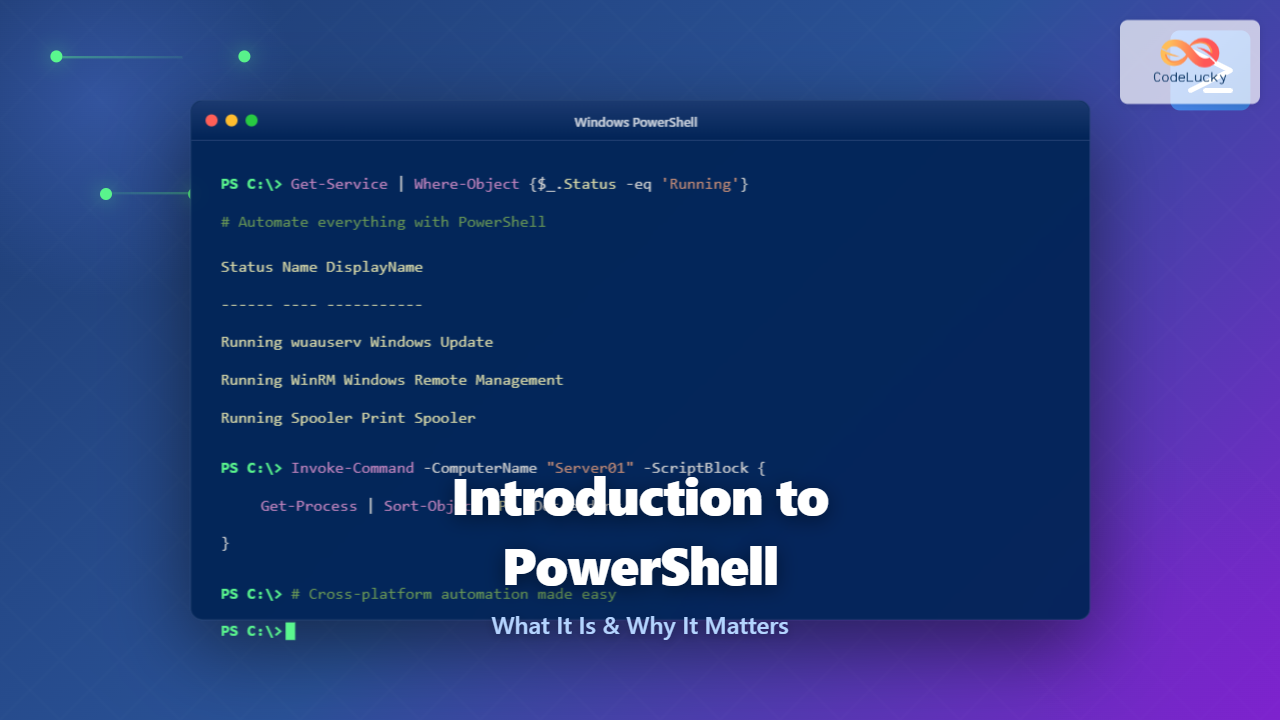
PowerShell has transformed how IT professionals interact with and manage Windows systems, cloud services, and enterprise infrastructure. Whether you’re a system administrator, developer, or IT professional, understanding PowerShell is no longer optional—it’s essential for efficient automation and management in modern computing environments.
What Is PowerShell?
PowerShell is a cross-platform task automation solution developed by Microsoft that combines a command-line shell, scripting language, and configuration management framework. Unlike traditional command-line interfaces that primarily work with text, PowerShell is built on the .NET framework and manipulates objects, making it significantly more powerful and flexible.
First released in 2006 as Windows PowerShell, it has evolved into PowerShell Core (now simply PowerShell 7+), which runs on Windows, Linux, and macOS. This evolution reflects Microsoft’s shift toward open-source development and cross-platform compatibility.
Key Components of PowerShell
PowerShell consists of three fundamental components that work together:
- Command-line Shell: An interactive interface where you execute commands immediately and see results
- Scripting Language: A powerful programming environment for creating automated workflows and complex scripts
- Configuration Management: Tools for managing system configurations through Desired State Configuration (DSC)

PowerShell vs Traditional Command Prompt
Understanding the difference between PowerShell and the traditional Command Prompt (cmd.exe) is crucial for appreciating PowerShell’s capabilities:
| Feature | Command Prompt (cmd.exe) | PowerShell |
|---|---|---|
| Data Type | Text-based output | Object-based output |
| Command Structure | Simple commands | Verb-Noun cmdlets |
| Scripting Capability | Basic batch files | Advanced scripting language |
| Pipeline Functionality | Text streams | Objects with properties and methods |
| Integration | Limited | .NET, WMI, COM, REST APIs |
| Cross-platform | Windows only | Windows, Linux, macOS |
Example: Listing Files
Here’s a simple comparison showing how both tools list files, but PowerShell provides much more power:
# Command Prompt
dir

# PowerShell
Get-ChildItem

# PowerShell with filtering and sorting
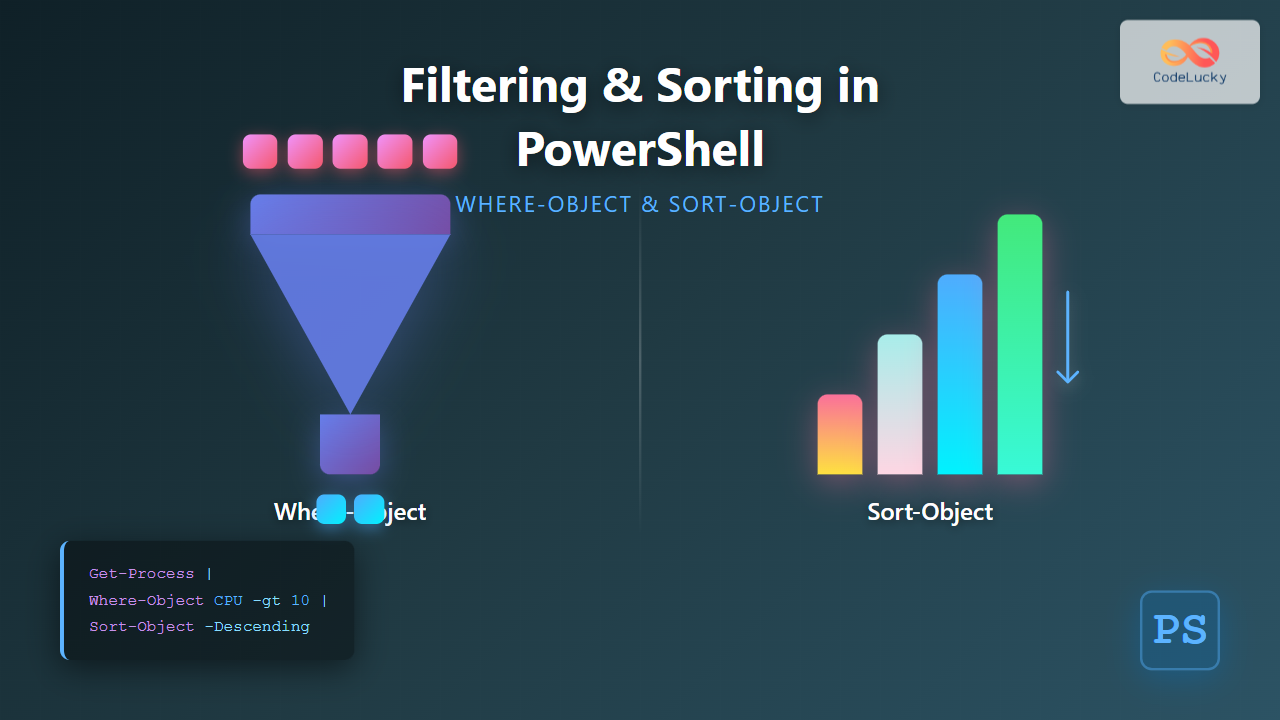
Get-ChildItem | Where-Object {$_.Length -gt 1MB} | Sort-Object Length -Descending
Output visualization:
Directory: C:\Users\Documents

Mode                 LastWriteTime         Length Name
----                 -------------         ------ ----
-a---          10/15/2025  2:30 PM        2547890 LargeReport.pdf
-a---          10/14/2025  4:15 PM        1893456 Presentation.pptx
-a---          10/10/2025  9:22 AM        1245678 Database.xlsx
Core Concepts: Understanding Cmdlets
PowerShell commands are called cmdlets (pronounced “command-lets”), and they follow a consistent Verb-Noun naming convention. This standardization makes PowerShell intuitive and predictable.
Common Verb Categories
- Get: Retrieves data (Get-Process, Get-Service, Get-Content)
- Set: Modifies data (Set-Location, Set-ExecutionPolicy)
- New: Creates new items (New-Item, New-Variable)
- Remove: Deletes items (Remove-Item, Remove-Variable)
- Start/Stop: Controls processes (Start-Service, Stop-Process)
Basic Cmdlet Example
# Get all running processes
Get-Process

# Get specific process
Get-Process -Name "chrome"

# Get process and display specific properties
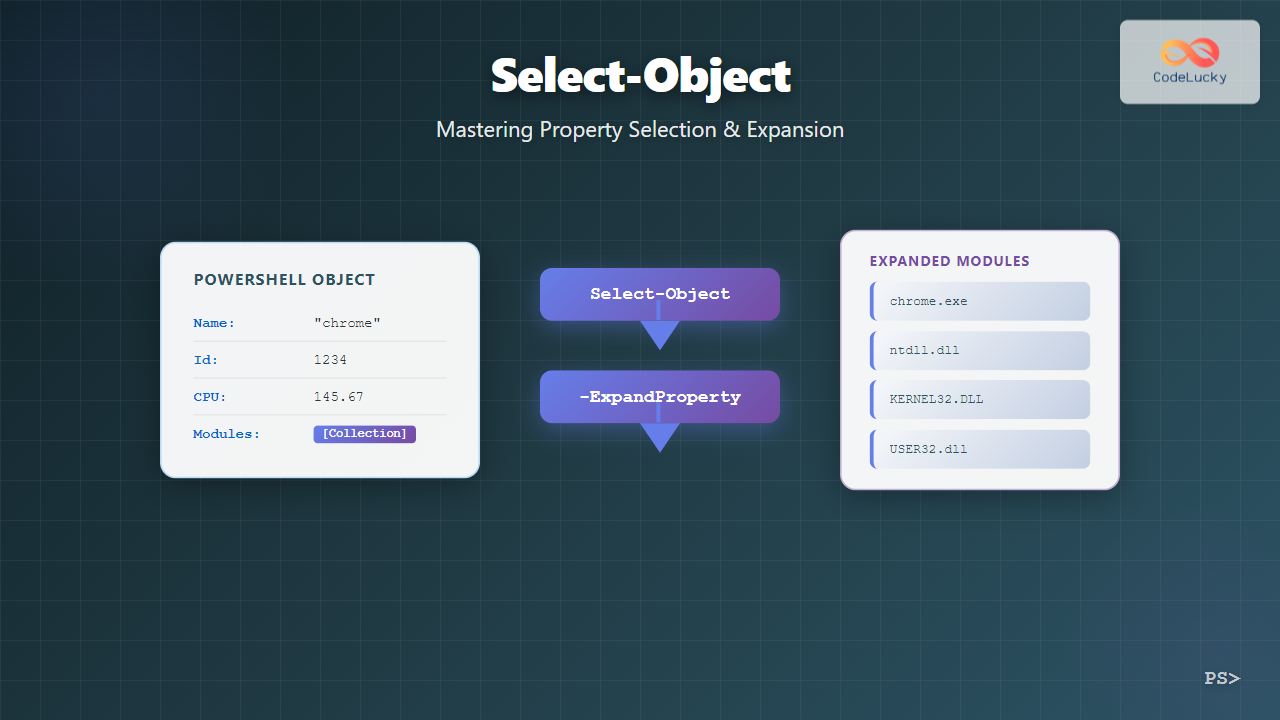
Get-Process | Select-Object Name, CPU, Memory | Format-Table
Sample Output:
Name                CPU(s)    Memory(MB)
----                ------    ----------
chrome              125.43         847.22
powershell           12.56         156.89
explorer             45.23         423.11
The Power of the Pipeline
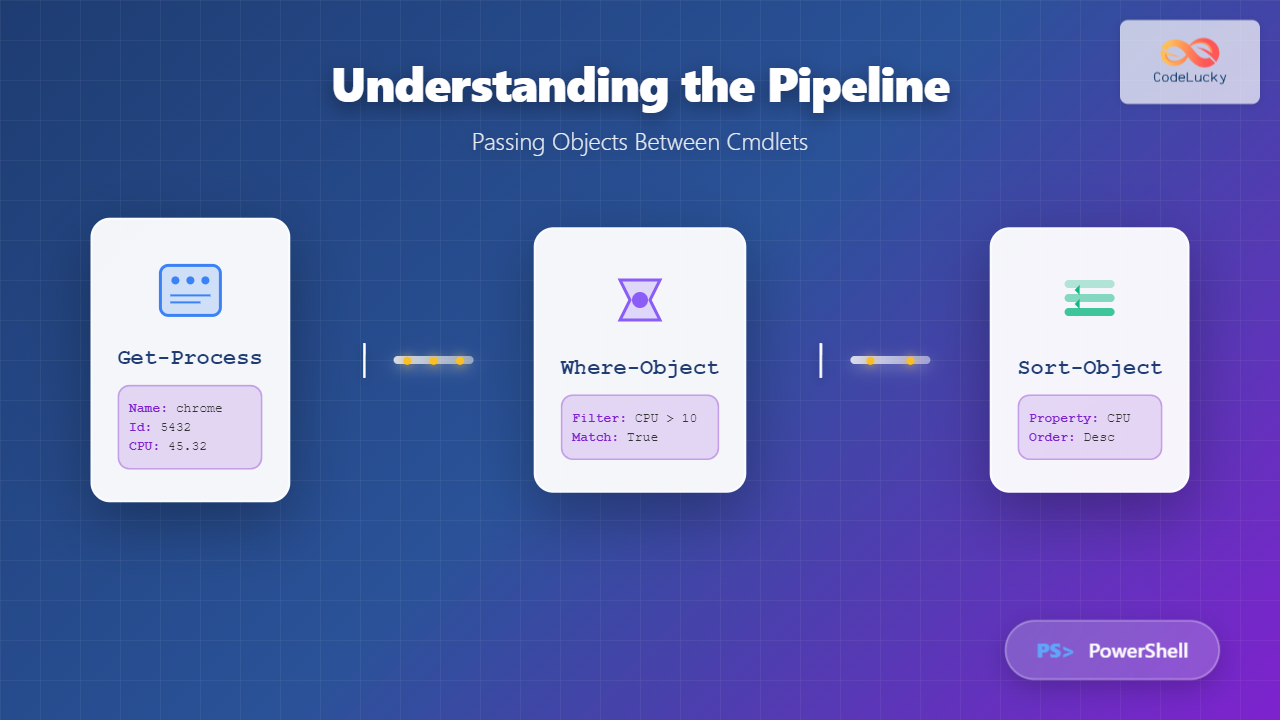
The pipeline is PowerShell’s most powerful feature. Unlike traditional shells that pass text between commands, PowerShell passes entire objects with properties and methods. This allows for sophisticated data manipulation without complex parsing.

Pipeline Example: Managing Services
# Get all stopped services, sort by name, and display first 5
Get-Service |
    Where-Object {$_.Status -eq 'Stopped'} |
    Sort-Object DisplayName |
    Select-Object -First 5 |
    Format-Table Name, DisplayName, Status

# Output:
# Name          DisplayName                    Status
# ----          -----------                    ------
# AJRouter      AllJoyn Router Service        Stopped
# ALG           Application Layer Gateway...  Stopped
# AppIDSvc      Application Identity          Stopped
# AppMgmt       Application Management        Stopped
# AppReadiness  App Readiness                 Stopped
Why PowerShell Matters: Real-World Benefits
Automation at Scale
PowerShell enables you to automate repetitive tasks that would take hours manually. Consider this scenario: you need to check disk space on 100 servers and generate a report.
# Without PowerShell: Log into each server manually (hours of work)
# With PowerShell: One script handles everything

$servers = Get-Content "servers.txt"
$results = foreach ($server in $servers) {
    $disk = Get-WmiObject Win32_LogicalDisk -ComputerName $server -Filter "DeviceID='C:'"
    [PSCustomObject]@{
        Server = $server
        FreeSpaceGB = [math]::Round($disk.FreeSpace / 1GB, 2)
        TotalSpaceGB = [math]::Round($disk.Size / 1GB, 2)
        PercentFree = [math]::Round(($disk.FreeSpace / $disk.Size) * 100, 2)
    }
}
$results | Export-Csv "DiskSpaceReport.csv" -NoTypeInformation
Consistent Management Across Platforms
PowerShell 7+ works identically across Windows, Linux, and macOS, allowing you to use the same scripts and tools regardless of the operating system.
# This works on Windows, Linux, and macOS
Get-ChildItem -Path /home/user/documents -Recurse |
    Where-Object {$_.Extension -eq '.log'} |
    Remove-Item -WhatIf
Cloud and DevOps Integration
PowerShell has become the de facto automation tool for cloud platforms and DevOps workflows:
- Azure: Az PowerShell module for managing Azure resources
- AWS: AWS Tools for PowerShell
- Microsoft 365: Manage users, mailboxes, SharePoint, and Teams
- Active Directory: Complete AD management without GUI

Essential PowerShell Features
Variables and Data Types
PowerShell handles variables intuitively with automatic type conversion:
# Creating variables
$name = "PowerShell"
$version = 7.3
$isAwesome = $true
$servers = @("Server01", "Server02", "Server03")

# Arrays and hash tables
$user = @{
    Name = "John Doe"
    Department = "IT"
    Role = "Administrator"
}

# Accessing hash table values
Write-Output "User: $($user.Name) - Department: $($user.Department)"
# Output: User: John Doe - Department: IT
Conditional Logic and Loops
# If statement
$diskSpace = 75
if ($diskSpace -gt 90) {
    Write-Output "Critical: Disk space above 90%"
} elseif ($diskSpace -gt 70) {
    Write-Output "Warning: Disk space above 70%"
} else {
    Write-Output "Disk space normal"
}

# ForEach loop
$services = @("Spooler", "W32Time", "WinRM")
foreach ($service in $services) {
    $status = (Get-Service -Name $service).Status
    Write-Output "$service is $status"
}

# Output:
# Spooler is Running
# W32Time is Running
# WinRM is Running
Functions and Reusability
# Creating a function
function Get-DiskInfo {
    param(
        [string]$ComputerName = $env:COMPUTERNAME,
        [string]$Drive = "C:"
    )

    $disk = Get-WmiObject Win32_LogicalDisk -ComputerName $ComputerName -Filter "DeviceID='$Drive'"

    [PSCustomObject]@{
        Computer = $ComputerName
        Drive = $Drive
        FreeGB = [math]::Round($disk.FreeSpace / 1GB, 2)
        TotalGB = [math]::Round($disk.Size / 1GB, 2)
        PercentFree = [math]::Round(($disk.FreeSpace / $disk.Size) * 100, 2)
    }
}

# Using the function
Get-DiskInfo
Get-DiskInfo -ComputerName "Server01" -Drive "D:"
Error Handling
# Try-Catch for robust error handling
try {
    $service = Get-Service -Name "NonExistentService" -ErrorAction Stop
    Start-Service -Name $service.Name
}
catch {
    Write-Output "Error occurred: $($_.Exception.Message)"
    # Log error or send notification
}
finally {
    Write-Output "Operation completed"
}

# Output:
# Error occurred: Cannot find any service with service name 'NonExistentService'.
# Operation completed
PowerShell in Action: Practical Use Cases
User Management
# Create multiple users from CSV
Import-Csv "NewUsers.csv" | ForEach-Object {
    New-ADUser -Name $_.Name `
               -GivenName $_.FirstName `
               -Surname $_.LastName `
               -Department $_.Department `
               -Title $_.JobTitle `
               -EmailAddress $_.Email `
               -AccountPassword (ConvertTo-SecureString $_.Password -AsPlainText -Force) `
               -Enabled $true
}
System Monitoring
# Monitor CPU usage and alert if high
while ($true) {
    $cpu = (Get-Counter '\Processor(_Total)\% Processor Time').CounterSamples.CookedValue

    if ($cpu -gt 80) {
        $message = "High CPU usage detected: $([math]::Round($cpu, 2))%"
        Write-Warning $message
        # Send email or notification
    }

    Start-Sleep -Seconds 30
}
File Operations
# Clean up old log files
Get-ChildItem -Path "C:\Logs" -Filter "*.log" -Recurse |
    Where-Object {$_.LastWriteTime -lt (Get-Date).AddDays(-30)} |
    Remove-Item -Force -WhatIf

# Archive files older than 90 days
$oldFiles = Get-ChildItem -Path "C:\Documents" -Recurse |
    Where-Object {$_.LastWriteTime -lt (Get-Date).AddDays(-90)}

Compress-Archive -Path $oldFiles.FullName -DestinationPath "C:\Archives\Archive_$(Get-Date -Format 'yyyy-MM-dd').zip"
Getting Started with PowerShell
Installation and Setup
PowerShell comes pre-installed on Windows 10 and later. For the latest version or for Linux/macOS:
# Check your PowerShell version
$PSVersionTable.PSVersion

# Output shows:
# Major  Minor  Build  Revision
# -----  -----  -----  --------
# 7      3      0      0
Essential Cmdlets to Learn First
# Discovery cmdlets
Get-Command          # Lists all available commands
Get-Help Get-Service # Gets help for specific cmdlet
Get-Member           # Shows properties and methods of objects

# Navigation and file operations
Get-Location         # Current directory (like pwd)
Set-Location         # Change directory (like cd)
Get-ChildItem        # List items (like dir/ls)
Copy-Item            # Copy files/folders
Move-Item            # Move files/folders
Remove-Item          # Delete files/folders

# System information
Get-Process          # Running processes
Get-Service          # System services
Get-EventLog         # Event logs (Windows)
Get-ComputerInfo     # System information

Using Get-Help Effectively
# Update help files (run once)
Update-Help -Force

# Get basic help
Get-Help Get-Service

# Get detailed help with examples
Get-Help Get-Service -Detailed

# Get specific examples
Get-Help Get-Service -Examples

# Get online help (opens browser)
Get-Help Get-Service -Online
PowerShell Best Practices
Naming and Formatting
- Use approved verbs for functions (Get-Verb shows the list)
- Follow PascalCase for function names and camelCase for variables
- Comment your code for clarity and maintenance
- Use meaningful variable and function names
Safe Execution
# Always test with -WhatIf first
Remove-Item -Path "C:\OldFiles\*" -Recurse -WhatIf

# Use -Confirm for critical operations
Stop-Service -Name "ImportantService" -Confirm

# Set execution policy appropriately
Set-ExecutionPolicy -ExecutionPolicy RemoteSigned -Scope CurrentUser
Performance Optimization
# Use filtering at the source (faster)
Get-Process | Where-Object {$_.CPU -gt 100}  # Slower
Get-Process | Where-Object CPU -GT 100        # Faster

# Use .NET methods when appropriate
[System.IO.File]::ReadAllLines("C:\file.txt")  # Faster than Get-Content for large files

# Measure script performance
Measure-Command {
    Get-ChildItem -Path C:\ -Recurse
}
Remote Management with PowerShell
PowerShell Remoting allows you to execute commands on remote computers, making it invaluable for managing multiple systems:
# Enable remoting (run on remote computer)
Enable-PSRemoting -Force

# Execute command on remote computer
Invoke-Command -ComputerName Server01 -ScriptBlock {
    Get-Service | Where-Object {$_.Status -eq 'Running'}
}

# Enter interactive session
Enter-PSSession -ComputerName Server01

# Execute on multiple computers
$servers = "Server01", "Server02", "Server03"
Invoke-Command -ComputerName $servers -ScriptBlock {
    Get-EventLog -LogName System -Newest 10
}
PowerShell Modules and Extension
Modules extend PowerShell’s functionality. The PowerShell Gallery hosts thousands of community and vendor modules:
# Find modules
Find-Module -Name "*Azure*"

# Install a module
Install-Module -Name Az -Scope CurrentUser

# Import a module
Import-Module Az

# List installed modules
Get-Module -ListAvailable

# View module commands
Get-Command -Module Az.Compute
Popular Modules
- Az: Azure management
- AWSPowerShell: AWS management
- ActiveDirectory: AD management
- ExchangeOnlineManagement: Exchange Online
- PSReadLine: Enhanced command-line editing
- Pester: Testing framework
Common Pitfalls and Solutions
Execution Policy Issues
# Error: Scripts are disabled on this system
# Solution: Set appropriate execution policy
Set-ExecutionPolicy -ExecutionPolicy RemoteSigned -Scope CurrentUser

# Check current policy
Get-ExecutionPolicy -List
Pipeline Understanding
# Common mistake: Treating objects as text
Get-Process | Select-String "chrome"  # Wrong approach

# Correct approach: Filter using object properties
Get-Process | Where-Object {$_.Name -like "*chrome*"}
Variable Scope
# Variables inside functions are local by default
function Test-Scope {
    $localVar = "I'm local"
    $global:globalVar = "I'm global"
}

Test-Scope
Write-Output $localVar      # Empty (not accessible)
Write-Output $globalVar     # Outputs: I'm global
The Future of PowerShell
PowerShell continues to evolve with regular updates and improvements. Key trends include:
- Deeper Cloud Integration: Enhanced modules for Azure, AWS, and multi-cloud environments
- Cross-platform Growth: Improved Linux and macOS support
- DevOps Adoption: Integration with CI/CD pipelines and infrastructure as code
- Security Focus: Enhanced security features and better auditing capabilities
- Performance Improvements: Faster execution and reduced memory footprint
Conclusion
PowerShell has evolved from a Windows-only scripting tool into a comprehensive, cross-platform automation framework that’s essential for modern IT professionals. Its object-oriented approach, consistent syntax, and extensive integration capabilities make it indispensable for system administration, cloud management, and DevOps workflows.
Whether you’re managing a single server or thousands of cloud resources, automating routine tasks or building complex deployment pipelines, PowerShell provides the tools and flexibility you need. The learning curve is gentle thanks to its intuitive cmdlet naming and comprehensive help system, while the depth of capability ensures you’ll continue discovering powerful features as your skills grow.
Starting with basic cmdlets and gradually incorporating automation, error handling, and remote management will transform how you work with technology. The investment in learning PowerShell pays immediate dividends in time saved and consistency gained, while positioning you for success in increasingly automated IT environments.