In English, words have different roles — nouns name things, verbs show actions, adjectives describe. But sometimes, when emotions take over, we don’t think in grammar — we just react! Those short, emotional reactions are called interjections. They bring energy, expression, and authenticity to our speech.
What Are Interjections?
Interjections are words or short phrases that express sudden feelings or emotions. They often stand alone and are followed by an exclamation mark. Even though they don’t add grammatical value to a sentence, they play a big role in making speech natural and emotional.
Examples:
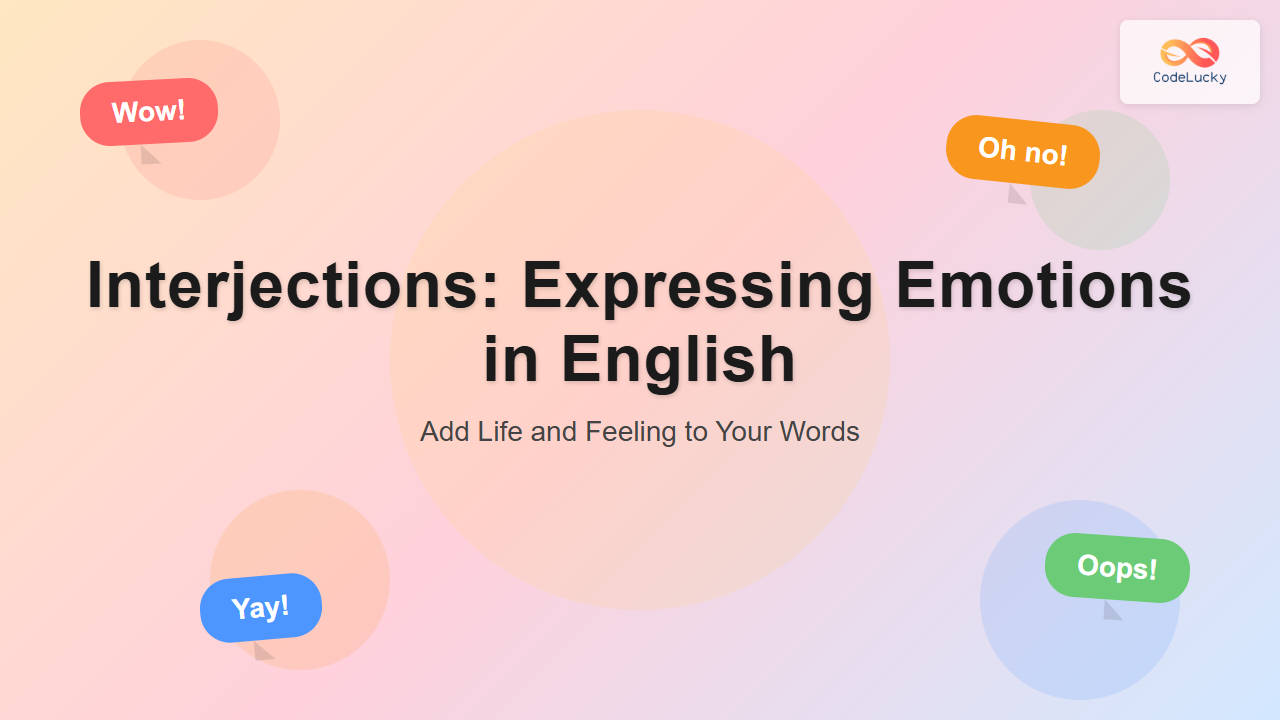
- Wow! That sunset looks amazing.
- Oops! I dropped my keys.
- Yay! We won the contest!
Each interjection conveys a specific emotion — surprise, regret, joy, pain, etc. Learning to use them helps English learners sound more fluent and emotionally connected.
Types of Interjections
Interjections can express a wide range of emotions. Here’s a breakdown:

Let’s understand these types with examples and meanings.
1. Interjections of Happiness
Used to express joy, excitement, or satisfaction.
- Yippee! We’re going on a holiday.
- Hurray! Our team scored the winning goal.
- Wow! What a beautiful painting.
2. Interjections of Surprise
Show sudden amazement or disbelief.
- Oh! I didn’t expect to see you here.
- What! You’re moving abroad?
- Whoa! That was so close!
3. Interjections of Sorrow
Express sadness, pity, or regret.
- Alas! The old temple was destroyed.
- Oh no! I forgot my wallet at home.
- Ouch! That really hurt my arm.
4. Interjections of Anger
Show dissatisfaction, annoyance, or frustration.
- Hey! Don’t talk to me like that.
- Ugh! This room is so messy.
- Damn! I missed the bus again.
5. Interjections of Pain
Used to show physical or emotional discomfort.
- Ouch! That sting was sharp.
- Ah! My back hurts.
- Ow! That was a rough tackle.
6. Interjections of Greeting or Parting
Used while meeting or departing from someone.
- Hello! How are you doing?
- Goodbye! See you tomorrow.
- Hi! Long time no see.
Punctuation of Interjections
Interjections can be followed by either a comma or an exclamation mark depending on their intensity.
| Emotion Intensity | Punctuation | Example |
|---|---|---|
| Strong Emotion | Exclamation Mark (!) | Wow! That’s unbelievable! |
| Mild Emotion | Comma (,) | Well, let’s start the meeting. |

Placement of Interjections in Sentences
Although interjections often stand alone, they can also appear at different positions in a sentence to create a conversational tone.

Interactive Practice: Identify the Emotion
Try to match each interjection below with its emotion:
- Ouch! – ______
- Hurray! – ______
- Oh no! – ______
- Hey! – ______
Click to check answers
- Ouch! – Pain
- Hurray! – Happiness
- Oh no! – Sorrow
- Hey! – Anger or Attention
Common Mistakes with Interjections
- Adding too many interjections makes writing feel exaggerated. Use them naturally.
- For formal writing (e.g., business emails), interjections are rarely appropriate.
- Don’t confuse interjections with exclamations. An exclamation can be a full sentence showing emotion, while an interjection is generally a single word or phrase.
Using Interjections in Spoken and Written English
Spoken English: Interjections help convey tone naturally. For example, “Oops!” instantly shows concern for a mistake.
Written English: In narratives or dialogues, interjections make characters sound realistic. For instance:
“Oh no! Did you leave the door open?” asked Rina.Learning how to use interjections enriches your English — it allows you to show emotions, not just describe them.
Quick Review
- Interjections express emotions or reactions.
- They are often followed by an exclamation mark.
- Different interjections reflect specific emotions like joy, sorrow, anger, and surprise.
- They make conversation lively and expressive.
Conclusion
Interjections may be short, but they pack a lot of feeling. They turn plain sentences into expressive speech. Whether you say “Yay!” to celebrate or “Oops!” after a mistake, you’re showing genuine emotion. Master them, and your English will sound more natural, human, and engaging.