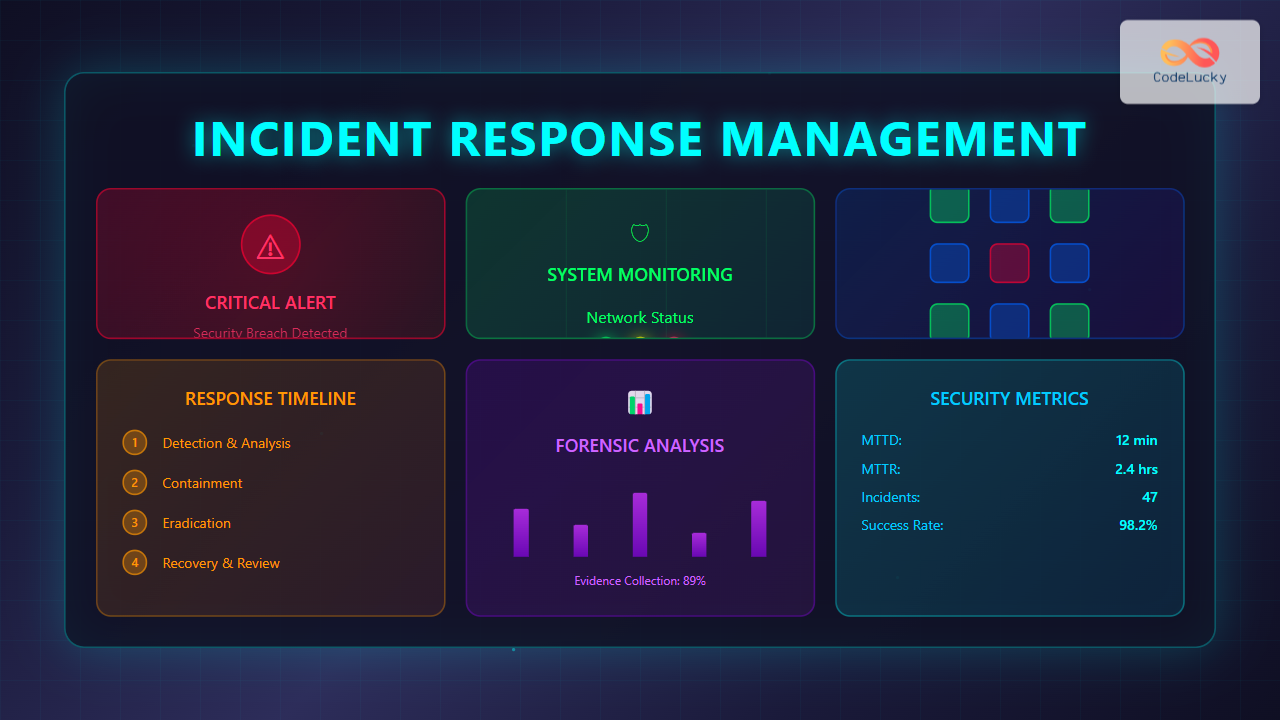
Security incidents are inevitable in today’s digital landscape. Whether you’re managing a small business network or enterprise infrastructure, having a robust incident response plan can mean the difference between a minor disruption and a catastrophic breach. This comprehensive guide covers everything system administrators need to know about effective security breach management.
Understanding Security Incidents
A security incident is any event that compromises the confidentiality, integrity, or availability of information systems. These can range from malware infections and unauthorized access attempts to data breaches and denial-of-service attacks.
Common Types of Security Incidents
- Malware Infections: Viruses, ransomware, trojans, and spyware
- Unauthorized Access: Credential compromise, privilege escalation
- Data Breaches: Unauthorized data exposure or theft
- Denial of Service: System availability disruption
- Insider Threats: Malicious or accidental actions by internal users
- Physical Security Breaches: Unauthorized physical access to systems

The Incident Response Framework
Effective incident response follows a structured approach that ensures consistent and thorough handling of security events. The most widely adopted framework consists of six key phases:
1. Preparation Phase
The foundation of any successful incident response program lies in thorough preparation. This phase involves establishing policies, procedures, and the necessary infrastructure before incidents occur.
Key Preparation Activities:
- Incident Response Team Formation: Assemble a cross-functional team with defined roles
- Policy Development: Create comprehensive incident response policies
- Tool Deployment: Implement monitoring, analysis, and communication tools
- Training Programs: Regular training for team members and end users
- Communication Plans: Establish internal and external communication procedures
Sample Incident Response Team Structure:
| Role | Responsibilities | Skills Required |
|---|---|---|
| Incident Commander | Overall incident management, decision-making, external communications | Leadership, communication, technical overview |
| Security Analyst | Technical investigation, evidence collection, threat analysis | Cybersecurity expertise, forensics, malware analysis |
| System Administrator | System isolation, recovery, infrastructure management | Network administration, system configuration |
| Legal Counsel | Regulatory compliance, legal implications assessment | Cybersecurity law, privacy regulations |
| Communications Lead | Public relations, customer communications, media relations | Public relations, crisis communication |
2. Identification Phase
The identification phase focuses on detecting and recognizing security incidents as quickly as possible. Early detection significantly reduces the potential impact of security breaches.
Detection Methods:
- Automated Monitoring: SIEM systems, IDS/IPS, antivirus alerts
- User Reports: End-user notifications of suspicious activity
- Third-party Notifications: External security researchers, law enforcement
- Routine Audits: Regular security assessments and log reviews
Incident Classification Example:
INCIDENT SEVERITY LEVELS:

CRITICAL (P1)
- Active data breach with confirmed data loss
- Ransomware encryption of critical systems
- Complete system compromise of critical infrastructure
- Response Time: <15 minutes

HIGH (P2)
- Suspected unauthorized access to sensitive systems
- Malware detection on critical servers
- Significant service disruption
- Response Time: <1 hour

MEDIUM (P3)
- Malware on non-critical systems
- Attempted unauthorized access (blocked)
- Minor service disruptions
- Response Time: <4 hours

LOW (P4)
- Policy violations
- Suspicious but unconfirmed activity
- Non-critical system anomalies
- Response Time: <24 hours
3. Containment Phase
Once an incident is identified, immediate action must be taken to prevent further damage. Containment strategies vary depending on the type and severity of the incident.

Containment Strategies:
Network-level Containment:
- Network Segmentation: Isolate affected systems from the network
- Firewall Rules: Block malicious traffic patterns
- DNS Blocking: Prevent communication with command and control servers
Host-level Containment:
- Process Termination: Kill malicious processes
- Service Shutdown: Stop compromised services
- Account Suspension: Disable compromised user accounts
Containment Decision Matrix:
| Incident Type | Immediate Action | Considerations |
|---|---|---|
| Ransomware | Immediate network isolation | Preserve evidence, prevent spread |
| Data Breach | Block unauthorized access | Legal requirements, customer notification |
| Malware | Isolate infected systems | Identify infection vector, scope assessment |
| Insider Threat | Suspend user access | HR coordination, evidence preservation |
4. Eradication Phase
After containing the incident, the next step involves completely removing the threat from the environment and addressing the root cause.
Eradication Activities:
- Malware Removal: Complete elimination of malicious software
- Vulnerability Patching: Address security weaknesses exploited
- System Hardening: Implement additional security controls
- Credential Reset: Change compromised passwords and certificates
Sample Malware Eradication Process:
MALWARE ERADICATION CHECKLIST:

□ Identify all infected systems
□ Document malware characteristics
□ Create system backups (clean state)
□ Boot from clean media
□ Run comprehensive antimalware scans
□ Manually remove persistent artifacts
□ Verify system integrity
□ Apply security patches
□ Update security configurations
□ Test system functionality
□ Monitor for reinfection signs
5. Recovery Phase
The recovery phase focuses on restoring affected systems to normal operations while maintaining enhanced monitoring for potential recurring issues.

Recovery Best Practices:
- Phased Approach: Gradual restoration of services and access
- Enhanced Monitoring: Increased logging and alerting during initial recovery
- Validation Testing: Comprehensive testing before full restoration
- User Communication: Regular updates to affected stakeholders
Recovery Timeline Example:
| Phase | Duration | Activities | Success Criteria |
|---|---|---|---|
| Validation | 2-4 hours | System integrity checks, security scans | No malware detected, systems stable |
| Limited Recovery | 4-8 hours | Core services restoration, limited access | Critical operations functional |
| Full Recovery | 12-24 hours | Complete service restoration | Normal operations resumed |
| Monitoring | 30 days | Enhanced surveillance, performance tracking | No recurring incidents |
6. Lessons Learned Phase
The final phase involves conducting a thorough post-incident review to identify improvements and prevent similar incidents in the future.
Post-Incident Review Components:
- Timeline Reconstruction: Detailed incident chronology
- Root Cause Analysis: Identification of underlying vulnerabilities
- Response Evaluation: Assessment of team performance and procedures
- Improvement Recommendations: Specific actions to enhance security posture
Incident Response Tools and Technologies
Modern incident response requires a comprehensive toolkit that enables efficient detection, analysis, and remediation of security incidents.
Essential Tool Categories:
1. Security Information and Event Management (SIEM)
- Purpose: Centralized log collection and analysis
- Key Features: Real-time monitoring, correlation rules, alerting
- Popular Solutions: Splunk, IBM QRadar, Elastic Security
2. Forensic Analysis Tools
- Network Forensics: Wireshark, NetworkMiner, TCPDUMP
- Disk Forensics: Autopsy, FTK, EnCase
- Memory Analysis: Volatility, Rekall, WinPmem
3. Threat Intelligence Platforms
- Commercial Feeds: Recorded Future, CrowdStrike, FireEye
- Open Source: MISP, OpenCTI, STIX/TAXII
- Government Sources: US-CERT, NCSC advisories

Building an Incident Response Plan
A well-structured incident response plan serves as the roadmap for handling security incidents effectively and consistently.
Plan Components:
1. Executive Summary
- Purpose and scope of the plan
- Key objectives and success metrics
- Management support and authority
2. Organizational Structure
- Team roles and responsibilities
- Escalation procedures
- External partner contacts
3. Communication Procedures
- Internal notification processes
- External reporting requirements
- Media and public relations guidelines
4. Incident Categories and Procedures
- Detailed response procedures for each incident type
- Evidence collection and preservation guidelines
- Recovery and restoration procedures
Sample Incident Response Playbook Structure:
INCIDENT RESPONSE PLAYBOOK TEMPLATE:

1. INCIDENT OVERVIEW
   - Incident type and description
   - Potential impact assessment
   - Initial response timeline

2. PRE-INCIDENT PREPARATION
   - Required tools and resources
   - Team member assignments
   - Communication contacts

3. DETECTION AND ANALYSIS
   - Indicators of compromise
   - Analysis procedures
   - Evidence collection steps

4. CONTAINMENT AND ERADICATION
   - Immediate containment actions
   - Eradication procedures
   - Verification steps

5. RECOVERY AND POST-INCIDENT
   - Recovery procedures
   - Monitoring requirements
   - Lessons learned template
Real-World Incident Response Examples
Example 1: Ransomware Incident
Scenario:
A healthcare organization discovers that 50 workstations are displaying ransomware messages demanding payment for data decryption.
Response Timeline:
| Time | Action | Responsible Party | Result |
|---|---|---|---|
| T+0 | Initial detection by user report | End User | Help desk ticket created |
| T+10min | Incident confirmation and classification | IT Security | P1 incident declared |
| T+15min | Network isolation of affected systems | Network Admin | Spread contained |
| T+30min | Backup verification and recovery planning | Backup Admin | Clean backups identified |
| T+2hrs | Forensic imaging of affected systems | IR Team | Evidence preserved |
| T+4hrs | System rebuilding from clean backups | System Admins | Core systems restored |
| T+24hrs | Full operations restoration | All Teams | Normal operations resumed |
Example 2: Data Breach Incident
Scenario:
Security monitoring detects unauthorized access to a database containing customer personal information.
Key Response Actions:
- Immediate Containment: Database access terminated, accounts suspended
- Impact Assessment: Forensic analysis reveals 10,000 customer records accessed
- Legal Compliance: Breach notification requirements triggered
- Customer Communication: Notification letters sent within 72 hours
- Remediation: Database hardening, access controls enhanced
Compliance and Legal Considerations
Incident response must align with various regulatory requirements and legal obligations that vary by industry and geographic location.
Key Regulatory Frameworks:
General Data Protection Regulation (GDPR)
- Notification Timeline: 72 hours to regulatory authorities
- Customer Notification: Without undue delay when high risk
- Documentation Requirements: Comprehensive incident records
Health Insurance Portability and Accountability Act (HIPAA)
- Breach Definition: Unauthorized access to protected health information
- Notification Requirements: 60 days to affected individuals
- Risk Assessment: Four-factor analysis for breach determination
Payment Card Industry Data Security Standard (PCI DSS)
- Incident Response Plan: Documented and tested annually
- Forensic Investigation: PCI Forensic Investigator engagement
- Card Brand Notification: Immediate notification requirements

Continuous Improvement and Metrics
Effective incident response programs require ongoing measurement, evaluation, and improvement to maintain their effectiveness.
Key Performance Indicators (KPIs):
Response Time Metrics:
- Mean Time to Detection (MTTD): Average time from incident occurrence to detection
- Mean Time to Response (MTTR): Average time from detection to initial response
- Mean Time to Recovery (MTTR): Average time from detection to full recovery
Effectiveness Metrics:
- Incident Volume Trends: Number and types of incidents over time
- False Positive Rate: Percentage of alerts that are not actual incidents
- Repeat Incident Rate: Percentage of incidents that recur after resolution
Sample Incident Response Metrics Dashboard:
| Metric | Current Month | Previous Month | Trend | Target |
|---|---|---|---|---|
| MTTD | 45 minutes | 52 minutes | ↓ 13% | <30 minutes |
| MTTR | 3.2 hours | 4.1 hours | ↓ 22% | <2 hours |
| Incidents Resolved | 47 | 52 | ↓ 10% | N/A |
| False Positive Rate | 15% | 18% | ↓ 17% | <10% |
Emerging Challenges and Future Considerations
The incident response landscape continues to evolve with new technologies, threats, and business requirements.
Current and Emerging Challenges:
Cloud Security Incidents
- Multi-cloud Environments: Complex visibility and control challenges
- Shared Responsibility: Unclear boundaries between provider and customer
- API Security: New attack vectors and investigation challenges
Internet of Things (IoT) Incidents
- Device Diversity: Heterogeneous ecosystems with limited security controls
- Scale Challenges: Massive numbers of connected devices
- Limited Forensics: Reduced logging and analysis capabilities
Artificial Intelligence and Machine Learning
- Automated Response: AI-driven incident detection and response
- Adversarial AI: New attack methods targeting AI systems
- Explainable Decisions: Need for transparent AI decision-making
Conclusion
Effective incident response is not just about having the right tools and procedures—it’s about building a culture of security awareness, continuous improvement, and organizational resilience. The key to successful security breach management lies in preparation, rapid response, thorough investigation, and learning from each incident.
Organizations that invest in comprehensive incident response capabilities are better positioned to minimize the impact of security incidents, maintain customer trust, and meet regulatory obligations. As the threat landscape continues to evolve, so too must incident response strategies, incorporating new technologies, methodologies, and best practices.
Remember that incident response is not a one-time implementation but an ongoing process that requires regular testing, updating, and refinement. By following the frameworks, procedures, and best practices outlined in this guide, system administrators can build robust incident response programs that effectively protect their organizations against the ever-changing cybersecurity threat landscape.
The investment in proper incident response planning pays dividends not just during security incidents, but also in building organizational confidence, meeting compliance requirements, and maintaining business continuity in an increasingly connected world.