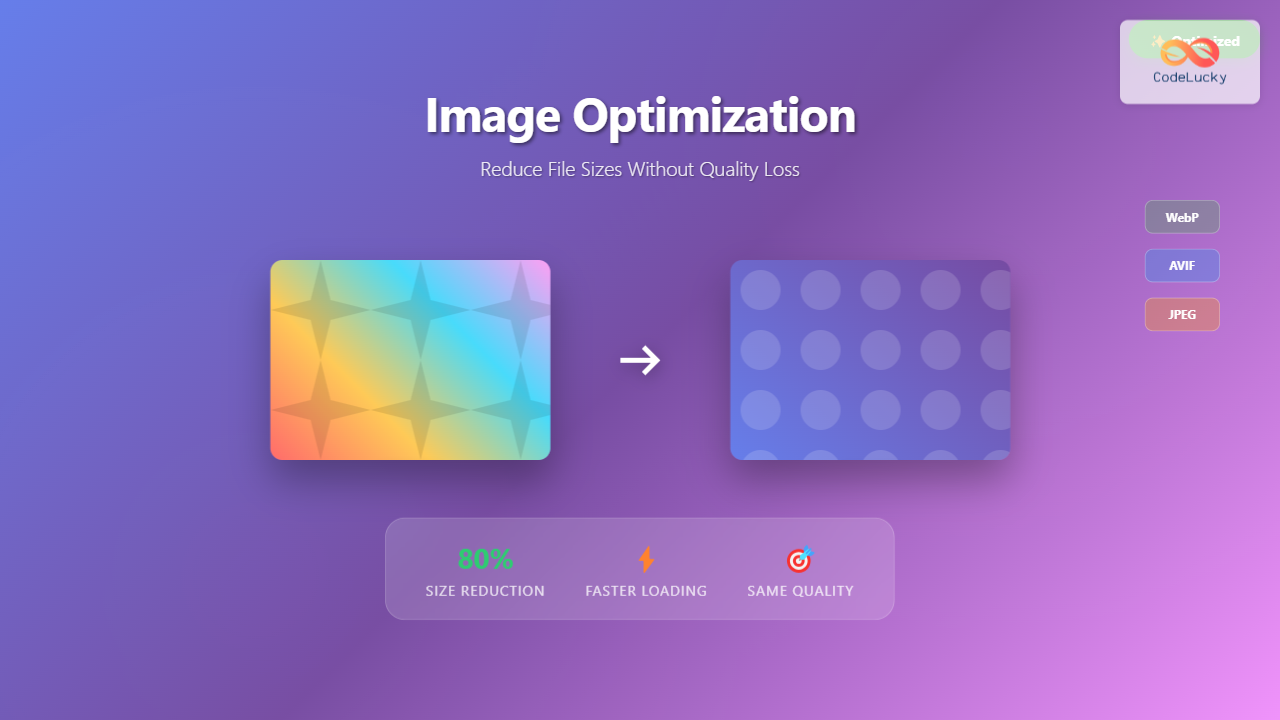
Web image optimization is crucial for modern web development, directly impacting page load times, user experience, and search engine rankings. With images accounting for over 60% of web page weight on average, proper optimization can reduce file sizes by 50-80% while maintaining visual quality.
Understanding Image File Formats
Choosing the right image format is the foundation of effective optimization. Each format serves different purposes and offers unique advantages.

JPEG – The Photography Standard
JPEG excels at compressing photographic images with millions of colors. It uses lossy compression, making it ideal for photographs where slight quality reduction is acceptable for significant file size savings.
- Best for: Photographs, complex images with many colors
- Compression ratio: 10:1 to 20:1 typical
- Quality settings: 85-95% for high quality, 75-85% for web optimized
PNG – Lossless Precision
PNG provides lossless compression with excellent transparency support. PNG-8 works well for simple graphics with limited colors, while PNG-24 handles complex images with full transparency.
- PNG-8: Up to 256 colors, smaller file sizes
- PNG-24: Millions of colors, larger but high quality
- Best for: Logos, icons, images requiring transparency
WebP – Modern Efficiency
WebP offers superior compression compared to JPEG and PNG, reducing file sizes by 25-35% while maintaining equivalent quality. It supports both lossy and lossless compression plus transparency.
<picture>
  <source srcset="image.webp" type="image/webp">
  <source srcset="image.jpg" type="image/jpeg">
  <img src="image.jpg" alt="Optimized image" loading="lazy">
</picture>
AVIF – Next-Generation Format
AVIF provides even better compression than WebP, offering 50% smaller file sizes compared to JPEG with equivalent quality. Browser support is growing rapidly.
Compression Techniques and Tools

Lossless Optimization
Lossless optimization removes unnecessary data without affecting image quality:
- Metadata removal: Strip EXIF data, color profiles, comments
- Encoding optimization: Improve compression algorithms
- Palette optimization: Reduce color palette for PNG images
Lossy Compression Strategies
Strategic lossy compression achieves significant size reductions with minimal visual impact:
// Example using Sharp.js for Node.js
const sharp = require('sharp');

await sharp('input.jpg')
  .jpeg({
    quality: 85,
    progressive: true,
    mozjpeg: true
  })
  .toFile('output.jpg');

// WebP conversion
await sharp('input.jpg')
  .webp({
    quality: 80,
    effort: 6
  })
  .toFile('output.webp');
Popular Optimization Tools
- Online tools: TinyPNG, Squoosh, Compressor.io
- Command line: ImageOptim, mozjpeg, cwebp
- Build tools: imagemin, sharp, webpack plugins
- CDN solutions: Cloudinary, ImageKit, Fastly
Responsive Images Implementation
Responsive images ensure optimal file sizes across different devices and screen resolutions, preventing mobile users from downloading desktop-sized images.

srcset and sizes Attributes
The srcset attribute enables browsers to choose appropriate image sizes based on device characteristics:
<img
  src="hero-800.jpg"
  srcset="
    hero-400.jpg 400w,
    hero-800.jpg 800w,
    hero-1200.jpg 1200w,
    hero-1600.jpg 1600w"
  sizes="
    (max-width: 400px) 100vw,
    (max-width: 800px) 80vw,
    50vw"
  alt="Hero image"
  loading="lazy">
Art Direction with Picture Element
The <picture> element enables art direction, serving different crops or compositions for different screen sizes:
<picture>
  <source media="(max-width: 600px)"
          srcset="mobile-portrait.webp"
          type="image/webp">
  <source media="(max-width: 600px)"
          srcset="mobile-portrait.jpg">
  <source srcset="desktop-landscape.webp"
          type="image/webp">
  <img src="desktop-landscape.jpg"
       alt="Responsive image with art direction">
</picture>
Advanced Loading Strategies
Development Workflow Integration
Automate image optimization in your build process:
// webpack.config.js example
const ImageMinimizerPlugin = require('image-minimizer-webpack-plugin');

module.exports = {
  optimization: {
    minimizer: [
      new ImageMinimizerPlugin({
        minimizer: {
          implementation: ImageMinimizerPlugin.sharpMinify,
          options: {
            encodeOptions: {
              jpeg: { quality: 85, progressive: true },
              webp: { quality: 80 },
              avif: { quality: 70 },
              png: { compressionLevel: 8 }
            }
          }
        },
        generator: [
          {
            type: 'asset',
            preset: 'webp-custom-name',
            test: /\.(jpe?g|png)$/i,
            options: {
              encodeOptions: {
                webp: { quality: 80 }
              }
            }
          }
        ]
      })
    ]
  }
};
Testing and Validation
Regular testing ensures optimization effectiveness:
- Visual comparison: Use tools like SSIM for quality assessment
- Performance metrics: Monitor LCP, CLS, and loading times
- Cross-browser testing: Verify format support and fallbacks
- Mobile optimization: Test on various devices and connection speeds
Common Pitfalls and Solutions
Over-compression: Avoid aggressive compression that degrades visual quality. Always test different quality settings and compare results visually.
Format inconsistency: Ensure proper fallbacks for modern formats. Not all browsers support WebP or AVIF yet.
Lazy loading issues: Be cautious with lazy loading above-the-fold images, as this can negatively impact LCP scores.
Responsive image complexity: Start simple with basic responsive images before implementing complex art direction scenarios.
Measuring Success
Track key performance indicators to validate your optimization efforts:
- File size reduction: Measure before/after compression ratios
- Page load speed: Monitor First Contentful Paint (FCP) and Largest Contentful Paint (LCP)
- User experience: Track bounce rates and engagement metrics
- SEO impact: Monitor search rankings and Core Web Vitals scores
Effective image optimization requires balancing file size, visual quality, and user experience. By implementing modern formats, responsive techniques, and smart loading strategies, you can achieve significant performance improvements while maintaining excellent visual presentation across all devices and connection speeds.