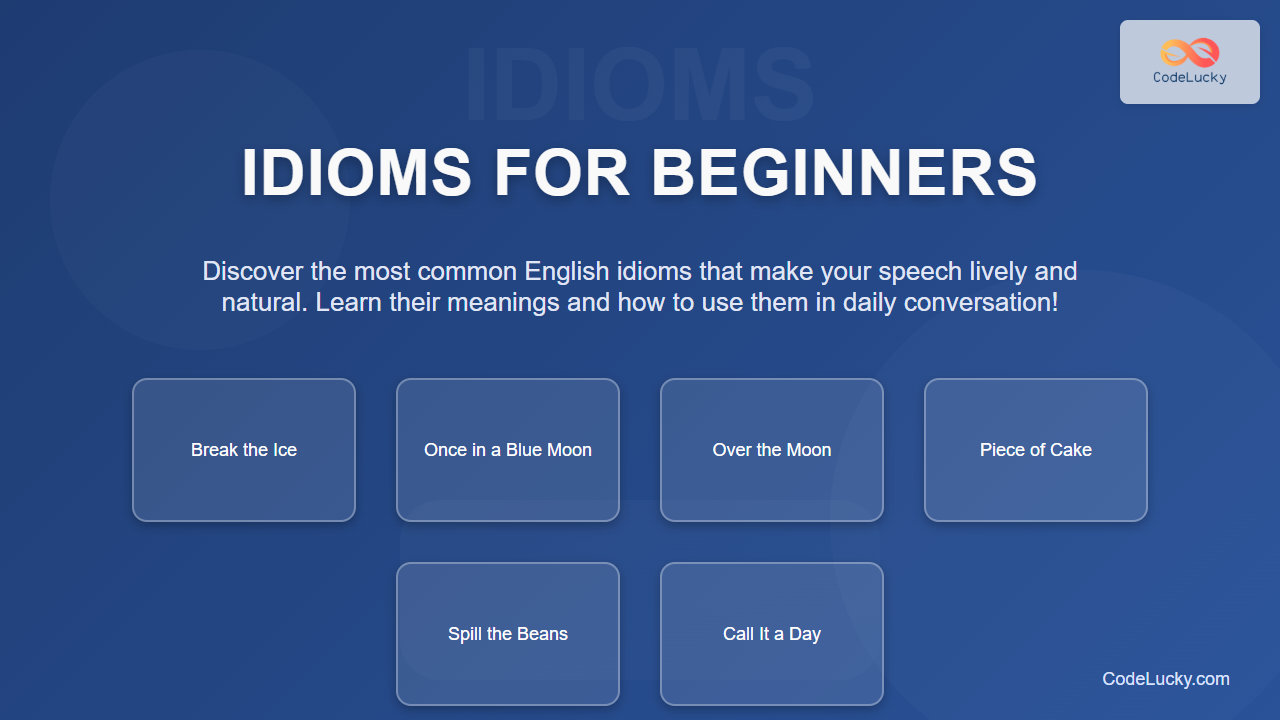
Idioms are expressions whose meanings cannot be understood from the individual words alone. They’re essential for natural English communication and understanding native speakers. This comprehensive guide introduces common idioms that every beginner should know, complete with practical examples and usage contexts.
What Are Idioms?
An idiom is a phrase or expression that has a figurative meaning different from its literal meaning. For example, “it’s raining cats and dogs” doesn’t mean animals are falling from the sky—it means it’s raining very heavily. Learning idioms helps you sound more natural and understand everyday English conversations better.

Time-Related Idioms
1. Once in a Blue Moon
Meaning: Very rarely; almost never
Example: “I only eat fast food once in a blue moon because I prefer cooking at home.”
Usage Context: Use this when describing something that happens very infrequently.
2. Beat Around the Bush
Meaning: Avoid talking directly about something; delay getting to the point
Example: “Stop beating around the bush and tell me what you really think about my presentation.”
Usage Context: Used when someone is being indirect or avoiding the main topic.
3. Better Late Than Never
Meaning: It’s better to do something late than not do it at all
Example: “You’re finally learning to drive at 35? Well, better late than never!”
Usage Context: Encourages someone who started something later than expected.
4. Call It a Day
Meaning: Stop working on something; finish for today
Example: “We’ve been studying for three hours. Let’s call it a day and continue tomorrow.”
Usage Context: Used when deciding to stop an activity and resume later.
Money and Success Idioms
5. Break the Bank
Meaning: Cost too much money; be very expensive
Example: “This vacation won’t break the bank—the hotel is quite affordable.”
Usage Context: Discussing the cost of something, usually in the negative form.
6. Cost an Arm and a Leg
Meaning: Be extremely expensive
Example: “That designer handbag costs an arm and a leg. I could never afford it.”
Usage Context: Emphasizing that something is overpriced or unaffordable.
7. Hit the Jackpot
Meaning: Have great success or good luck, especially financially
Example: “Sarah really hit the jackpot with her new job—great salary and benefits!”
Usage Context: Celebrating someone’s success or good fortune.
8. Make Ends Meet
Meaning: Have enough money to pay for necessities
Example: “After losing his job, it’s been difficult for him to make ends meet.”
Usage Context: Discussing financial struggles or managing on a limited budget.

Action and Effort Idioms
9. Bite Off More Than You Can Chew
Meaning: Take on more responsibility than you can handle
Example: “I think I bit off more than I could chew by accepting three projects at once.”
Usage Context: Admitting you’ve overcommitted yourself.
10. Go the Extra Mile
Meaning: Make more effort than is expected or required
Example: “The customer service team went the extra mile to solve my problem quickly.”
Usage Context: Praising someone for exceptional effort or service.
11. Pull Someone’s Leg
Meaning: Joke with someone; tease someone playfully
Example: “I’m not really moving to Antarctica—I’m just pulling your leg!”
Usage Context: Indicating you were joking or teasing.
12. Get the Ball Rolling
Meaning: Start something; initiate an activity
Example: “Let’s get the ball rolling on this project by scheduling our first meeting.”
Usage Context: Beginning a task or project.
13. Burn the Midnight Oil
Meaning: Work late into the night
Example: “I had to burn the midnight oil to finish the report before the deadline.”
Usage Context: Describing working late or studying intensively.
Weather and Nature Idioms
14. Under the Weather
Meaning: Feeling sick or ill
Example: “I won’t be coming to work today—I’m feeling a bit under the weather.”
Usage Context: Polite way to say you’re not feeling well.
15. Every Cloud Has a Silver Lining
Meaning: There’s something good in every bad situation
Example: “I lost my job, but every cloud has a silver lining—now I have time to pursue my passion.”
Usage Context: Offering comfort or finding positivity in difficult situations.
16. A Storm in a Teacup
Meaning: A lot of unnecessary anger or worry about something unimportant
Example: “Their argument about what color to paint the door is just a storm in a teacup.”
Usage Context: Pointing out that people are overreacting to a minor issue.
17. Break the Ice
Meaning: Make people feel more comfortable in a social situation
Example: “The host told a funny joke to break the ice at the party.”
Usage Context: Starting conversations or reducing awkwardness in social settings.
Communication Idioms
18. Speak of the Devil
Meaning: Said when someone appears just as you’re talking about them
Example: “We were just discussing your presentation—speak of the devil, here you are!”
Usage Context: Used when someone arrives while being discussed.
19. Get Something Off Your Chest
Meaning: Tell someone about something that has been worrying you
Example: “I need to get this off my chest—I’ve been feeling overwhelmed at work lately.”
Usage Context: Sharing concerns or confessing something.
20. Hear It Through the Grapevine
Meaning: Hear news or information informally through gossip
Example: “I heard through the grapevine that the company is hiring new staff.”
Usage Context: Indicating information came from unofficial sources.

Emotion and Feeling Idioms
21. Over the Moon
Meaning: Extremely happy and excited
Example: “She was over the moon when she got accepted into her dream university.”
Usage Context: Expressing extreme happiness or joy.
22. On Cloud Nine
Meaning: Very happy; in a state of bliss
Example: “After his proposal was accepted, he’s been on cloud nine all week.”
Usage Context: Similar to “over the moon,” describing great happiness.
23. Bite Your Tongue
Meaning: Stop yourself from saying something you want to say
Example: “I had to bite my tongue when he criticized my work unfairly.”
Usage Context: Restraining yourself from speaking, usually to avoid conflict.
24. Get Cold Feet
Meaning: Become nervous or fearful about doing something
Example: “He got cold feet about skydiving and decided not to jump.”
Usage Context: Describing last-minute anxiety or backing out of something.
25. Have Butterflies in Your Stomach
Meaning: Feel nervous or anxious
Example: “I always have butterflies in my stomach before giving a presentation.”
Usage Context: Describing nervous anticipation, especially before performances.
Problem and Solution Idioms
26. Piece of Cake
Meaning: Very easy to do
Example: “Don’t worry about the test—it’ll be a piece of cake if you’ve studied.”
Usage Context: Reassuring someone that something is simple.
27. A Blessing in Disguise
Meaning: Something that seems bad but turns out to be good
Example: “Missing that flight was a blessing in disguise—it ended up being delayed for hours.”
Usage Context: Recognizing hidden benefits in unfortunate situations.
28. The Last Straw
Meaning: The final problem that makes you unable to tolerate a situation
Example: “When my computer crashed for the third time today, that was the last straw—I’m buying a new one.”
Usage Context: Indicating you’ve reached your limit of patience.
29. Let the Cat Out of the Bag
Meaning: Accidentally reveal a secret
Example: “Don’t let the cat out of the bag about the surprise party!”
Usage Context: Warning against revealing confidential information.
30. Spill the Beans
Meaning: Reveal secret information
Example: “Come on, spill the beans—what did they say about me?”
Usage Context: Asking someone to share information or gossip.

Practice: Interactive Examples
Let’s practice using idioms in context. Below are scenarios where you can apply what you’ve learned:
Scenario 1: Work Conversation
Context: You’re discussing a project with your colleague.
Before (Without Idiom): “This project is very easy. We should start working on it.”
After (With Idioms): “This project is a piece of cake. Let’s get the ball rolling!”
Scenario 2: Describing Feelings
Context: You’re telling a friend about receiving good news.
Before (Without Idiom): “I’m very happy about getting the promotion.”
After (With Idioms): “I’m over the moon about getting the promotion!”
Scenario 3: Discussing Finances
Context: You’re talking about buying something expensive.
Before (Without Idiom): “That car is very expensive, but I don’t need to spend all my money.”
After (With Idioms): “That car costs an arm and a leg, but it won’t break the bank for me.”
Common Mistakes When Using Idioms
Beginners often make these mistakes when learning idioms:
- Mixing idioms: Don’t combine parts of different idioms (e.g., “It’s raining dogs and cats” instead of “cats and dogs”)
- Translating literally: Idioms from your native language might not work in English
- Using them too formally: Many idioms are casual; avoid them in very formal writing
- Forcing them: Use idioms naturally; don’t insert them where they don’t fit
- Wrong context: Make sure the idiom matches the situation you’re describing
Tips for Learning Idioms Effectively
Master idioms faster with these proven strategies:
- Learn in context: Always learn idioms with example sentences, not just definitions
- Use them actively: Practice using new idioms in conversations or writing
- Group by theme: Study related idioms together (like all money idioms)
- Watch native content: Movies and TV shows use idioms naturally
- Keep a journal: Write down new idioms you hear with their contexts
- Start small: Focus on 5-10 common idioms before learning more
Regional Variations
Some idioms vary between English-speaking countries. For example:
| American English | British English | Meaning |
|---|---|---|
| A piece of cake | Easy as pie | Very easy |
| In hot water | In a pickle | In trouble |
| Monday through Friday | Monday to Friday | Weekdays |
Building Your Idiom Vocabulary
As you progress in your English learning journey, gradually expand your idiom knowledge. Start with the 30 idioms covered in this guide, then explore specialized idioms related to your interests or profession. Remember that understanding idioms takes time—native speakers spend years naturally absorbing these expressions.
Practice these idioms regularly in your conversations, and don’t be afraid to ask native speakers about unfamiliar expressions you encounter. The more you use idioms, the more natural they’ll become in your speech and writing.
Quick Reference Guide
| Category | Idioms Covered |
|---|---|
| Time-Related | Once in a blue moon, Beat around the bush, Better late than never, Call it a day |
| Money & Success | Break the bank, Cost an arm and a leg, Hit the jackpot, Make ends meet |
| Action & Effort | Bite off more than you can chew, Go the extra mile, Get the ball rolling, Burn the midnight oil |
| Weather & Nature | Under the weather, Every cloud has a silver lining, Break the ice |
| Emotions | Over the moon, On cloud nine, Get cold feet, Have butterflies in your stomach |
| Problems & Solutions | Piece of cake, A blessing in disguise, The last straw, Let the cat out of the bag |
Conclusion
Mastering common idioms is a crucial step in becoming fluent in English. These expressions add color and naturalness to your communication, helping you understand native speakers and express yourself more effectively. Start by incorporating a few idioms into your daily conversations, and gradually expand your repertoire as you become more comfortable.
Remember that idioms are learned best through consistent exposure and practice. Listen for them in conversations, movies, and podcasts, and don’t hesitate to use them in appropriate contexts. With time and practice, these expressions will become second nature, making your English sound more authentic and engaging.