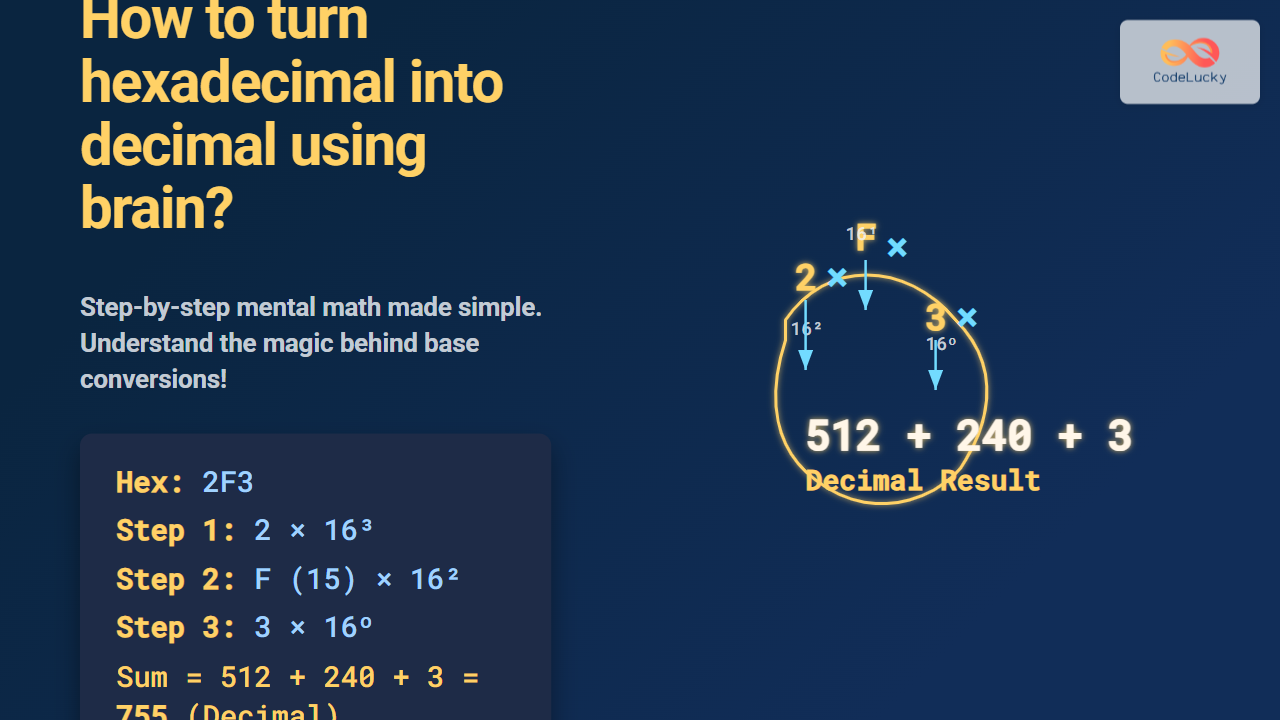
Hexadecimal and decimal number systems are fundamental concepts in programming and digital electronics. If you’ve ever wondered how to quickly convert hexadecimal numbers into decimal numbers using just your brain, you’ve come to the right place! This guide will walk you through a detailed, step-by-step method to mentally convert hexadecimal (base 16) values into their decimal (base 10) equivalents with clear examples and visual aids. By mastering this technique, you’ll improve your number system fluency, enhance problem-solving skills, and gain confidence in programming contexts where base conversions are common.
What is Hexadecimal and Decimal?
The hexadecimal system (also known as base 16) uses 16 symbols to represent numbers: 0-9 and A-F, where A=10, B=11, C=12, D=13, E=14, and F=15. It is widely used in computer science because each hexadecimal digit directly corresponds to four binary digits (bits).
The decimal system (base 10) uses ten symbols: 0-9. It is the standard numbering system we use every day.
Understanding the Place Values in Hexadecimal
Hexadecimal numbers are positional, like decimal. Each position represents a power of 16, starting from the rightmost digit (which is multiplied by \(16^0=1\)). The digit to the left is multiplied by \(16^1=16\), the next by \(16^2=256\), and so forth.

Step-by-Step Guide to Mental Conversion
Step 1: Break Down the Hex Number
Separate the hexadecimal number into individual digits.
Example: 2F3
Digits: 2, F, 3
Step 2: Convert Hex Digits to Decimal
For digits 0-9, the decimal value is the same. For letters A-F, convert to decimal as follows:
- A = 10
- B = 11
- C = 12
- D = 13
- E = 14
- F = 15
In the example: F = 15
Step 3: Multiply Each Digit by the Corresponding Power of 16
| Digit | Decimal Value | Power of 16 | Calculation |
|---|---|---|---|
| 2 | 2 | \(16^2 = 256\) | 2 × 256 = 512 |
| F | 15 | \(16^1 = 16\) | 15 × 16 = 240 |
| 3 | 3 | \(16^0 = 1\) | 3 × 1 = 3 |
Step 4: Sum All Results
Add all of the calculated values together:
512 + 240 + 3 = 755So, the hexadecimal 2F3 corresponds to decimal 755.
Quick Mental Tips for Conversion
- Memorize powers of 16: \(16^0=1\), \(16^1=16\), \(16^2=256\), \(16^3=4096\) — this helps break down larger hex numbers quickly.
- Know your hex digits: Quickly convert letters
A-Fto decimal 10–15 in your head. - Start from right to left: Multiply each digit by increasing powers of 16.
- Use breaking down for big hex numbers: Split the number into smaller chunks you can calculate mentally, then add.
Visualizing the Conversion Process
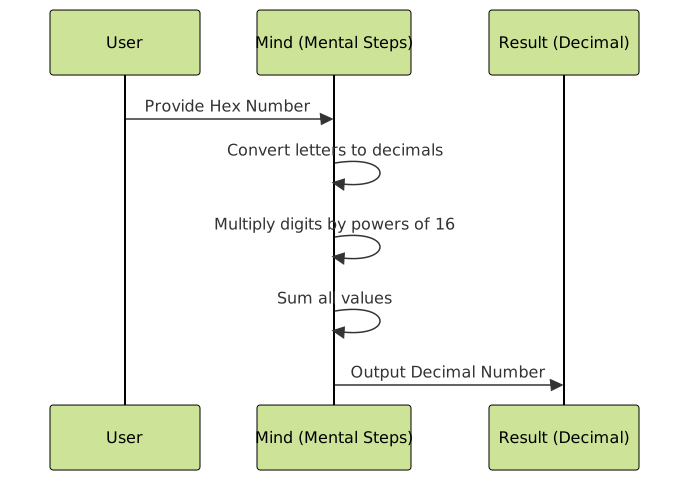
Here is a stepwise flow from hexadecimal input to decimal output:
Additional Example: Convert Hexadecimal 1A7 to Decimal
| Digit | Decimal Value | Power of 16 | Calculation |
|---|---|---|---|
| 1 | 1 | \(16^2=256\) | 1×256 = 256 |
| A | 10 | \(16^1=16\) | 10×16 = 160 |
| 7 | 7 | \(16^0=1\) | 7×1 = 7 |
Sum: 256 + 160 + 7 = 423 (decimal)
Interactive Mental Exercise
Try converting the hexadecimal number 4D2 to decimal using the steps above.
- Digit values: 4, D (13), 2
- Multiply by powers of 16: \(4 \times 16^2\), \(13 \times 16^1\), \(2 \times 16^0\)
- Sum the results to get the decimal value.
This encourages active learning for rapid hex-decimal conversions.
Why Learn Mental Hex to Decimal Conversion?
Understanding and practicing this mental math skill improves your numerical intuition and helps in debugging, reading memory addresses, color codes in web design (#RRGGBB), and working with low-level programming languages or computer architecture.

Summary
Converting hexadecimal to decimal using your brain becomes easy once you understand place values and how to multiply each hex digit by corresponding powers of 16. Practice makes perfect, so start with shorter hex numbers and gradually move to longer ones. Use the tips and examples provided in this tutorial to enhance your speed and accuracy.
With this mental technique, base conversions in programming and electronics won’t be a challenge anymore!