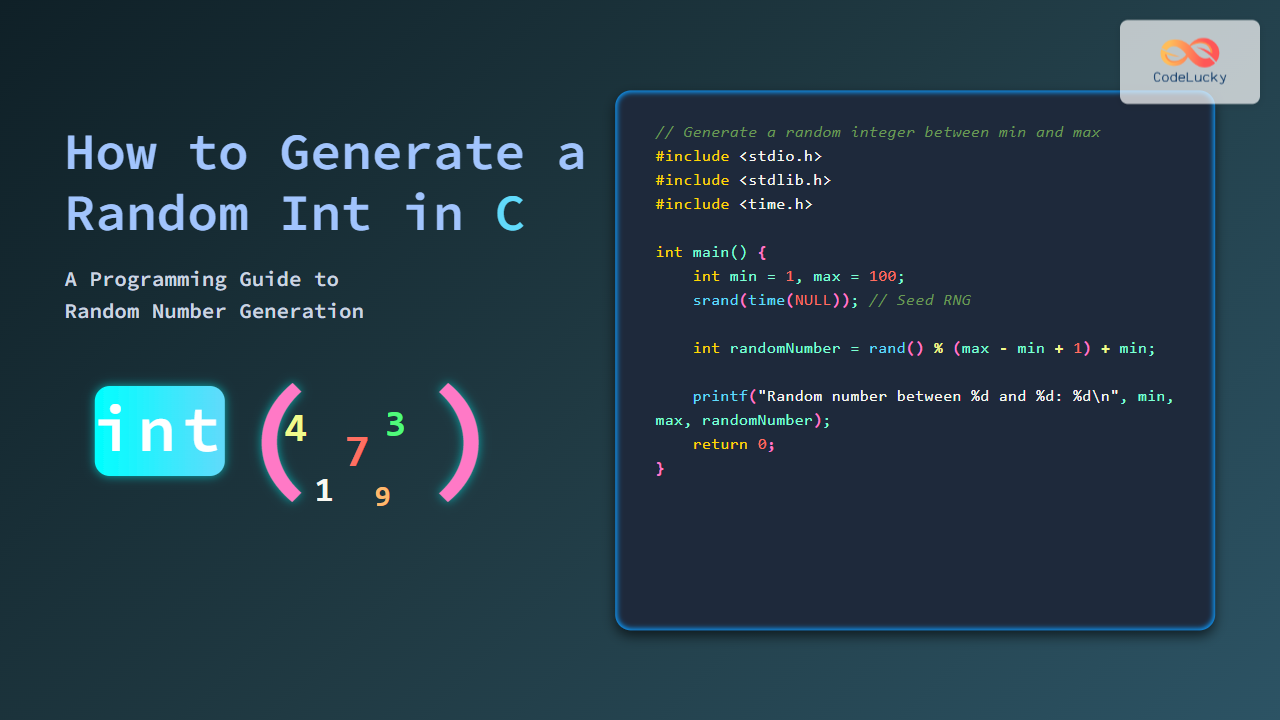
Generating random integers in the C programming language is a foundational skill every C developer should master. Whether you are creating games, simulations, cryptographic applications, or test data, understanding how to generate random numbers properly in C will greatly enhance your coding flexibility and reliability.
Understanding Random Number Generation in C
C provides built-in functions to generate pseudo-random numbers, primarily through rand() and the ability to seed those numbers with srand(). These random numbers are not truly random but are generated algorithmically, typically using a seed value to produce a sequence that appears random.
As shown in the diagram above, the srand() function initializes the seed, usually with the current time so that the sequence varies each program run. Then, rand() generates an integer within a certain range based on that seed.
Basic Usage of rand() and srand()
To generate a random integer, you typically seed the random number generator once with srand() and then call rand() whenever a random integer is needed.
// Example: Basic random integer generation in C
#include <stdio.h>
#include <stdlib.h>   // For rand() and srand()
#include <time.h>     // For time()

int main() {
    // Seed random number generator
    srand(time(NULL));

    // Generate a random integer
    int randomNumber = rand();

    printf("Random integer: %d\n", randomNumber);
    return 0;
}
Output example:
Random integer: 1804289383
Note: The output number will vary each run because srand(time(NULL)) seeds the generator with the current system time.
Generating Random Integers Within a Specific Range
The rand() function generates an integer between 0 and RAND_MAX (a constant usually defined as 32767 or higher). Often, you require a random number within a specific range, such as between 1 and 100.
To generate a random integer between min and max, use this formula:
random_num = (rand() % (max - min + 1)) + min;This expression uses the modulo operator to limit the range of the random number and then shifts it by adding the minimum value.
// Example: Random integer between 1 and 100
#include <stdio.h>
#include <stdlib.h>
#include <time.h>

int main() {
    srand(time(NULL));

    int min = 1;
    int max = 100;
    int randomNumber = (rand() % (max - min + 1)) + min;

    printf("Random integer between %d and %d: %d\n", min, max, randomNumber);
    return 0;
}
Output example:
Random integer between 1 and 100: 57
Why Seed with srand()? Understanding the Seed
Without calling srand(), rand() will produce the same sequence of numbers each time the program runs, because it starts from the same seed by default (usually 1).
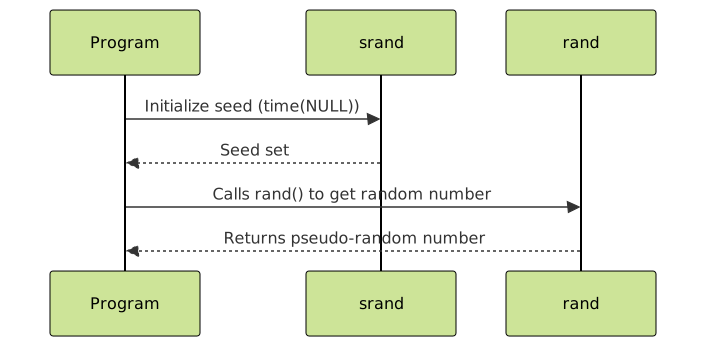
By seeding with the current time (which changes every second), the sequence of random numbers changes every run, which simulates randomness better.
Important Considerations and Limitations
- Range and Distribution:
rand()generates numbers from 0 toRAND_MAX, which may be only 32767 on some systems. For larger ranges, you may need to combine multiple calls or use better random generators. - Modulo Bias: Using modulo for range reduction can cause slight bias if the range doesn’t evenly divide
RAND_MAX+1. For many applications, this bias is negligible, but for cryptographic or scientific use, better methods or libraries should be used. - Thread Safety: The standard
rand()andsrand()are not thread-safe. In multithreaded programs, consider thread-safe alternatives.
Interactive Code Example in C
Here is a simple interactive example where the user can specify the range and generate random numbers accordingly:
// Interactive random integer generator in C
#include <stdio.h>
#include <stdlib.h>
#include <time.h>

int main() {
    int min, max, randomNumber;
    printf("Enter minimum value: ");
    scanf("%d", &min);
    printf("Enter maximum value: ");
    scanf("%d", &max);

    if (min > max) {
        printf("Minimum cannot be greater than maximum.\n");
        return 1;
    }

    srand(time(NULL));

    randomNumber = (rand() % (max - min + 1)) + min;
    printf("Random integer between %d and %d: %d\n", min, max, randomNumber);

    return 0;
}
Summary of Key Functions
| Function | Description | Header | Usage Notes |
|---|---|---|---|
rand() |
Generates pseudo-random integer between 0 and RAND_MAX |
<stdlib.h> |
Call repeatedly after seeding for random values |
srand(unsigned int seed) |
Sets the seed for rand() pseudo-random sequence |
<stdlib.h> |
Call once at program start, commonly with time(NULL) |
time(NULL) |
Returns current time as time_t value, useful as seed for randomness |
<time.h> |
Pass to srand() for varying random sequences |
Further Enhancements for Better Randomness
- Use
rand()alternatives likearc4random()on BSD systems orrandom()on Linux for better randomness. - For cryptographic applications, prefer libraries like OpenSSL or platform-specific secure random functions.
- Use modern C11
rand_s()for more secure random values if supported by your compiler.
Generating random integers in C is simple yet powerful once the mechanics of srand() and rand() are understood. Seeding well and applying careful range calculations will allow the creation of effective random-based logic in any C program.