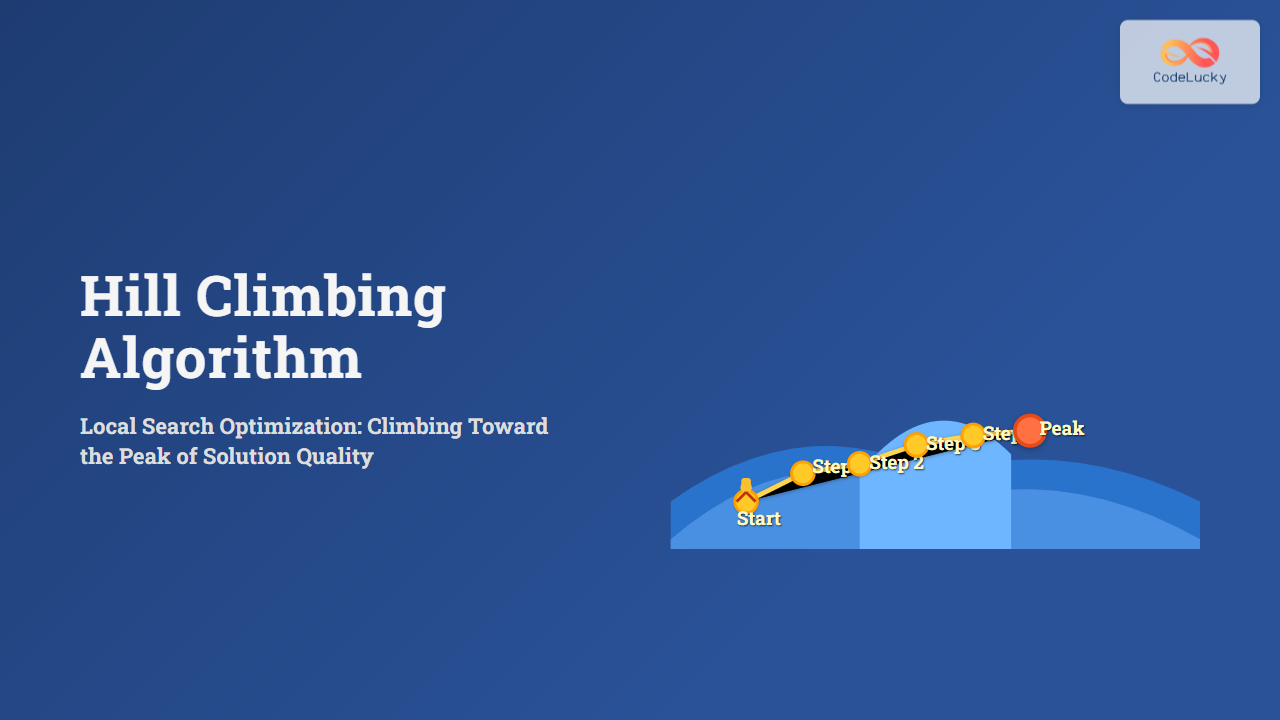
The Hill Climbing Algorithm is one of the simplest local search optimization algorithms widely used in Artificial Intelligence, combinatorial optimization, and heuristic problem-solving. Inspired by the metaphor of a climber seeking the highest peak, this algorithm aims to improve a solution iteratively by moving to a better neighbor until no better option exists.
What is Hill Climbing Algorithm?
Hill climbing is a mathematical optimization technique that belongs to the family of greedy algorithms. Given a problem with a solution space, the algorithm iteratively evaluates neighboring solutions and chooses the one with a higher value (in case of maximization) or lower cost (in case of minimization).
Key idea: “Always move uphill” until you reach a peak where no higher neighbor exists.
How Hill Climbing Works?
The process of the Hill Climbing Algorithm can be summarized in these steps:
- Start with an initial solution (randomly or provided).
- Evaluate the neighboring solutions based on the fitness function.
- If a neighbor provides a better outcome, move to that neighbor.
- Repeat until:
- No better neighbors exist (local maximum reached).
- A termination condition is met (e.g., iteration limit or time bound).

Types of Hill Climbing Algorithm
There are several variants of the Hill Climbing strategy:
- Simple Hill Climbing: Considers only one neighbor at a time, moving if it is better.
- Steepest-Ascent Hill Climbing: Examines all neighbors and chooses the one with the best improvement.
- Stochastic Hill Climbing: Selects neighbors randomly and makes probabilistic moves.
Python Example of Hill Climbing
import random

def fitness_function(x):
    # Objective: maximize the function f(x) = -(x-3)^2 + 9 (a parabola with max at x=3)
    return -(x - 3) ** 2 + 9

def hill_climb(start, step_size=0.1, max_iterations=1000):
    current = start
    for _ in range(max_iterations):
        # Generate a small neighboring candidate
        neighbor = current + random.uniform(-step_size, step_size)
        if fitness_function(neighbor) > fitness_function(current):
            current = neighbor
    return current, fitness_function(current)

best_x, best_score = hill_climb(start=random.uniform(-10, 10))
print("Best solution found:", best_x, "with fitness:", best_score)
Visualizing the Search on a Curve
Consider the objective function f(x) = -(x-3)^2 + 9. The algorithm starts at a random x-value and iteratively moves uphill until it finds the peak at x=3, f(x)=9.

Interactive Example
To make learning interactive, try running this modified Python script and experiment with different starting points:
for start in [-8, -2, 0, 5, 10]:
    best_x, best_score = hill_climb(start)
    print(f"Start={start}, Peak found at x={round(best_x,2)}, f(x)={round(best_score,2)}")
Challenges with Hill Climbing
- Local Maxima: The algorithm may stop at a local peak, missing the global optimum.
- Plateaus: Large flat areas may trap the algorithm.
- Ridges: The optimal path may require lateral movement, which hill climbing ignores.

Strategies to Address Limitations
Several techniques help Hill Climbing overcome its limitations:
- Random-Restart Hill Climbing: Run the algorithm multiple times from different initial states.
- Simulated Annealing: Allow occasional downhill moves to escape local maxima.
- Genetic Algorithms: Explore diverse solution populations instead of a single path.
Applications of Hill Climbing
Hill Climbing is widely applied across different domains:
- AI Gaming: To optimize move decisions based on heuristics.
- Robotics: For path optimization and motion planning.
- Machine Learning: As a simple optimization algorithm for parameter tuning.
- Operations Research: For solving scheduling, assignment, and routing problems.
Advantages of Hill Climbing
- Simple to implement and understand.
- Works well for unimodal functions (single peak).
- Efficient for problems where global optimum lies close to local maximum.
Drawbacks of Hill Climbing
- Easily gets stuck at local maxima or plateaus.
- Not suitable for complex landscapes with many peaks.
- No backtracking once a path fails.
Conclusion
The Hill Climbing Algorithm is a powerful yet simple local search optimization strategy that plays an important role in artificial intelligence and optimization problems. While it suffers from challenges like local maxima and plateaus, its variants and extensions (like simulated annealing or random-restart techniques) make it more robust for real-world applications. Whether you are designing AI game strategies, optimizing machine learning hyperparameters, or solving combinatorial problems, hill climbing serves as the building block toward more sophisticated algorithms.