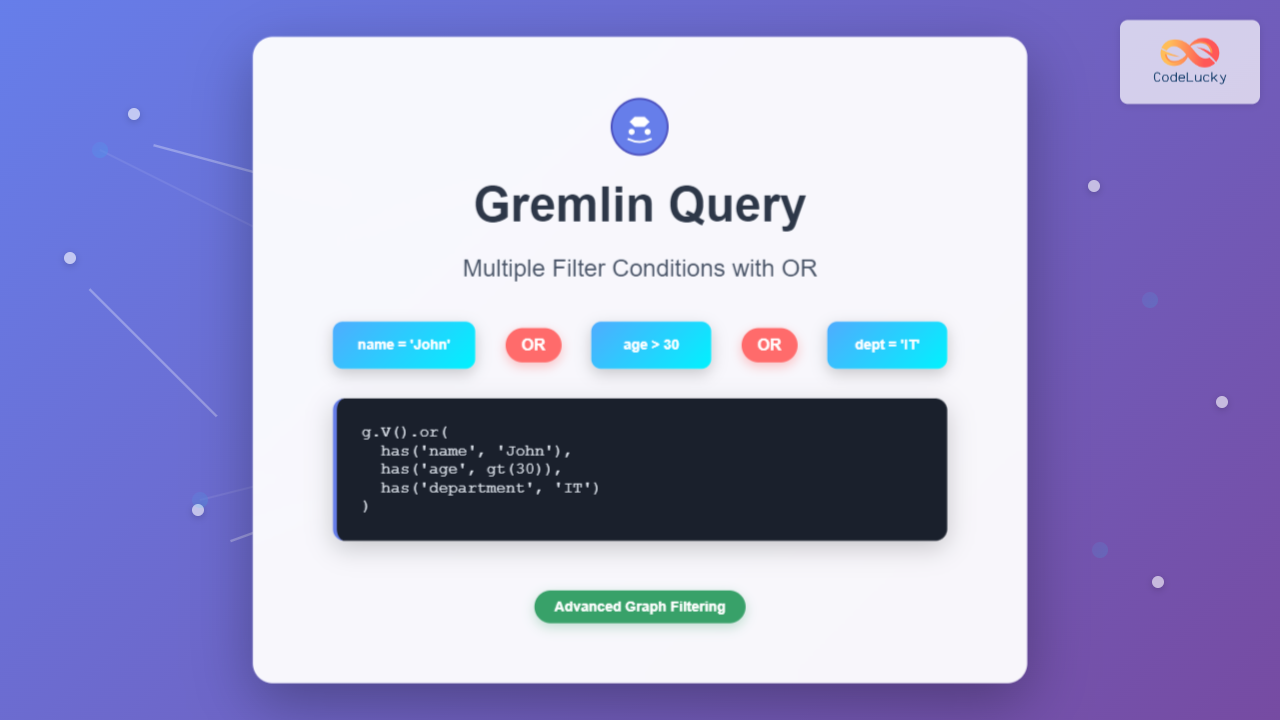
When working with graph databases, you’ll often need to filter data based on multiple conditions using OR logic. Gremlin, the graph traversal language for Apache TinkerPop, provides several powerful methods to implement OR conditions in your queries. This comprehensive guide will show you exactly how to use multiple filter conditions with OR in Gremlin queries.
Understanding OR Logic in Gremlin Queries
OR conditions in Gremlin allow you to retrieve data that matches any one of multiple specified criteria. Unlike AND conditions that require all criteria to be met, OR conditions are satisfied when at least one condition is true. This flexibility makes OR conditions essential for complex graph traversals and data filtering scenarios.

Basic OR Syntax with the or() Step
The most straightforward way to implement OR conditions in Gremlin is using the or() step. This step takes multiple traversal conditions and returns vertices or edges that satisfy at least one of them.
Simple OR Example
g.V().or(
    has('name', 'John'),
    has('age', gt(30))
)
This query returns all vertices where the name is ‘John’ OR the age is greater than 30. The or() step evaluates each condition and includes any vertex that matches at least one criterion.
Multiple Property OR Conditions
g.V().or(
    has('department', 'Engineering'),
    has('department', 'Marketing'),
    has('salary', gt(75000))
)
This example demonstrates filtering vertices based on department being either ‘Engineering’ or ‘Marketing’, or having a salary greater than $75,000.
Advanced OR Patterns with Complex Conditions
For more sophisticated filtering, you can combine OR conditions with other Gremlin steps and create nested logical structures.
Nested OR with AND Conditions
g.V().or(
    and(has('age', gt(25)), has('experience', gt(2))),
    has('certification', 'Senior'),
    has('department', 'Executive')
)
This query finds vertices where:
- Age > 25 AND experience > 2 years, OR
- Has ‘Senior’ certification, OR
- Department is ‘Executive’

OR Conditions with Edge Traversals
OR conditions become particularly powerful when combined with edge traversals, allowing you to filter based on relationship patterns.
Finding Connected Vertices with OR
g.V().hasLabel('person').or(
    out('knows').hasLabel('person'),
    out('worksAt').hasLabel('company'),
    in('manages').hasLabel('person')
)
This query finds person vertices that either:
- Know another person, OR
- Work at a company, OR
- Are managed by someone
Complex Relationship OR Filtering
g.V().hasLabel('employee').or(
    out('reportsTo').has('title', 'Manager'),
    outE('collaborates').has('project', 'ProjectX'),
    in('mentors').count().is(gt(0))
)
Using where() with OR Conditions
The where() step provides another approach to implementing OR logic, especially useful for cross-referencing and complex filtering scenarios.
g.V().as('person').
out('worksAt').as('company').
where(
    select('person').has('experience', gt(5)).or().
    select('company').has('industry', 'Technology')
)
Performance Optimization for OR Queries
When using OR conditions, query performance can vary significantly based on your approach. Here are key optimization strategies:
Index-Friendly OR Conditions
// Optimized: Uses indexes effectively
g.V().or(
    has('email', '[email protected]'),
    has('userId', '12345')
)

// Less optimal: Complex nested conditions
g.V().or(
    and(has('firstName', 'John'), has('lastName', 'Doe')),
    has('email', containing('@company.com'))
)
Limiting Results Early
g.V().limit(1000).or(
    has('status', 'active'),
    has('lastLogin', gt(System.currentTimeMillis() - 86400000))
)
Common OR Query Patterns and Use Cases
User Authentication Queries
g.V().hasLabel('user').or(
    has('email', userInput),
    has('username', userInput),
    has('phone', userInput)
)
Product Search with Multiple Criteria
g.V().hasLabel('product').or(
    has('name', containing(searchTerm)),
    has('description', containing(searchTerm)),
    has('category', searchTerm),
    out('hasTag').has('name', searchTerm)
)
Error Handling and Best Practices
When implementing OR conditions in Gremlin queries, follow these best practices to avoid common pitfalls:
Null Value Handling
g.V().or(
    has('email'),
    has('phone')
).or(
    has('email', neq('')),
    has('phone', neq(''))
)
Type Safety in OR Conditions
g.V().or(
    and(hasLabel('person'), has('age', gt(18))),
    and(hasLabel('company'), has('founded', lt(2000)))
)
Testing and Debugging OR Queries
When debugging complex OR queries, use the explain() step to understand query execution:
g.V().or(
    has('name', 'John'),
    has('age', gt(30))
).explain()
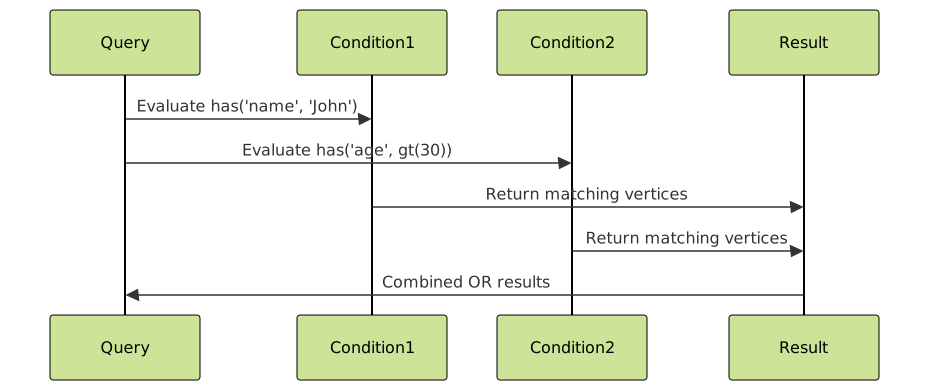
For step-by-step debugging, break down your OR conditions:
// Test individual conditions
condition1 = g.V().has('name', 'John')
condition2 = g.V().has('age', gt(30))

// Combine with OR
g.V().or(
    has('name', 'John'),
    has('age', gt(30))
)
Conclusion
Mastering OR conditions in Gremlin queries is essential for building flexible and powerful graph database applications. Whether you’re implementing simple property filters or complex relationship-based conditions, the techniques covered in this guide will help you create efficient and maintainable graph traversals. Remember to consider performance implications, use appropriate indexing strategies, and test your queries thoroughly to ensure optimal results.
By combining OR conditions with other Gremlin features like edge traversals, nested logic, and proper error handling, you can build sophisticated graph queries that handle real-world data complexity with ease.