Graph coloring is a fundamental problem in graph theory and computer science where the goal is to assign colors to vertices of a graph such that no two adjacent vertices share the same color. The Backtracking Vertex Coloring Algorithm offers a practical method to solve this problem by systematically exploring color assignments and retracting choices when conflicts arise.
Understanding Graph Coloring and Its Importance
Graph coloring has vast applications in scheduling, register allocation in compilers, frequency assignment, and pattern matching. In vertex coloring, each vertex is assigned a color so adjacent vertices differ in color, minimizing the number of colors used.

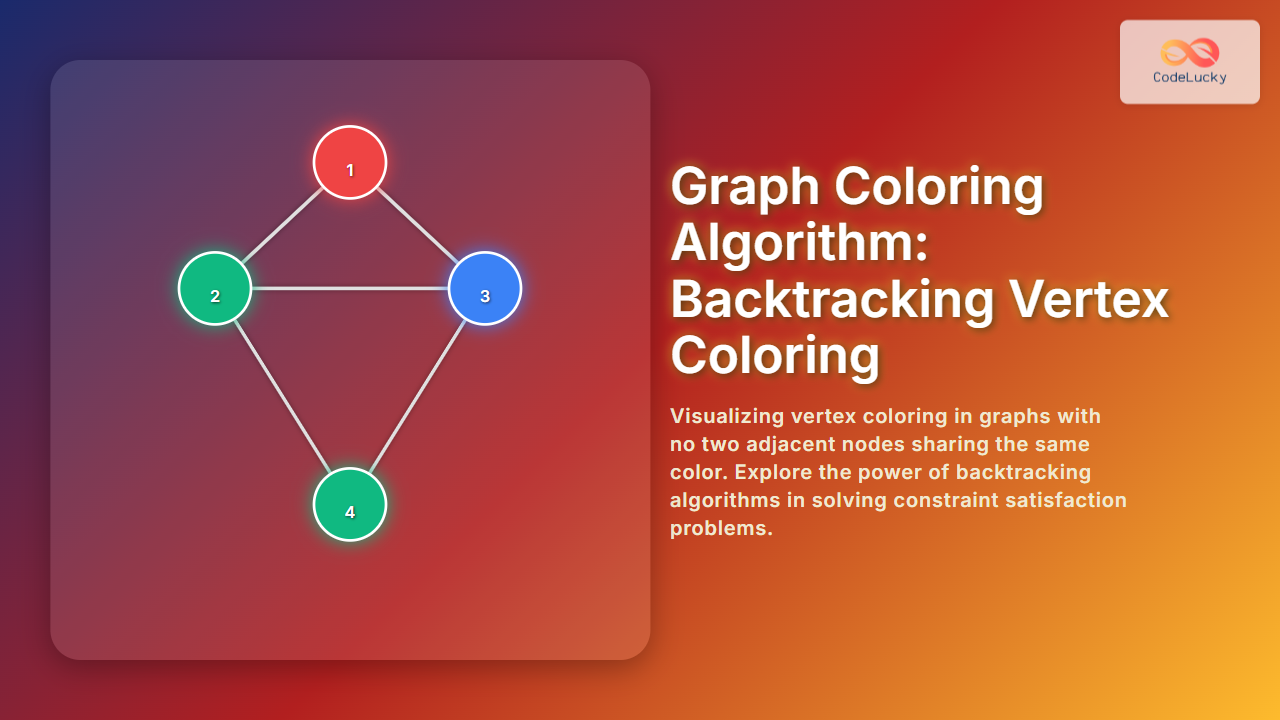
This simple graph has 4 vertices and edges connecting some of them. The objective is to color each vertex such that connected nodes have different colors.
Backtracking Approach for Vertex Coloring
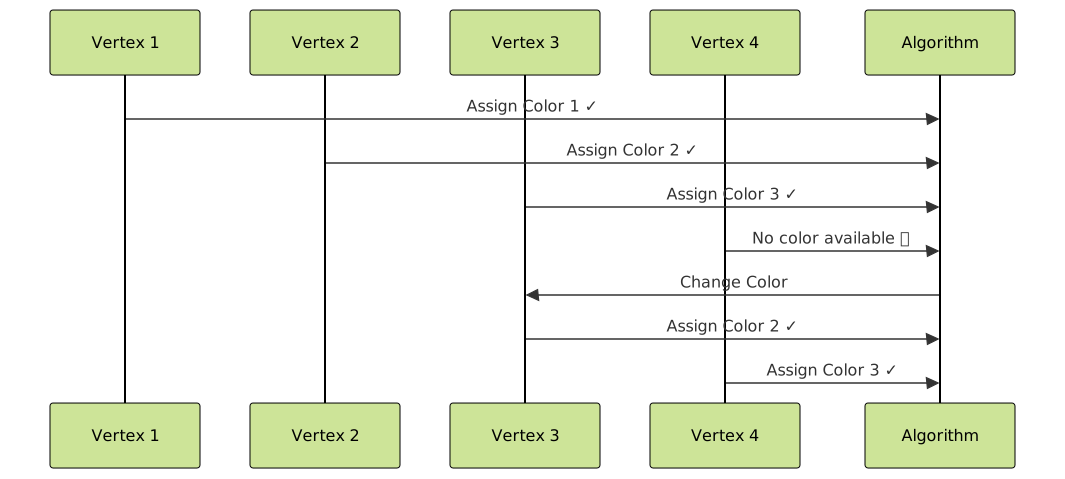
The backtracking technique tries to assign colors one vertex at a time, checking for conflicts with previously colored vertices. If a conflict happens, it backtracks to try a different color.
Algorithm Steps
- Start with the first vertex and assign the first available color.
- Move to the next vertex, assign a color that doesn’t conflict with its adjacent vertices.
- If no color is available, backtrack to the previous vertex to change its color.
- Repeat until all vertices are colored or all possibilities are exhausted.
Example Code in Python
Here is a step-by-step implementation of the backtracking algorithm for vertex coloring in Python:
def is_safe(graph, color, v, c):
    for i in range(len(graph)):
        if graph[v][i] == 1 and color[i] == c:
            return False
    return True

def graph_coloring_backtracking(graph, m, color, v=0):
    if v == len(graph):
        return True  # All vertices colored

    for c in range(1, m+1):
        if is_safe(graph, color, v, c):
            color[v] = c
            if graph_coloring_backtracking(graph, m, color, v+1):
                return True
            color[v] = 0  # Backtrack

    return False

# Example graph adjacency matrix
graph = [
    [0, 1, 1, 0],
    [1, 0, 1, 1],
    [1, 1, 0, 1],
    [0, 1, 1, 0]
]

m = 3  # Number of colors
color = [0] * len(graph)

if graph_coloring_backtracking(graph, m, color):
    print("Solution exists: ", color)
else:
    print("No solution found")
Explanation
is_safechecks if assigning colorcto vertexvviolates the coloring rule.graph_coloring_backtrackingattempts to assign colors recursively, backtracking if failure occurs.- The adjacency matrix represents edges (1 for connected vertices).
- Output displays a feasible color assignment like
[1, 2, 3, 2].
Visualizing Color Assignments
Using an example graph, vertices are colored as follows (1 = red, 2 = green, 3 = blue):
Interactive Coloring Concept
Conceptually, users can experiment by selecting different colors on vertices interactively to visualize backtracking behavior. While a full interactive demo is beyond this article scope, web implementations could utilize HTML canvas or JavaScript frameworks for dynamic exploration of the backtracking process.
Time Complexity and Optimization
The backtracking vertex coloring worst-case time complexity is exponential, \(O(m^V)\), where \(m\) is colors and \(V\) vertices, as every vertex could try all colors. Therefore, optimizations including pruning and heuristic ordering (e.g., coloring the most connected vertices first) can drastically improve performance.
Summary
The Backtracking Vertex Coloring Algorithm is a fundamental approach to solving graph coloring by exploring color assignments systematically and reverting conflicting choices. Through clear logic, adjacency representation, and usage of colors limited by problem constraints, it finds valid colorings or reports none exist.
This article has detailed the approach, implementation, and visualized the problem domain to facilitate a deep understanding of this vital graph algorithm.