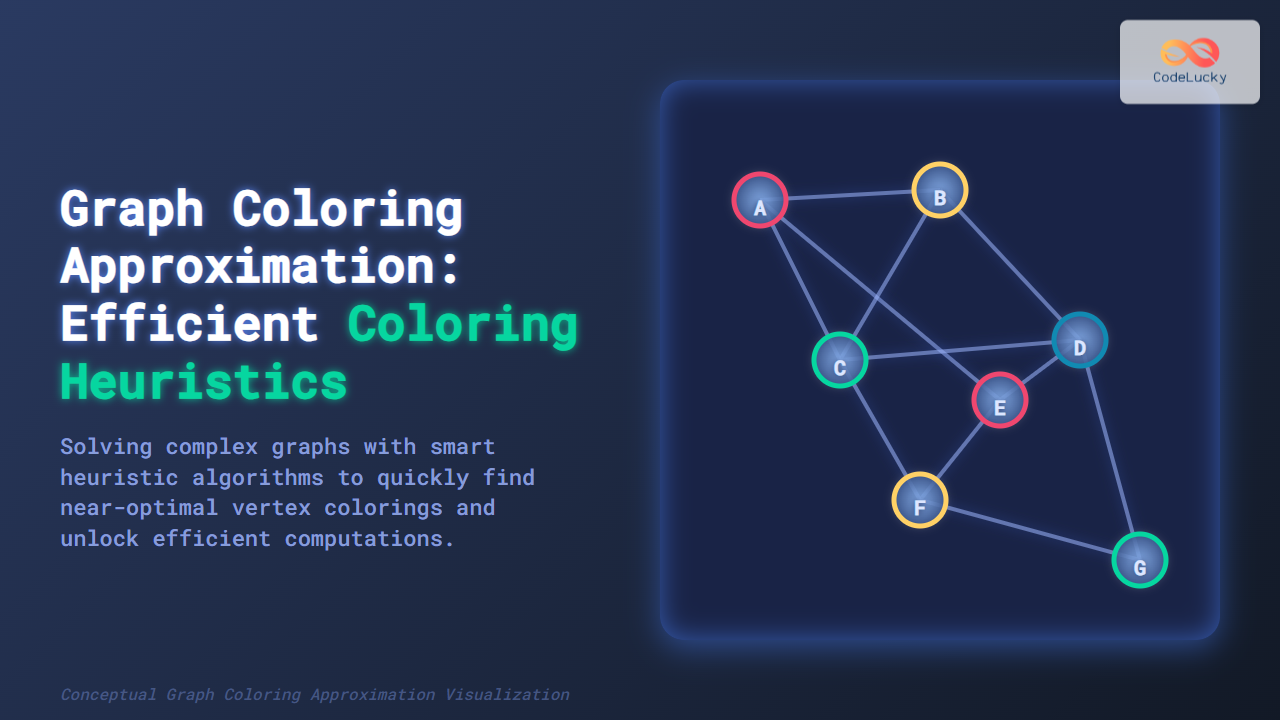
Graph coloring is a fundamental problem in computer science and combinatorial optimization where the goal is to assign colors to the vertices of a graph so that no two adjacent vertices share the same color. Due to its NP-hard nature in many cases, exact solutions are often impractical for large graphs. This article explores graph coloring approximation techniques with an emphasis on efficient coloring heuristics, practical implementations, and visual examples to aid understanding.
Understanding Graph Coloring and Its Challenges
The graph coloring problem can be formally stated as follows: Given a graph G = (V, E), color each vertex in V with the minimum number of colors such that no edge (u, v) ∈ E connects vertices of the same color. The minimum number of colors needed is called the chromatic number.
Finding the exact chromatic number is computationally intensive (NP-hard). Hence, approximation algorithms and heuristics are commonly used for practical purposes, offering near-optimal solutions in reasonable time.
Efficient Coloring Heuristics Overview
Several heuristics enable efficient graph coloring approximations:
- Greedy Algorithm: Assign colors one vertex at a time in a fixed order, using the smallest available color.
- Largest Degree First (LDF): Color vertices in order of decreasing degree. Higher-degree nodes get colored first to reduce future conflicts.
- DSatur (Degree of Saturation): Prioritize vertices based on the number of differently colored neighbors, dynamically updated as coloring proceeds.
- Iterative Improvement: Start with a heuristic coloring, then improve by recoloring vertices to reduce color count or improve distribution.
Greedy Coloring Heuristic
This is the simplest heuristic where vertices are processed in a predetermined order. For each vertex, assign the lowest-numbered color that hasn’t been assigned to its neighbors.
Input: Graph G=(V,E)
colors = array initialized to -1 for each vertex

for vertex in V:
   available = list of colors marked True
   for neighbor in neighbors(vertex):
       if colors[neighbor] != -1:
           mark colors[neighbor] as unavailable
   assign the smallest available color to vertex
Example:
Consider a graph with 5 vertices connected as follows:

Applying greedy coloring in the order v1, v2, v3, v4, v5:
- v1: Assign Color 1
- v2: Adjacent to v1 (Color 1), assign Color 2
- v3: Adjacent to v1 (Color 1) and v2 (Color 2), assign Color 3
- v4: Adjacent to v2 (Color 2), assign Color 1
- v5: Adjacent to v3 (Color 3), assign Color 1
This heuristic uses 3 colors but not necessarily the minimum. Its time complexity is O(V + E).
Largest Degree First (LDF) Heuristic
LDF orders vertices by their degree in descending order and applies the greedy coloring in this order. This often reduces the number of colors needed, as high-degree vertices are handled first.
DSatur Algorithm
DSatur dynamically selects the next vertex to color based on saturation — the number of differently colored neighbors. Ties are broken by degree. This heuristic is more sophisticated and tends to use fewer colors compared to simple greedy methods.

Interactive Example: Greedy Coloring Algorithm
Below is a simple interactive code example (JavaScript embedded) to visualize greedy coloring with user-supplied order of vertices. Refresh or reorder to see different coloration outcomes.
Summary of Approximation Benefits
Heuristic graph coloring methods provide a balance between efficiency and color usage quality, vital for large-scale graphs in diverse applications like scheduling, register allocation in compilers, and frequency assignment in telecommunication.
While these heuristics do not always find the minimum color count, their speed and adaptability make them practical and widely applicable.
Conclusion
Graph Coloring Approximation is a critical area in algorithmic research due to the complexity of exact solutions. Efficient heuristics like Greedy, Largest Degree First, and DSatur offer powerful tools for handling real-world large graphs. Understanding these heuristics, coupled with practical examples and visualizations, empowers developers and researchers to apply graph coloring effectively in various domains.