Welcome to CodeLucky’s English Learning Series! In this article, we’ll guide you through a complete revision of English grammar for beginners. Whether you’re brushing up before an exam, improving your writing, or refining spoken English, this detailed guide will simplify every concept with examples, interactive exercises, and visual flow diagrams.
Why Grammar Matters
Grammar is the system of a language. It helps you understand how words combine to make sense. Without grammar, sentences would be confusing or incomplete. Think of it as the rules of a game — once you know them, you can play (or write) confidently.
1. Parts of Speech Explained
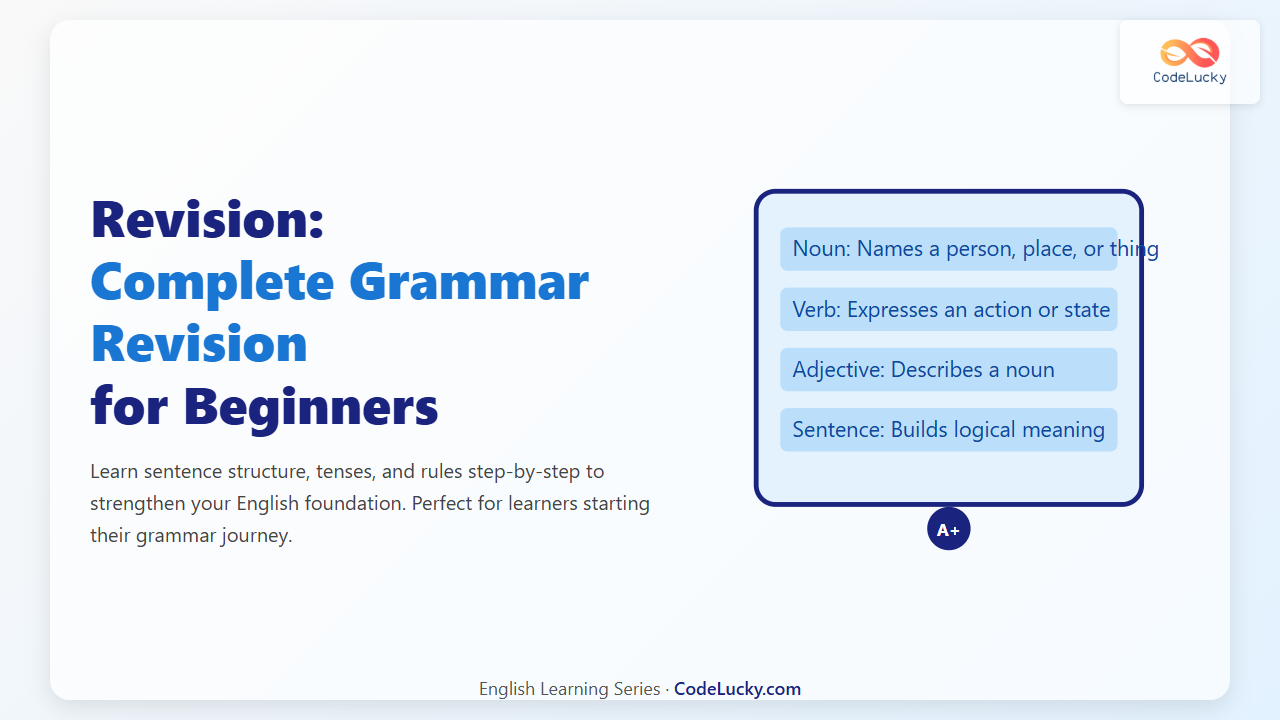
There are eight main parts of speech that form the building blocks of English:
- Noun — Names of people, places, things, or ideas. (e.g., dog, city, happiness)
- Pronoun — Replaces a noun. (e.g., he, they)
- Verb — Shows action or state of being. (e.g., run, is)
- Adjective — Describes nouns. (e.g., beautiful house)
- Adverb — Describes verbs, adjectives, or other adverbs. (e.g., runs quickly)
- Preposition — Shows relationship between words. (e.g., on the table)
- Conjunction — Joins words or sentences. (e.g., and, but)
- Interjection — Expresses emotion. (e.g., Wow!, Oh no!)
Example: Wow! She quickly ran to the beautiful park with her dog.
This one sentence includes almost all parts of speech.

2. Sentence Structure
Every correct English sentence has at least one subject and one predicate. The subject tells who or what the sentence is about, and the predicate tells what happens.
Example: John (subject) plays football (predicate).
- Simple Sentence: One clause. (She sings.)
- Compound Sentence: Two clauses joined by a conjunction. (She sings and he dances.)
- Complex Sentence: Main clause + subordinate clause. (She sings when she is happy.)

3. English Tenses Simplified
Tenses help us express the time of an action. English has three main tenses — past, present, and future — each with four forms.
| Tense | Example |
|---|---|
| Present Simple | I eat an apple. |
| Present Continuous | I am eating an apple. |
| Past Simple | I ate an apple. |
| Past Continuous | I was eating an apple. |
| Future Simple | I will eat an apple. |
| Future Continuous | I will be eating an apple. |

4. Active and Passive Voice
The active voice focuses on the subject performing the action, while the passive voice focuses on the action itself or the receiver of the action.
Example:
Active: The chef cooks the meal.
Passive: The meal is cooked by the chef.

5. Direct and Indirect Speech
We use direct speech to quote exact words and indirect speech to report them in our own way.
Example:
Direct: He said, “I’m tired.”
Indirect: He said that he was tired.
6. Common Grammar Mistakes Beginners Make
- Using your instead of you’re.
- Confusing its and it’s.
- Incorrect verb tense agreement.
- Missing prepositions. (He depends on me not He depends me.)
- Overusing articles (like “a”, “an”, “the”).
7. Interactive Exercise: Spot the Errors
Try finding and correcting the grammar mistakes below.
- She don’t like coffee.
- He go to school everyday.
- Its a beautiful day.
Answers:
- She doesn’t like coffee.
- He goes to school every day.
- It’s a beautiful day.
8. Punctuation Basics
Punctuation helps express clarity and tone. Here’s a quick revision:
- Full stop (.) ends a statement.
- Comma (,) separates ideas or lists.
- Question mark (?) ends a question.
- Exclamation mark (!) shows strong feeling.
- Apostrophe (’) shows possession or contraction.

9. Quick Grammar Quiz (Self-check)
Test your understanding. Choose the correct options:
- She ____ to the market every Sunday. (go / goes)
- I have ____ apple in my bag. (a / an)
- They ____ playing now. (is / are)
Answers: 1) goes, 2) an, 3) are
Conclusion
Learning English grammar doesn’t have to be boring or complicated. With regular practice and clarity on core concepts like tenses, parts of speech, and sentence structure, your language skills can improve quickly. Bookmark this Complete Grammar Revision for Beginners by CodeLucky.com and use it as your quick-reference guide whenever you need a grammar refresh.
Next in the English Learning Series: Vocabulary Power for Beginners