Writing flawless English takes more than vocabulary and creativity — it requires attention to grammar accuracy. Even fluent speakers often fall into subtle grammatical traps that weaken their writing. In this article, we’ll explore the most common grammar mistakes, how to correct them, and practical strategies to eliminate them from your writing.
1. Subject-Verb Agreement Errors
One of the most frequent grammar mistakes happens when subjects and verbs don’t agree in number.
Incorrect Example:
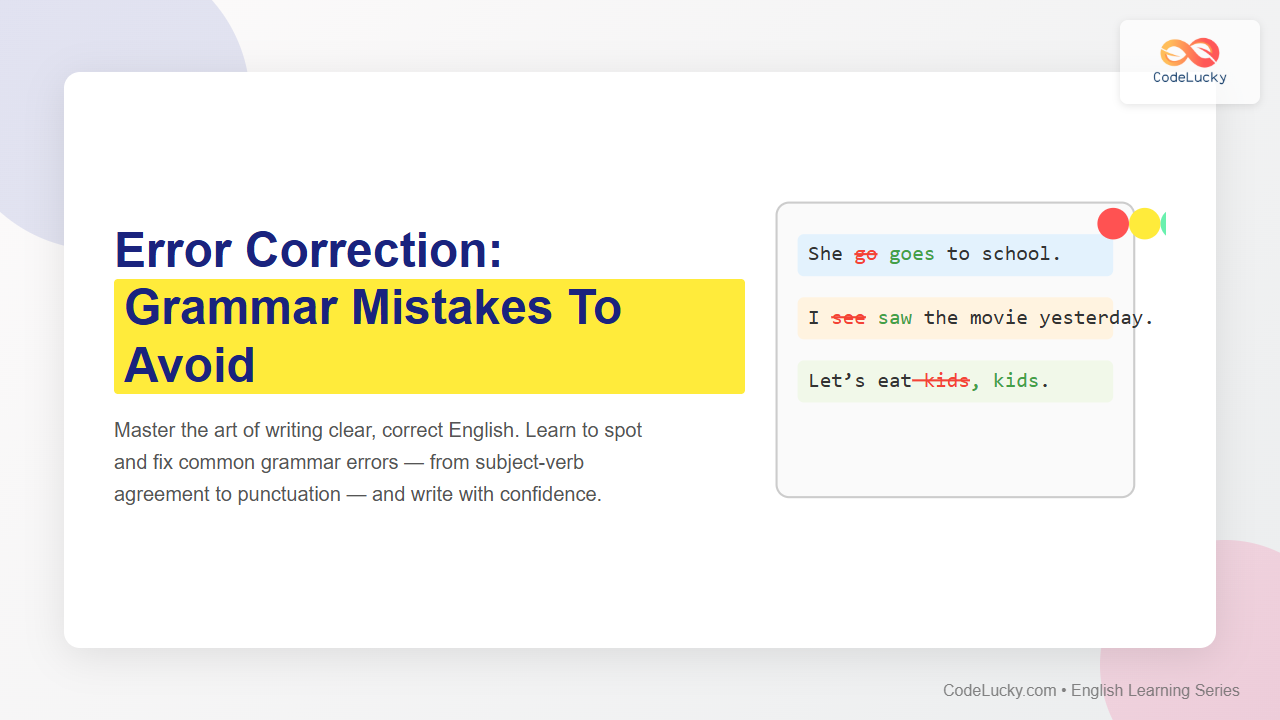
❌ She go to school every day.
Correct Example:
✅ She goes to school every day.
Remember, singular subjects take singular verbs, and plural subjects take plural verbs.
Quick Tip:
- He/She/It → Verb + s/es (e.g., He runs)
- I/You/We/They → Base verb form (e.g., They run)
2. Misuse of Tenses
Tenses express the time of an action. Using an inappropriate tense can confuse the reader.
Incorrect Example:
❌ I see the movie yesterday.
Correct Example:
✅ I saw the movie yesterday.
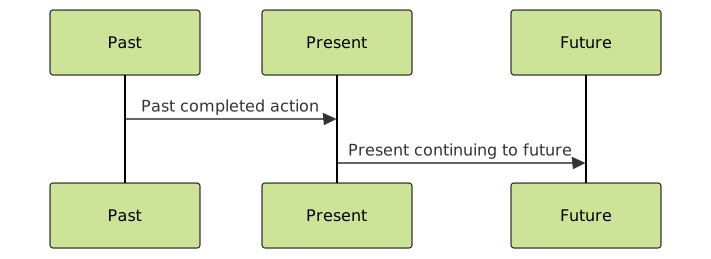
Always ensure the tense logically matches the timing indicated in your sentence.
Interactive Exercise:
Try this practice: Replace the verbs inside brackets with the correct tense.
Example: She (go) to work yesterday → She to work yesterday.
3. Incorrect Use of Articles (a, an, the)
Articles define whether something is specific or general. Misplacing them often leads to unclear meaning.
Examples:
❌ I saw a sun in the sky.
✅ I saw the sun in the sky.

Usage Rules:
- Use a before consonant sounds: a book, a car.
- Use an before vowel sounds: an apple, an hour.
- Use the when referring to something specific: the moon, the President.
4. Confusing Homophones
Words like “their,” “there,” and “they’re” sound alike but differ in meaning and usage.
Examples:
- Their = possession: Their house is big.
- There = location: The book is over there.
- They’re = contraction of “they are”: They’re coming soon.

Interactive Tip:
Test your memory — fill in the blanks:
- ____ car is parked outside.
- I left my bag over ____.
5. Sentence Fragments and Run-On Sentences
Fragments lack a subject or verb, while run-ons cram too many ideas without proper punctuation.
Incorrect Examples:
Fragment: Because I was tired. ❌
Run-on: I was tired I went to bed. ❌
Corrected Versions:
✅ I went to bed because I was tired.
✅ I was tired, so I went to bed.

6. Misplaced Modifiers
Modifiers describe nouns or verbs, but when misplaced, they cause confusion or humor unintentionally.
Incorrect:
❌ She served sandwiches to the children on paper plates.
(Who’s on paper plates — the children or the sandwiches?)
Correct:
✅ She served the children sandwiches on paper plates.
Pro Tip:
Keep modifiers close to the words they modify to preserve meaning clarity.
7. Common Pronoun Mistakes
Consistency in pronoun reference ensures sentences stay logical and clear.
Incorrect Example:
❌ Each student must submit their assignment.
This mixes singular (each student) with plural (their).
Correct Example:
✅ Each student must submit his or her assignment.
Alternatively, rephrase to the plural form:
✅ All students must submit their assignments.
8. Double Negatives
Using two negatives can make your sentence confusing or incorrect.
Incorrect Example:
❌ I don’t need no help.
Correct Example:
✅ I don’t need any help.
Only one negative word should be used for clarity.
9. Parallel Structure Mistakes
Parallelism makes your sentence balanced and easy to follow.
Incorrect:
❌ She likes dancing, to sing, and books.
Correct:
✅ She likes dancing, singing, and reading.

10. Punctuation Misuse
Punctuation errors can drastically change meaning. Consider:
❌ Let’s eat kids.
✅ Let’s eat, kids.
Comma saves lives!
Tips:
- Use commas after introductory phrases.
- Avoid comma splices (don’t join two full sentences with a comma alone).
- Use semicolons to connect independent clauses.
Practice Task: Spot and Correct
Try correcting this passage:
He don’t has no friends because he gone to another city. Their not much peoples there.
Answer:
He doesn’t have any friends because he went to another city. There aren’t many people there.
Final Thoughts
Mastering grammar takes consistency and awareness. By understanding common errors — from subject-verb disagreements to misplaced modifiers — you elevate not just your correctness but also your confidence as a writer. Keep practicing, and soon these corrections will become second nature.
For more grammar guides and interactive lessons, visit CodeLucky.com — your hub for mastering English, technology, and communication skills.