Random number generation is a fundamental concept in programming, critical for simulations, games, security, and more. In Java, multiple approaches offer flexibility for developers to generate pseudo-random or cryptographically secure random numbers. This comprehensive guide dives deep into how to get random numbers in Java, enriched with clear examples, outputs, and helpful visual diagrams to enhance understanding.
Overview of Random Number Generation in Java
Java provides several classes and methods to generate random numbers, broadly categorized as:
- Random class from
java.util - Math.random() method
- ThreadLocalRandom for multithreaded environments
- SecureRandom for cryptographically strong random numbers
Each approach serves different needs based on randomness quality, performance, and usage complexity.
Using the Random Class
The Random class is a versatile way to generate random integers, floats, doubles, and booleans. It produces pseudo-random numbers based on an initial seed.
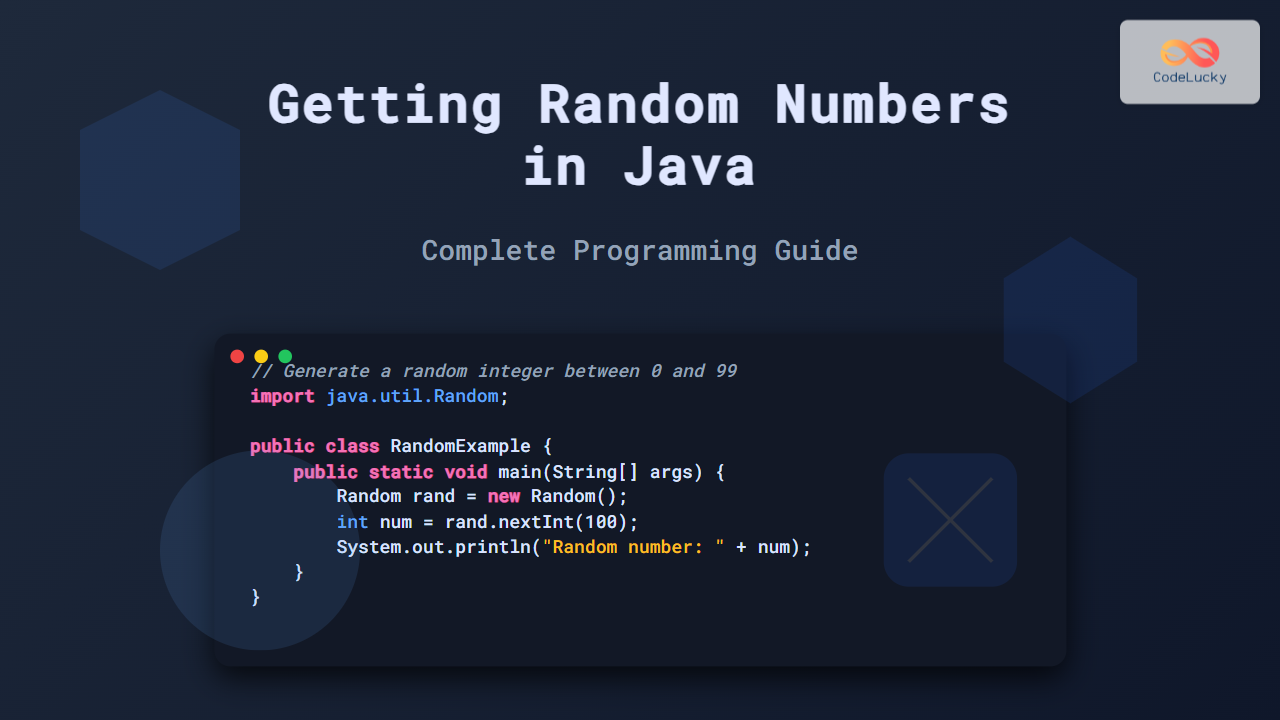
import java.util.Random;

public class RandomExample {
    public static void main(String[] args) {
        Random rand = new Random();

        // Generate random integer
        int number = rand.nextInt();
        System.out.println("Random integer: " + number);

        // Generate random integer within a bound (e.g., 0 to 99)
        int boundedNumber = rand.nextInt(100);
        System.out.println("Random integer between 0-99: " + boundedNumber);

        // Generate a random double between 0.0 and 1.0
        double randomDouble = rand.nextDouble();
        System.out.println("Random double between 0.0 and 1.0: " + randomDouble);
    }
}
Sample Output:
Random integer: 123456789
Random integer between 0-99: 56
Random double between 0.0 and 1.0: 0.726354
Explanation:
nextInt()returns any 32-bit integer value.nextInt(100)returns an integer between 0 (inclusive) and 100 (exclusive).nextDouble()returns a double between 0.0 (inclusive) and 1.0 (exclusive).
Generating Random Numbers with Math.random()
Math.random() is a simple static method that returns a double between 0.0 and 1.0.
public class MathRandomExample {
    public static void main(String[] args) {
        double randomValue = Math.random();
        System.out.println("Random double: " + randomValue);

        // Generate an integer between 0 and 49
        int intValue = (int)(Math.random() * 50);
        System.out.println("Random integer between 0-49: " + intValue);
    }
}
Sample Output:
Random double: 0.854312
Random integer between 0-49: 27
Visualization of Math.random() output scaling:
ThreadLocalRandom for Concurrent Applications
In multi-threaded applications, using java.util.concurrent.ThreadLocalRandom improves performance by avoiding contention.
import java.util.concurrent.ThreadLocalRandom;

public class ThreadLocalRandomExample {
    public static void main(String[] args) {
        int randomNum = ThreadLocalRandom.current().nextInt(1, 101); // 1 to 100 inclusive
        System.out.println("ThreadLocalRandom number (1-100): " + randomNum);
    }
}
Sample Output:
ThreadLocalRandom number (1-100): 77Why Use ThreadLocalRandom?
- Eliminates contention between threads generating random numbers.
- Recommended for high-performance concurrent applications.
SecureRandom for Cryptographic Needs
When security is paramount, java.security.SecureRandom generates cryptographically strong random values, suitable for passwords, tokens, and keys.
import java.security.SecureRandom;

public class SecureRandomExample {
    public static void main(String[] args) {
        SecureRandom secureRand = new SecureRandom();

        // Generate a secure random integer within 0-999
        int secureNum = secureRand.nextInt(1000);
        System.out.println("Secure random number (0-999): " + secureNum);
    }
}
Sample Output:
Secure random number (0-999): 492Key Features of SecureRandom:
- Uses platform-specific entropy sources.
- Harder to predict, suitable for security-sensitive applications.
Additional Tips and Best Practices
- Avoid reseeding: Create one random generator instance and reuse it rather than creating new instances repeatedly.
- Seed control: You can manually set a seed for reproducible results (mostly used in testing).
- Range precision: Always remember upper bound in
nextInt(bound)is exclusive. - Use the right tool: Use
SecureRandomfor security,ThreadLocalRandomfor concurrency,RandomorMath.random()for general purposes.
Mermaid Diagram: Random Number Generation Flow
Interactive Example (Code Snippet to Run Locally)
Copy this Java code to experiment with different random number generation techniques in your preferred IDE.
import java.util.Random;
import java.util.concurrent.ThreadLocalRandom;
import java.security.SecureRandom;

public class RandomInteractiveDemo {
    public static void main(String[] args) {
        Random rand = new Random();
        ThreadLocalRandom tlRand = ThreadLocalRandom.current();
        SecureRandom secRand = new SecureRandom();

        System.out.println("Random class nextInt(0-10): " + rand.nextInt(11));
        System.out.println("Math.random()*10 cast int: " + (int)(Math.random()*11));
        System.out.println("ThreadLocalRandom nextInt(1-10): " + tlRand.nextInt(1, 11));
        System.out.println("SecureRandom nextInt(0-10): " + secRand.nextInt(11));
    }
}
Conclusion
Java offers rich APIs to generate random numbers tailored to different needs. Understanding their differences and use cases ensures efficient and appropriate randomness in applications. Whether you need simple random values for simulations or cryptographically secure tokens, this guide arms developers with the knowledge and examples to implement them confidently.