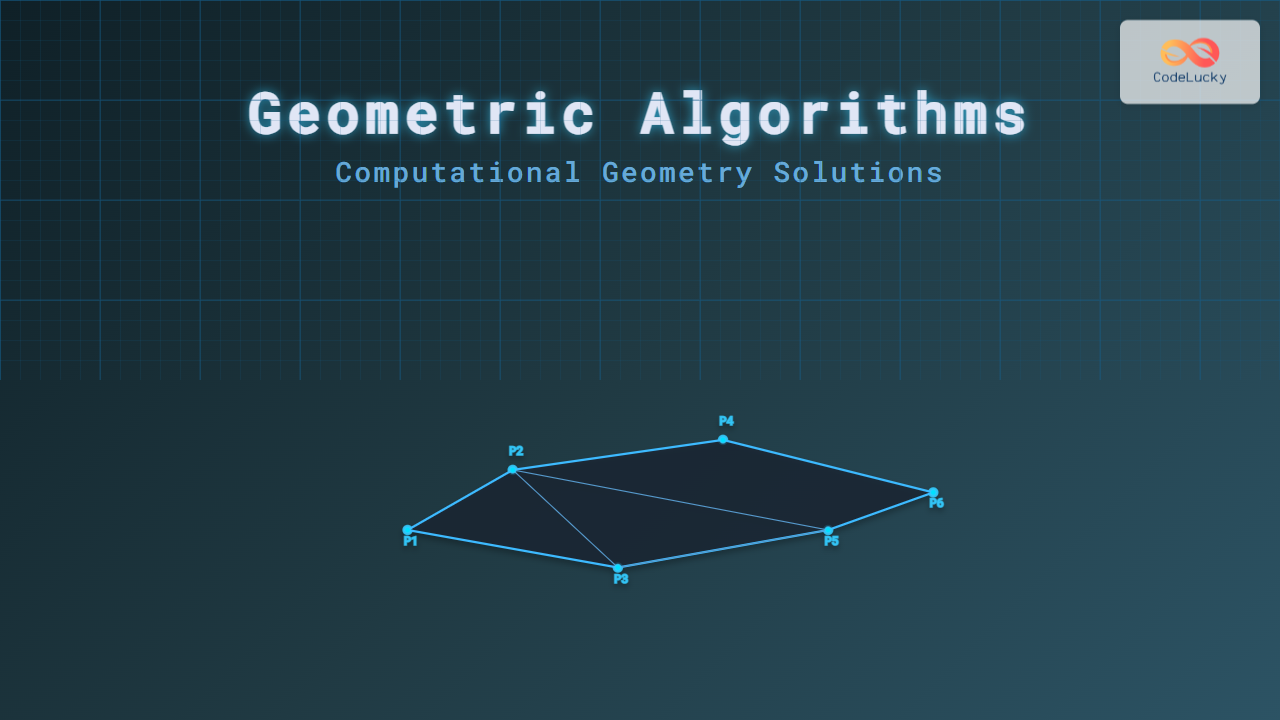
Computational geometry is a fascinating area of computer science focused on designing algorithms to solve geometric problems efficiently. Geometric algorithms form the backbone of various applications including computer graphics, geographic information systems (GIS), robotics, and more. This article dives deep into key geometric algorithms and computational geometry solutions, exploring their principles, applications, and providing visual and interactive examples to solidify understanding.
Introduction to Geometric Algorithms
Geometric algorithms operate on points, lines, polygons, and other geometric entities to solve problems such as intersection testing, proximity queries, convex hull construction, and triangulation. These algorithms leverage spatial properties and mathematical insights to optimize computation and deliver accurate results.
Core Concepts in Computational Geometry
- Points and Vectors: Basic building blocks representing locations and directions in space.
- Lines and Segments: Infinite lines and bounded segments connecting points with important properties like slope and intersection.
- Polygons: Closed shapes formed by line segments; they can be convex or concave.
- Convex Hull: The smallest convex polygon enclosing a set of points.
- Voronoi Diagrams: Partitioning of space into regions closest to given points.
- Delaunay Triangulation: Triangulation maximizing the minimum angle of triangles for mesh quality.
Example: Convex Hull Algorithm (Graham Scan)
The Convex Hull is a fundamental problem: find the smallest convex polygon that contains all points in a plane. Graham Scan is a classic algorithm to compute the convex hull efficiently in O(n log n) time.

Visualizing Graham Scan helps understanding the stepwise construction of the hull by sorting points and maintaining a stack that forms a polygon boundary without inward dents.
Interactive Example: Point-in-Polygon Test
The point-in-polygon problem determines if a query point lies inside, outside, or on the boundary of a polygon. One popular method is the ray casting algorithm where a ray is cast from the point and intersections with edges are counted.
Algorithm Steps:
- Cast a horizontal ray to the right from the query point.
- Count how many polygon edges intersect this ray.
- If the count is odd, point is inside; if even, outside.
This method handles convex and concave polygons alike.

Algorithm: Line Segment Intersection
Detecting if two line segments intersect is crucial in graphics and networking. A robust way involves using orientation tests and bounding box checks.
Process:
- Check if bounding boxes of segments overlap.
- Calculate orientation of ordered triples to detect relative turns.
- Segments intersect if they “straddle” each other’s endpoints.

Voronoi Diagram and Delaunay Triangulation
Voronoi Diagrams partition space according to nearest neighborhood. Points closer to a site belong to that site’s region.
Delaunay Triangulation is its dual; it connects points to maximize minimum angles avoiding skinny triangles, useful in mesh generation.

Practical Example: Closest Pair of Points
The closest pair problem finds two points with the smallest distance between them from a set. Divide and conquer provides an optimal O(n log n) solution:
- Sort points by x-coordinate.
- Divide into halves, find closest pairs recursively.
- Merge step checks crossing pairs within a strip area.
This prevents the brute force O(n²) approach and leverages spatial ordering effectively.
Conclusion
Geometric algorithms provide powerful tools to solve spatial problems in computing efficiently. From convex hull construction and point-in-polygon tests to Voronoi diagrams and closest pair algorithms, mastering these techniques empowers development of robust applications in graphics, robotics, and GIS.
Understanding these algorithms with visual explanations fosters deeper insight and confidence in implementation. Exploring and experimenting with real datasets can further enhance proficiency in computational geometry.