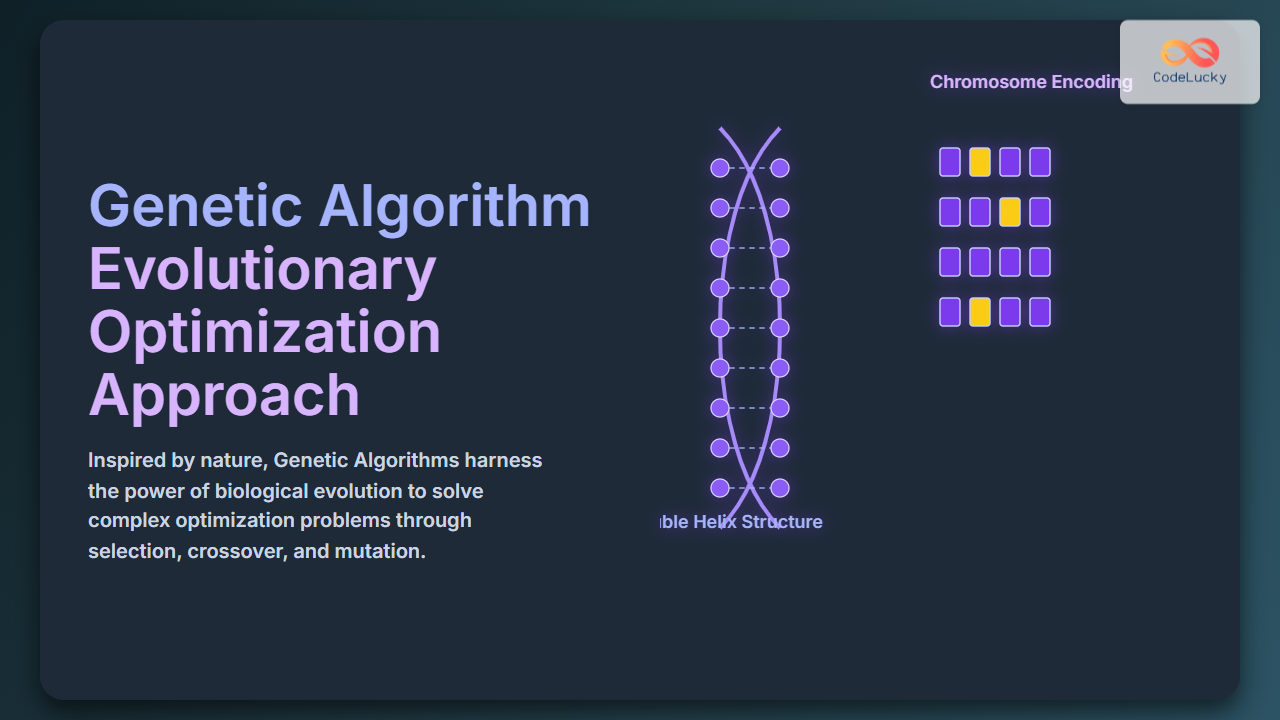
Genetic Algorithm (GA) is an innovative and powerful evolutionary optimization approach inspired by the natural process of selection and genetics. It belongs to a family of evolutionary algorithms aimed at solving complex optimization problems where traditional methods struggle. In this detailed guide, we will explore the core principles of Genetic Algorithms, their working mechanism, application examples, and useful visual explanations to help understand this fascinating technique clearly.
What is a Genetic Algorithm?
At its core, a Genetic Algorithm mimics the process of biological evolution. Candidate solutions, encoded as chromosomes, evolve toward better solutions through iterative application of selection, crossover (recombination), and mutation. Solutions compete and adapt over generations, following the principle of survival of the fittest, seeking optimal or near-optimal solutions to difficult problems.

Key Components of a Genetic Algorithm
- Population: A diverse set of candidate solutions (chromosomes).
- Chromosome Encoding: Representing each solution as a string (binary, integer, or real-valued).
- Fitness Function: A function that quantifies the quality or suitability of each solution.
- Selection: Choosing better-fit solutions for reproduction.
- Crossover (Recombination): Combining two parents to create offspring.
- Mutation: Introducing random changes for diversity.
- Termination Criteria: A stopping condition based on generations count, fitness threshold, or solution stability.
How Genetic Algorithms Work: Step-by-Step
The GA follows a cyclical process:
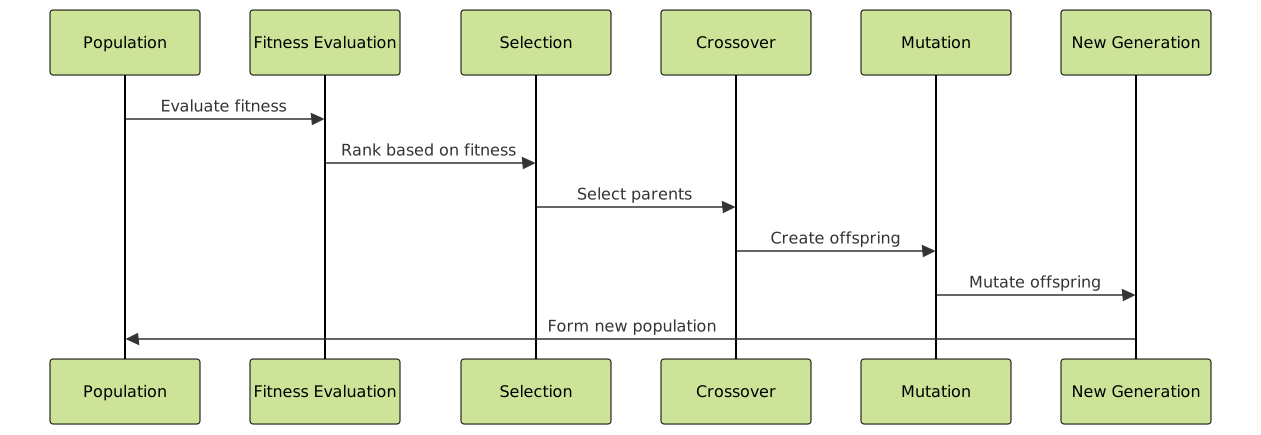
- Initialization: Generate random population.
- Evaluation: Calculate fitness score.
- Selection: Pick candidates proportional to fitness scores.
- Crossover: Mix genetic info of parents to produce new offspring.
- Mutation: Slightly alter genes to maintain diversity.
- Replacement: New generation replaces old.
- Termination: Repeat until criteria met.
Example: Maximize the Function \( f(x) = x^2 \)
Suppose we want to maximize \( f(x) = x^2 \) for \( x \in [0, 31] \). We can represent numbers 0 to 31 as 5-bit binary strings.
Chromosome Representation:
Binary string of length 5, e.g., 10101.
Fitness Function:
Fitness is \( f(x) = x^2 \); decode chromosome to decimal \( x \), calculate fitness.
Process Example:
- Initial random chromosomes: 01010 (10), 11100 (28), 00011 (3), 10101 (21)
- Fitness: 100, 784, 9, 441 respectively.
- Selection favors chromosomes with higher fitness.
- Crossover mixes parents to create better offspring.
- Mutation adds random bit flips.
- A few generations later, GA converges to 11111 (31) with max fitness 961.

Interactive Genetic Algorithm
Below is a basic interactive visualization setup in JavaScript that can be embedded to simulate and observe the evolution process for the function maximization example above.
// Pseudocode for simple Genetic Algorithm demo
class GA {
  constructor(populationSize, chromosomeLength) {
    this.population = this.initPopulation(populationSize, chromosomeLength);
  }
  initPopulation(size, length) {
    let pop = [];
    for(let i=0; i<size; i++) {
      let chromosome = '';
      for(let j=0; j<length; j++) {
        chromosome += Math.round(Math.random()).toString();
      }
      pop.push(chromosome);
    }
    return pop;
  }
  fitness(chromosome) {
    return parseInt(chromosome, 2) ** 2;
  }
  selection() {
    // Tournament or roulette-wheel selection based on fitness
  }
  crossover(parent1, parent2) {
    // Single-point crossover
  }
  mutation(chromosome, mutationRate) {
    // Flip bits with mutationRate probability
  }
  evolve() {
    // Repeat selection, crossover, mutation to form next generation
  }
}
Applications of Genetic Algorithms
Genetic Algorithms solve various real-world problems including:
- Function optimization and parameter tuning
- Scheduling and timetabling
- Traveling Salesman and routing problems
- Game playing and AI strategy development
- Feature selection in machine learning
- Design optimization in engineering
Advantages and Limitations
| Advantages | Limitations |
|---|---|
|
|
Summary
Genetic Algorithms provide a biologically inspired, heuristic optimization approach that is extremely useful for complex and nonlinear problems where classical algorithms fail. By simulating natural evolutionary processes through selection, crossover, and mutation, GAs efficiently explore large search spaces. This article covered the fundamental concepts, a practical example, and visual explanations supporting a clear understanding of genetic algorithms for optimization tasks.