Generating all subsets, also known as the Power Set, is a fundamental problem in computer science and mathematics. Given a set of elements, the goal is to find all possible combinations, including the empty set and the full set itself. This problem is often used as a classic introduction to recursion and backtracking techniques, which systematically explore all possible options.
In this article, we will cover:
- What is the Power Set?
- How Backtracking helps generate subsets
- Step-by-step algorithm with visual explanation
- Python implementation of subset generation
- Example outputs with visualization
What is the Power Set?
The Power Set of a given set S is the set of all possible subsets of S, including:
- The empty set
- Subsets of size 1
- Subsets of size 2
- …
- The full set itself
Example: If S = {a, b, c}, then the Power Set is:
{ }
{ a }
{ b }
{ c }
{ a, b }
{ a, c }
{ b, c }
{ a, b, c }
There are 2^n subsets for a set of size n, because each element can either be included or excluded.
Why Backtracking for Subsets?
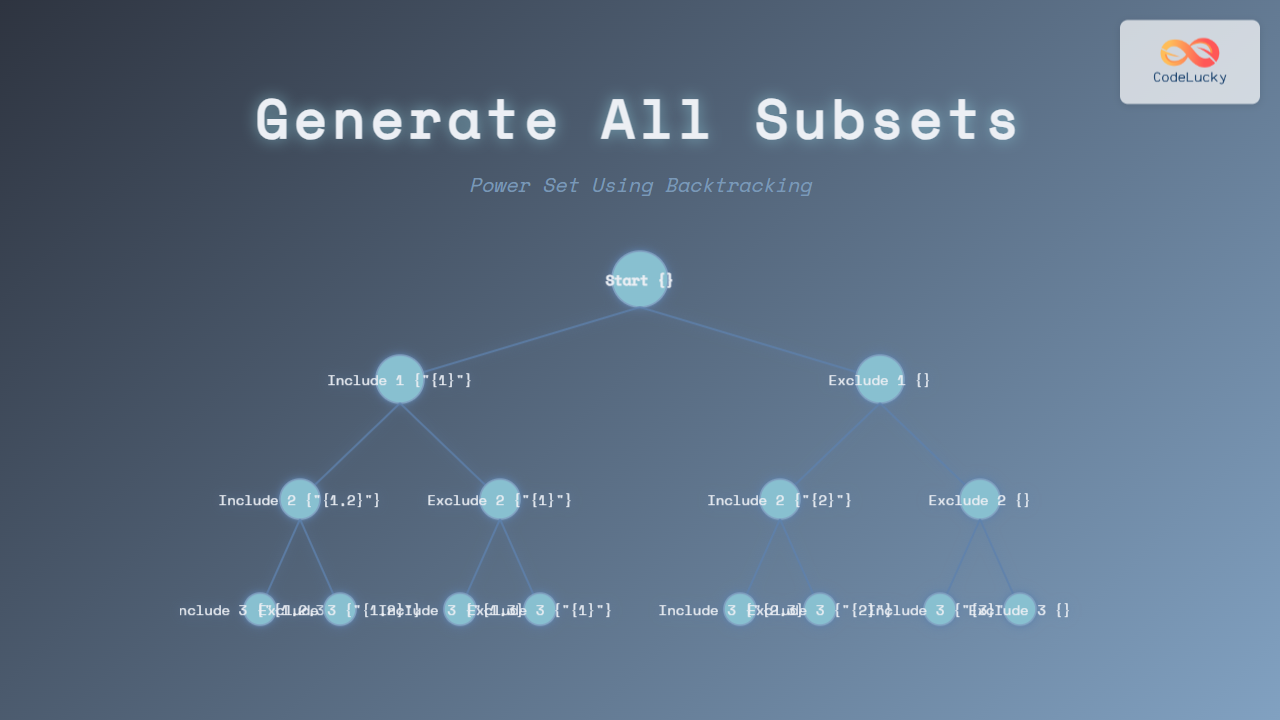
Backtracking is particularly effective here because subset generation requires exploring all combinations of “include or exclude” decisions for each element. This naturally forms a binary recursion tree.

Each level of recursion corresponds to one element of the set, with two choices: include it or exclude it.
Backtracking Algorithm for Subsets
- Start with an empty temporary list (
current_subset). - At each step, choose to:
- Include the current element and recurse.
- Exclude the current element and recurse.
- When you reach the end of the set, record the current subset.
Python Implementation
Here’s how to generate all subsets using backtracking in Python:
def generate_subsets(nums):
    result = []

    def backtrack(start, current):
        # Record current subset
        result.append(list(current))

        # Explore further
        for i in range(start, len(nums)):
            current.append(nums[i])
            backtrack(i + 1, current)
            current.pop()  # backtrack step

    backtrack(0, [])
    return result


# Example usage
nums = [1, 2, 3]
subsets = generate_subsets(nums)
for s in subsets:
    print(s)
Output for Example Input
[]
[1]
[1, 2]
[1, 2, 3]
[1, 3]
[2]
[2, 3]
[3]
Step-by-Step Visual Walkthrough
Let’s walk through input [1, 2]:
This shows how each recursion branch leads to a complete subset.
Complexity Analysis
- Time Complexity:
O(2^n * n)because there are2^nsubsets, and each subset may take O(n) time to copy into results. - Space Complexity:
O(n)for recursion stack (excluding result storage).
Applications of Subset Generation
- Solving combinatorial problems
- Generating all possible feature combinations in machine learning
- Exploring solution spaces in optimization problems
- Subproblems in knapsack or decision problems
Interactive Thought Exercise
Try thinking: if we had [a, b, c, d], how many recursive calls will be made? As per the 2^n rule, we should have 2^4 = 16 subsets. Can you visualize the binary recursion tree where each node branches into “include current element” and “exclude current element”?
Conclusion
Generating the Power Set using backtracking is an elegant way to explore all possible subsets of a given set. The recursive include/exclude strategy mirrors the mathematical basis of subset formation. With a clear understanding of this approach, you’ll also find it easier to grasp advanced backtracking problems like combinations, permutations, and N-Queens.