The Greatest Common Divisor (GCD), also known as the Greatest Common Factor (GCF) or Highest Common Factor (HCF), is one of the foundational concepts in number theory and computer science. It finds applications in simplifying fractions, cryptography, modular arithmetic, and algorithm design. One of the most efficient and elegant methods of computing the GCD is the Euclidean Algorithm. In this article, we will understand the concept of GCD, explore how the Euclidean Algorithm works, and implement it step by step in Python, illustrated with visual aids for clarity.
What is the Greatest Common Divisor?
The GCD of two integers is the largest positive integer that divides both numbers without leaving a remainder. For example:
- GCD(24, 36) = 12
- GCD(17, 31) = 1 (because they are coprime numbers)
- GCD(81, 27) = 27
The Euclidean Algorithm Explained
The Euclidean Algorithm, introduced by the Greek mathematician Euclid over 2000 years ago, is an efficient method to calculate the GCD. The core principle is based on the fact that:
GCD(a, b) = GCD(b, a mod b), where mod is the remainder operation.
This recursive process continues until the remainder becomes 0. At that point, the divisor is the GCD.
Step-by-Step Example
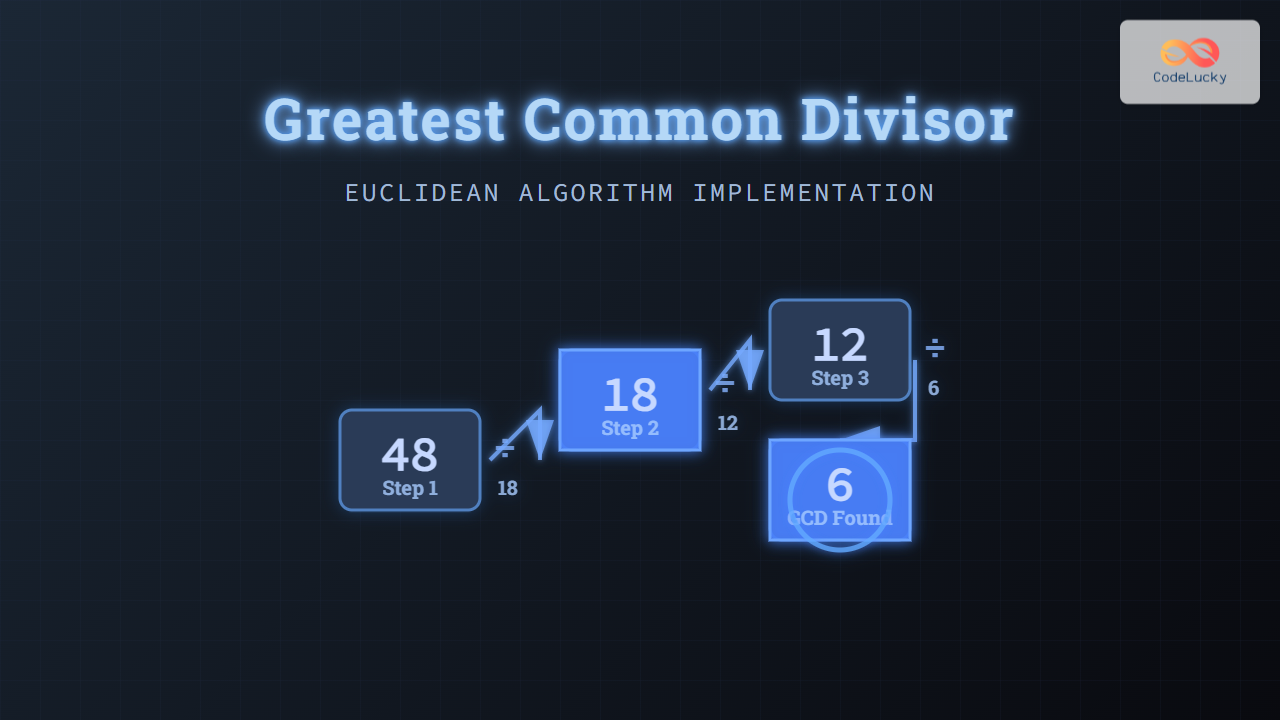
Let’s find GCD(48, 18) using the Euclidean Algorithm:
- 48 ÷ 18 = 2 remainder 12 → GCD(48, 18) = GCD(18, 12)
- 18 ÷ 12 = 1 remainder 6 → GCD(18, 12) = GCD(12, 6)
- 12 ÷ 6 = 2 remainder 0 → GCD(12, 6) = 6
Thus, GCD(48, 18) = 6.
Python Implementation of the Euclidean Algorithm
The Python implementation of the Euclidean Algorithm is straightforward. Here is a simple recursive version:
def gcd(a, b):
    if b == 0:
        return a
    else:
        return gcd(b, a % b)

# Example usage
print(gcd(48, 18))  # Output: 6
Iterative Approach
A non-recursive (iterative) implementation is also common:
def gcd_iterative(a, b):
    while b != 0:
        a, b = b, a % b
    return a

print(gcd_iterative(81, 27))  # Output: 27
Visualizing the Algorithm
The Euclidean Algorithm can be represented as a recursive problem tree:
Applications of GCD in Computer Science
- Reducing fractions: A fraction like 150/210 can be simplified to 5/7 using GCD.
- Cryptography: Algorithms like RSA make use of coprime numbers, where GCD(a, b) = 1.
- Chinese Remainder Theorem: A cornerstone in modular arithmetic relies on GCD checks for consistency.
- Efficient computations: GCD helps in algorithms involving divisibility and number systems.
Interactive Example
To experiment, try the following Python snippet and enter your own numbers:
def gcd_interactive():
    a = int(input("Enter first number: "))
    b = int(input("Enter second number: "))
    def gcd(a, b):
        while b:
            a, b = b, a % b
        return a
    print(f"The GCD is: {gcd(a, b)}")

# Run this function to try interactively
gcd_interactive()
Time Complexity of the Euclidean Algorithm
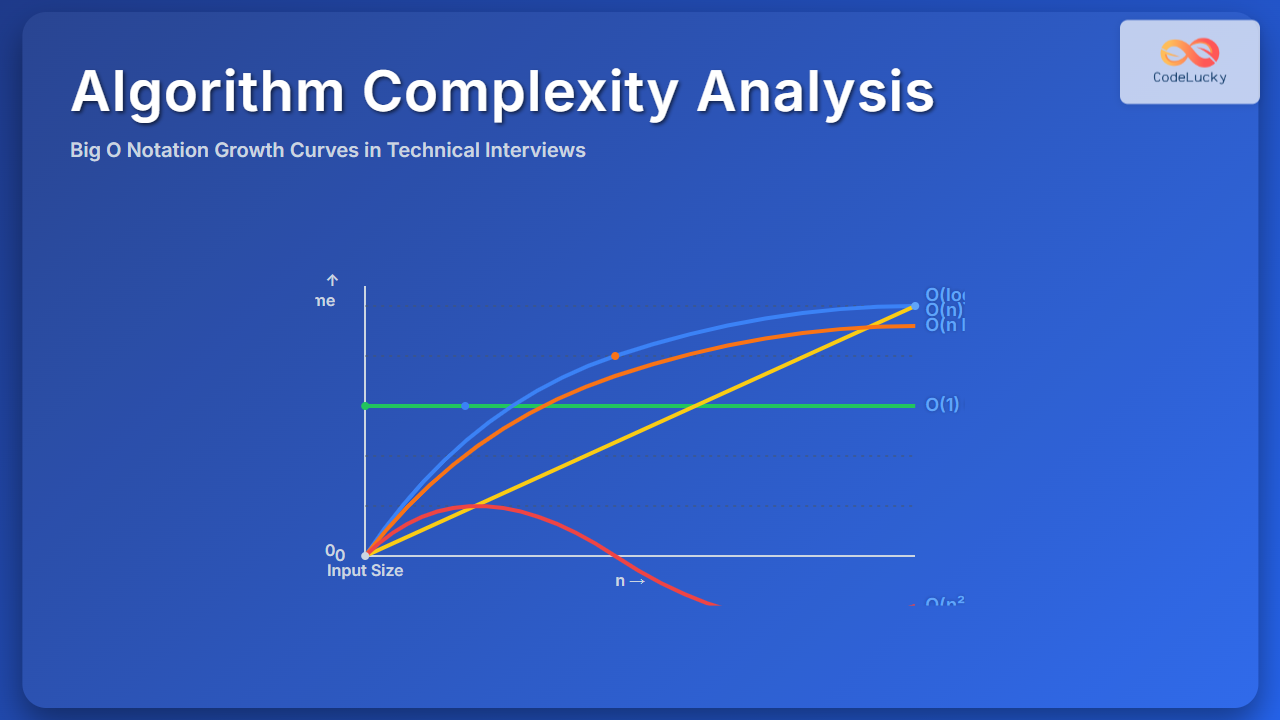
The Euclidean Algorithm is extremely efficient. Its time complexity is:
- O(log(min(a, b))) in the worst case.
- This makes it suitable for very large integers, even in cryptography (hundreds or thousands of digits).
Conclusion
The Euclidean Algorithm remains one of the most elegant and efficient algorithms in mathematics and computer science. It not only solves the fundamental problem of finding the Greatest Common Divisor with optimal performance but also underpins many advanced algorithmic techniques. Whether you are working with fractions, modular arithmetic, or cryptographic applications, mastering GCD and its computation with the Euclidean Algorithm is essential.