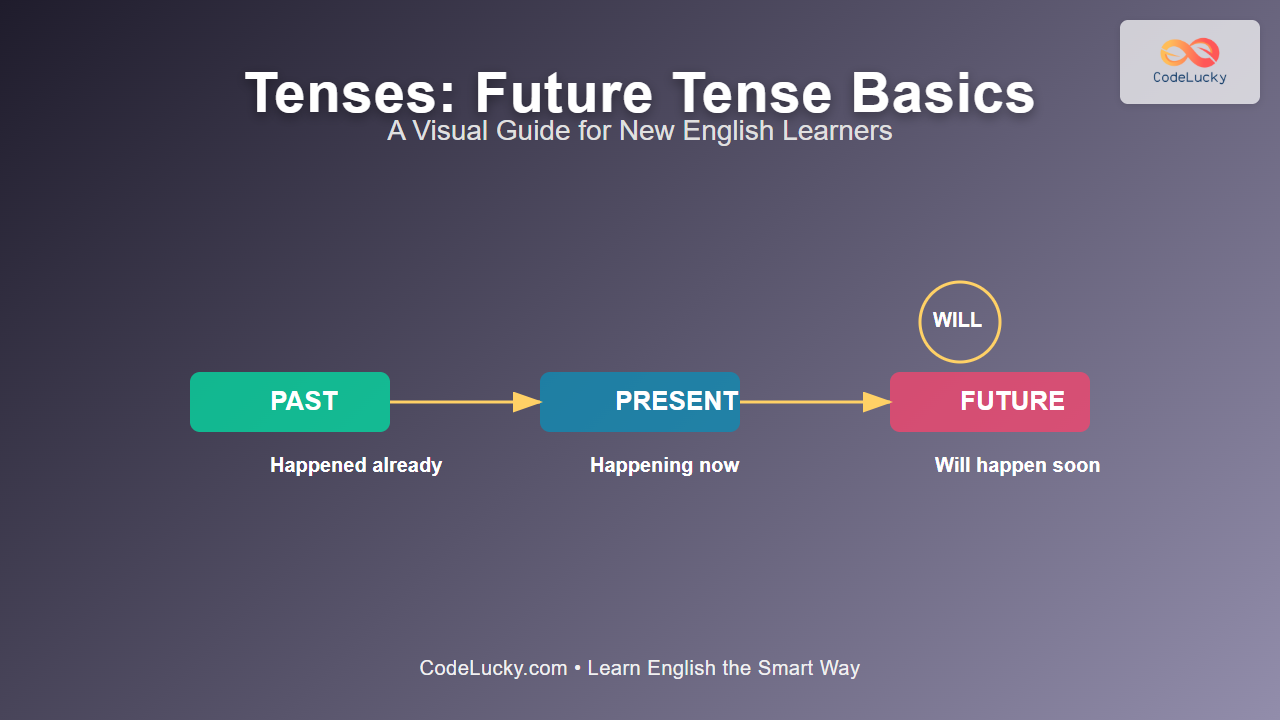
Future Tense plays a key role in English communication, helping learners talk about events, plans, predictions, and actions that haven’t happened yet. Whether you’re saying “I will go to school tomorrow” or “She will be traveling next month”, you’re expressing actions that take place in the future.
What Is Future Tense?
The Future Tense describes an action that will happen after the present. In English, it mainly uses “will” or “shall” with the base form of the verb. However, as English evolved, “shall” became less common, especially in American usage, while “will” took over as the universal future marker.

In simple terms, Future Tense helps express things that haven’t occurred yet — upcoming events, predictions, plans, promises, and intentions.
The Four Types of Future Tense
The Future Tense in English consists of four main forms, each with a specific use. Let’s explore them with examples, structures, and explanations.
1. Simple Future Tense
Structure: Subject + will/shall + base form of verb
Use: To express a decision made at the moment of speaking, or a future fact.
- I will travel to Japan next year.
- She will help you with your homework.

Tip: Use “will” for promises or instant decisions. Example: “I will call you right away.”
2. Future Continuous Tense
Structure: Subject + will be + verb-ing
Use: To describe an action that will be in progress at a specific time in the future.
- They will be working when you arrive.
- At 10 PM, I will be watching a movie.

Key point: The action will be continuous at a future moment — it won’t be finished yet.
3. Future Perfect Tense
Structure: Subject + will have + past participle
Use: To express an action that will be completed before a particular time in the future.
- I will have finished the report by tomorrow morning.
- She will have reached home before dinner.

Remember: Future Perfect looks at the completion of an activity before another future moment.
4. Future Perfect Continuous Tense
Structure: Subject + will have been + verb-ing
Use: To show that a continuous action will have been happening for some time before a future event or time.
- By next May, I will have been studying English for two years.
- She will have been working here for a decade by 2030.

Definition Simplified: It joins the concept of future, continuity, and time duration together.
Quick Comparison Table
| Form | Structure | Usage | Example |
|---|---|---|---|
| Simple Future | will + base verb | Future facts, decisions, promises | She will call you tomorrow. |
| Future Continuous | will be + verb-ing | Ongoing actions in the future | I will be driving at 8 PM. |
| Future Perfect | will have + past participle | Action completed before future time | He will have finished by noon. |
| Future Perfect Continuous | will have been + verb-ing | Continuous action up to a point | We will have been waiting for an hour. |
Interactive Practice Exercise
Can you guess the right tense?
Try identifying the correct Future Tense below. Hover or click to see the answer (if implemented interactively on your site).
- By next year, I ______ (complete) my diploma. → will have completed
- Tomorrow at this time, she ______ (work) in the office. → will be working
- I think it ______ (rain) tonight. → will rain
Common Mistakes to Avoid
- Don’t mix present tense with future expressions like “tomorrow” – use Future Tense forms.
- Remember that “going to” can also express planned future actions, similar to “will.”
- Use time markers such as tomorrow, next week, or by the time for clarity.
Conclusion
Understanding Future Tense helps learners communicate upcoming events and express intentions clearly. By mastering the four forms — Simple, Continuous, Perfect, and Perfect Continuous — you gain the ability to speak about the future with precision. Keep practicing with everyday examples like planning routines or predicting events, and your fluency will naturally improve.
Explore more grammar topics on CodeLucky.com to strengthen your English foundation!